
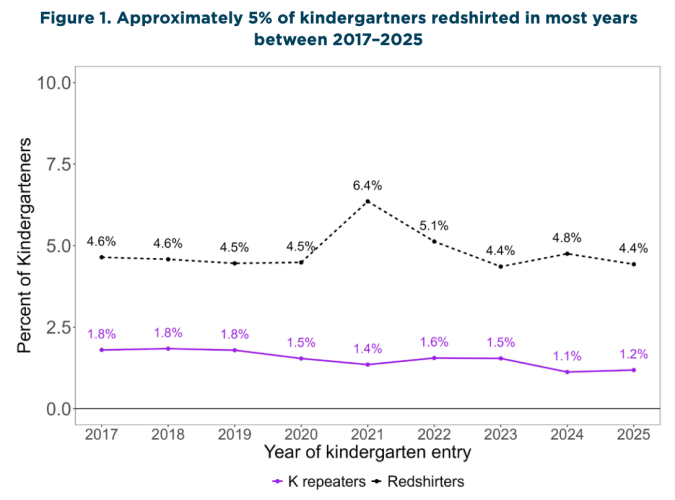
The conversation around delaying kindergarten, often termed "redshirting," has exploded in parent circles, leading many educators to believe it's a widespread phenomenon. Yet, new data reveals a stark contrast: while many parents *discuss* holding their children back a year, the actual practice remains remarkably uncommon, with rates hovering around 5% for the past two decades. This disconnect between perception and reality has significant implications for how schools prepare for incoming classes and how educators engage with parents navigating this complex decision.
The Perception vs. The Data: Redshirting's Quiet Reality
Walk into any parent group discussing early childhood education, and you're likely to hear about redshirting. Parents of children with summer or late spring birthdays frequently ponder the benefits of an extra year of preschool before the academic rigor of kindergarten begins. This sentiment was echoed by Ally Bollman in Scottsdale, Arizona, whose son's August birthday placed him among the youngest in his peer group.
Bollman recalls a common refrain from teachers she consulted: "Not one teacher told me to send him early." This consistent advice, particularly for boys, fueled her consideration of delaying her son's entry. The notion that redshirting is a near-universal strategy is pervasive, creating an expectation that many families are opting for this path.
A recent analysis from NWEA finds that rates of kindergarten redshirting in recent years have held remarkably steady with trends from the 1990s and 2000s, averaging about 5% each year and peaking in fall 2021 at 6.4%.
Despite the buzz, research from NWEA, analyzing data from over three million kindergarteners, indicates that redshirting rates have remained surprisingly stable. The practice, popularized in discussions by figures like Richard Reeves and Malcolm Gladwell, has not translated into a significant surge in its adoption. Megan Kuhfeld, director of growth modeling and data analytics at NWEA, suggests that many families consider redshirting but ultimately decide against it, often citing the financial burden of an additional year of preschool.
Why the Discrepancy? Unpacking the Decision-Making Process
The gap between the perceived popularity of redshirting and its actual prevalence suggests a complex interplay of factors influencing parental decisions. While academic readiness is often a stated concern, social and emotional development frequently emerge as the primary drivers for parents who do choose to delay kindergarten.
Ally Bollman's decision for her son was rooted not in academic fears, but in his struggles with managing disappointment. She worried that entering kindergarten at four, facing potential setbacks, could negatively impact his foundational academic experience. An extra year allowed for greater emotional maturity, enabling him to better handle challenges.
This focus on social-emotional growth is a critical nuance often missed in broader discussions about redshirting. While NWEA's data can track academic outcomes, it acknowledges limitations in capturing these qualitative developmental advantages. The "arms race" mentality, where parents seek every possible edge for their child, is certainly a factor, particularly in more affluent communities, but it doesn't tell the whole story.
The Financial Equation: Costs and Considerations
The financial implications of redshirting are substantial and cannot be ignored. For families like Bollman's, the cost of an additional year of preschool can amount to thousands of dollars. Diane Schanzenbach, an economist at Georgetown University, highlights that this front-end cost is significant, with the average preschool year in the U.S. costing around $11,500.
Beyond the immediate expense of preschool, there's also the long-term consideration of a year of potential lost earnings if the child enters the workforce a year later. This economic reality often tempers the desire to delay, pushing many families back towards the traditional kindergarten entry path.
“Parenting is really hard. The kid you’ve got today is not the kid you’ve got in a week, in a month, in a year. You’re trying to make the best possible decisions under a ton of uncertainty… but there’s a lot of reasons to stick with the normal path.”
— Diane Schanzenbach, Economist
The decision-making window also presents a challenge. Parents must often commit to delaying kindergarten many months before their child would actually start, adding another layer of complexity to an already uncertain process. The child's developmental trajectory can change significantly in that intervening year.
Redshirting in Practice: Case Studies and Nuances
Elia Garrison, a parent in Bucks County, Pennsylvania, chose to redshirt two of her six children, both boys with summer birthdays. Her motivation wasn't about academic competition, but rather about shielding her children from the intense pressure she perceived in early schooling. She felt that kindergarten had become significantly more demanding than when she was a child, with teachers often remarking that "kindergarten is the new first grade."
Garrison specifically wanted her son to have an additional year of "play-based fun" before the structured environment of school. The COVID-19 pandemic also played a role in her decision for her fifth child. Imagining him navigating kindergarten virtually solidified her choice to wait a year.
Her experience suggests that for some children, redshirting can indeed lead to better concept grasp and a smoother transition to later grades. However, Garrison emphasizes that this is not a universal solution. She draws a line, stating she's comfortable holding back a child "within reason," but acknowledges that some children thrive on the challenge of starting kindergarten even if they are younger.
When the Pandemic Shifted the Scales
The unique circumstances brought about by the COVID-19 pandemic undoubtedly influenced some redshirting decisions. For parents like Diane Schanzenbach, faced with the prospect of virtual kindergarten, delaying entry would have been a clear choice. The uncertainty and disruption of remote learning made the traditional kindergarten experience seem less appealing, and an extra year of development at home or in a more stable preschool setting became a more attractive option.
This highlights how external factors can significantly alter the calculus for parents. What might have been a clear "no" to redshirting could become a compelling "yes" under extraordinary circumstances. It underscores the dynamic nature of parenting decisions and the need for educators to be adaptable and understanding.
The Fading Advantage: Long-Term Impact of Redshirting
While social-emotional benefits may persist, the academic advantages often cited for redshirting tend to diminish over time. NWEA's analysis indicates that by third grade, most redshirted students perform on par with their peers who started kindergarten on time.
This suggests that the initial boost gained from being older and more mature in the early years of schooling may not translate into sustained academic superiority. The focus on early academic gains, while understandable, might overlook the long-term developmental trajectory of the child.
The implication for educators is that while some students may benefit from the extra year, a significant portion will likely catch up academically regardless of their entry age. This doesn't negate the value of redshirting for individual children, but it contextualizes the decision within a broader developmental landscape.
Navigating the Decision: Advice for Educators and Parents
For educators, understanding the nuances of redshirting is crucial for effective parent-teacher communication. Instead of a one-size-fits-all approach, discussions should focus on the individual child's needs, strengths, and areas for growth.
Here are key takeaways for educators:
- Listen empathetically: Acknowledge parents' concerns about readiness, whether academic, social, or emotional.
- Focus on individual development: Discuss your observations of the child's specific needs and how they are progressing.
- Highlight available resources: Share information about early intervention services, preschool programs, and school readiness initiatives.
- Emphasize play-based learning: Reinforce the importance of play for all young children, regardless of their kindergarten entry age.
- Avoid definitive pronouncements: Frame advice as suggestions based on your professional experience, recognizing the ultimate decision rests with parents.
For parents still on the fence, the decision is deeply personal. As Elia Garrison wisely states, "One size doesn’t fit all." Understanding your child best, considering your family's resources, and weighing the potential benefits against the costs are all vital steps.
The conversation about redshirting is likely to continue, fueled by parental aspirations and evolving educational landscapes. While the data shows it's not as widespread as perceived, the reasons behind considering it—the desire for a child to be well-prepared and socially adept—are valid and deserve thoughtful consideration from both families and educators. Tools like Mentofy AI teaching tools can help educators differentiate instruction to support a wider range of developmental stages within a single classroom, and Mentofy classroom games can foster social-emotional learning in engaging ways.






 Explore AI Teaching Tools
Comments (0)
Please login to comment
No comments yet
Be the first to comment on this article