
California's Top Education Race a Mystery as Voters Remain Unconvinced
In a surprising twist for the Golden State's education landscape, the race for California's top education official is wide open, with no clear front-runner emerging among the ten candidates vying for the position of State Superintendent of Public Instruction. A recent voter survey reveals a significant lack of name recognition and voter commitment, suggesting a long and unpredictable campaign ahead for the crucial role overseeing the state's public schools.
A Field of Unknowns: The Superintendent Showdown
A comprehensive voter survey conducted by the Public Policy Institute of California (PPIC) has cast a spotlight on the current state of the race for State Superintendent of Public Instruction. The findings are stark: not a single candidate has managed to capture even 10% of support among likely voters. This data, gathered from a poll of 1,604 California adults between March 26 and April 3, paints a picture of an electorate largely undecided and perhaps unaware of the individuals seeking to lead the state's vast education system.
The survey director at PPIC, Mark Baldassare, noted the unusual nature of this situation. "When you have more than half the people saying that they think that the quality of education has gotten worse, I think that’s something," Baldassare remarked. He elaborated that despite significant investments in public education in recent years, a substantial portion of the public remains concerned about the current trajectory of schools.
The Candidates and Their Standing
The lack of a clear leader is evident in the poll numbers. A significant 32% of likely voters admitted they did not know who they would support in the race. The remaining voters are scattered across the ten candidates, with support levels often falling within the survey's margin of error.
Among those who have garnered some recognition, Ainye Long, a public school teacher from San Francisco, and Anthony Rendon, the former speaker of the California Assembly, each received 9% of the vote. Following closely are two school board members: Richard Barrera of the San Diego Unified School District and Sonja Shaw, president of the Chino Valley Unified School District, who each garnered 7%.
Assemblymember Al Muratsuchi and former State Senator Josh Newman are polling at 6%, while Nichelle Henderson, a board member of the Los Angeles Community College District, has secured 5% of voter support. The remaining candidates are trailing behind these figures.
The Financial Hurdle
The challenge for these candidates is not just about voter awareness but also about the substantial financial resources required to run a statewide campaign. Experts estimate that a candidate would need to spend between $15 million and $20 million to achieve the necessary visibility for a winning campaign.
Currently, no candidate has come close to reaching this financial benchmark. Anthony Rendon has raised approximately $1.2 million, making him the highest fundraiser to date. Assemblymember Al Muratsuchi is in second place, having raised about half of Rendon's total.
The California Teachers Association (CTA), a historically influential force in state superintendent elections, has endorsed Richard Barrera. However, Barrera has only raised around $180,000 so far. This could shift, as the CTA's focus might be elsewhere this election cycle. With the CTA endorsing Tom Steyer for governor, who has committed $100 million of his own funds, the union may have more resources to allocate to other races, potentially benefiting Barrera.
"We’re in it to win it. We know it takes money," stated CTA President David Goldberg, underscoring the union's commitment without specifying the exact amount they plan to invest in the primary campaign.
Voter Concerns and Hopes for California's Schools
Despite the uncertainty in the superintendent race, the survey provides crucial insights into what California voters care about when it comes to public education. A significant portion of the electorate believes the quality of education has declined, with 51% stating that major changes are needed and 47% feeling that public schools are headed in the wrong direction.
Interestingly, parents of public school students express a more optimistic outlook, with 57% believing schools are on the right track. This divergence in opinion highlights the varied perspectives on the state of education across different segments of the population.
Key Areas of Public Concern
Voters expressed particular concern about equity and student readiness. A striking 79% of those surveyed are worried that students in lower-income areas are less likely to be prepared for college upon high school graduation. Similarly, 71% are concerned about improving educational outcomes for English language learners.
These concerns do not, however, translate into widespread support for radical policy shifts. For instance, an initiative proposing vouchers for private and religious schools garnered only 24% support among likely voters, indicating a preference for strengthening the existing public school system.
Support for Educational Initiatives
The survey also revealed strong public backing for several key initiatives championed by Governor Gavin Newsom. Transitional kindergarten, an expanded pre-kindergarten program for all 4-year-olds, enjoys broad approval, with 68% of voters supporting state funding for it. A substantial 72% believe transitional kindergarten is important for students' future academic success.
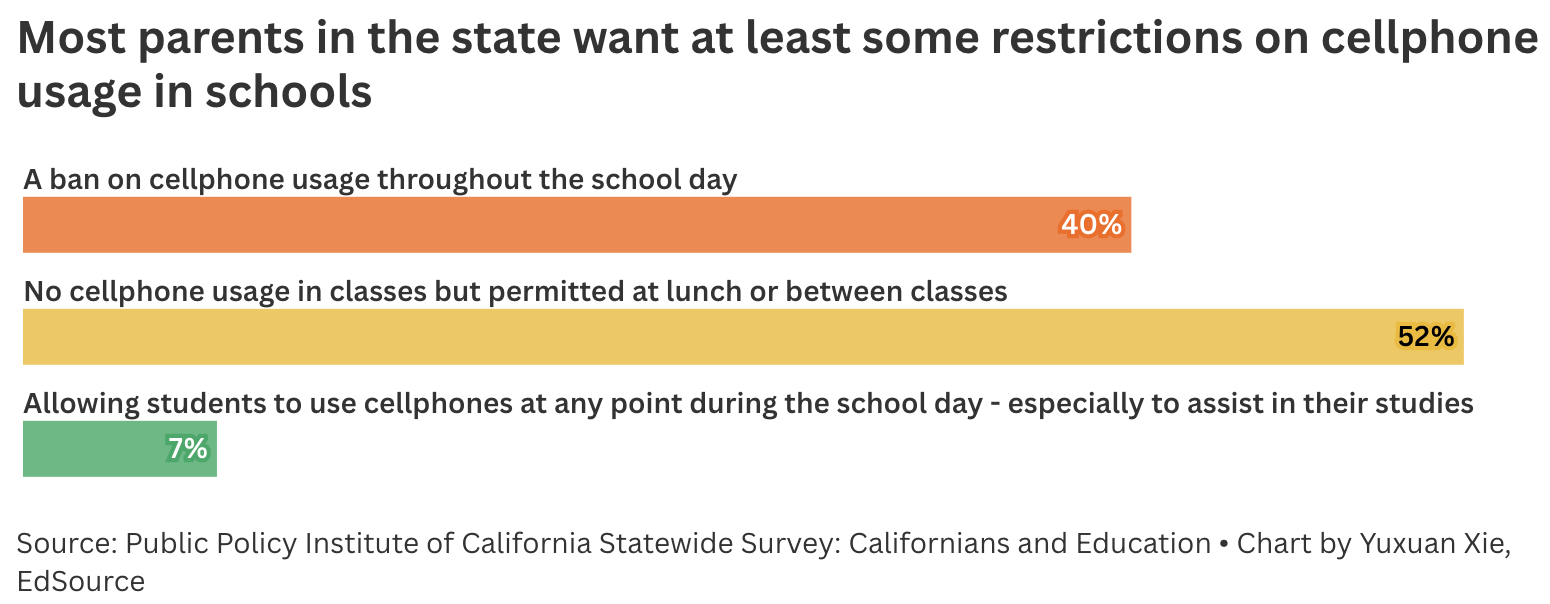
Furthermore, policies aimed at limiting cellphone use in schools have overwhelming support. More than 90% of parents with school-age children back such measures. While 52% prefer allowing phone use during non-instructional times, 40% favor a complete ban throughout the school day.
Protections for vulnerable student populations also resonate with voters. Two-thirds of voters are concerned about the impact of federal immigration enforcement on undocumented students and support schools becoming "sanctuary safe zones." Additionally, 57% approve of a recent law that prohibits schools from mandating the disclosure of students' gender identity or sexual orientation to parents without their consent.
The Future of Funding and Policy
The conversation around education in California is inextricably linked to funding. While 47% of voters believe current state funding for public schools is insufficient, the path to increasing that funding is complex. Local bond measures and parcel taxes, which could provide additional resources, often require a 55% majority to pass, and the survey indicates that many voters might be hesitant to approve measures that limit their ability to pass local taxes, with 57% opposing initiatives requiring a two-thirds majority for such measures.
A significant ballot initiative for the November election proposes making permanent a tax surcharge on high-income earners, currently set to expire in 2031. This measure is supported by 62% of likely voters, and its failure could result in an estimated annual loss of $2 billion to $5 billion for K-12 schools and community colleges.
Shifting Department of Education Control
Governor Newsom's proposal to transition control of the state Department of Education from an elected Superintendent to an appointed State Board of Education appears to have weak public backing. Only 43% of voters approve of removing the elected superintendent and placing the department under the purview of the appointed board, suggesting that the public may favor the current elected structure or may not fully grasp the implications of the proposed change.
As the election season progresses, the race for State Superintendent of Public Instruction is poised to become a focal point. The low name recognition among candidates, coupled with voters' clear concerns about educational quality and equity, sets the stage for a dynamic and closely watched contest that will shape the future of public education in California.





 Explore AI Teaching Tools
Comments (0)
Please login to comment
No comments yet
Be the first to comment on this article