
Boosting Native American Student Attendance: Strategies for Success in American Schools
The journey of education is a cornerstone for every student's future, yet for many Native American students, consistent school attendance presents significant challenges.
These hurdles, often exacerbated by historical context and contemporary societal factors, have seen a concerning rise, particularly in the wake of recent global disruptions.
This article delves into the multifaceted reasons behind these attendance gaps and explores innovative, culturally sensitive approaches being implemented in American schools to ensure every student, including those from Native American communities, has the opportunity to thrive and achieve their full potential.
The Persistent Challenge of Chronic Absenteeism
Chronic absenteeism, defined as missing 10% or more of the school year, has become a critical issue impacting educational outcomes across the United States.
While this problem affects many student populations, data indicates a disproportionately higher rate among Native American and Alaska Native students.
This disparity, present long before recent global events, has unfortunately widened, creating a significant barrier to academic progress and future opportunities for these students.
The impact of missing even a few days of school can be profound, leading to a cascade of academic difficulties and disengagement.
Consider the experience of a young student, let's call him Carlos, who faced significant attendance issues.
Last year, Carlos missed a substantial portion of the school year, a pattern that worried his family and educators.
The importance of showing up to school was a constant message from both his home and his educational institution.
When he did attend, Carlos sometimes reported feeling singled out or experiencing social difficulties, which understandably impacted his willingness to go.
His grandmother, a pillar of strength in his life and an enrolled member of a Native American tribe, emphasized the long-term benefits of education, reminding him of the opportunities available to him that she herself did not have.
She highlighted the resources he had access to, such as stable housing with modern amenities, contrasting it with past limitations.
This personal encouragement, coupled with proactive support from school staff, including teachers and attendance officers, aimed to re-engage Carlos with his education.
The situation faced by Carlos is not isolated.
Across many school districts serving Native American communities, absenteeism rates are alarmingly high.
For instance, in one district, a staggering percentage of students were classified as chronically absent during a recent school year.
This figure underscores the systemic nature of the challenge and the urgent need for tailored interventions.
The reasons behind these absences are complex, often stemming from a confluence of socio-economic factors, health concerns, and deeply rooted historical experiences that have shaped the relationship between Native American communities and educational institutions.
Understanding the Scope of the Problem
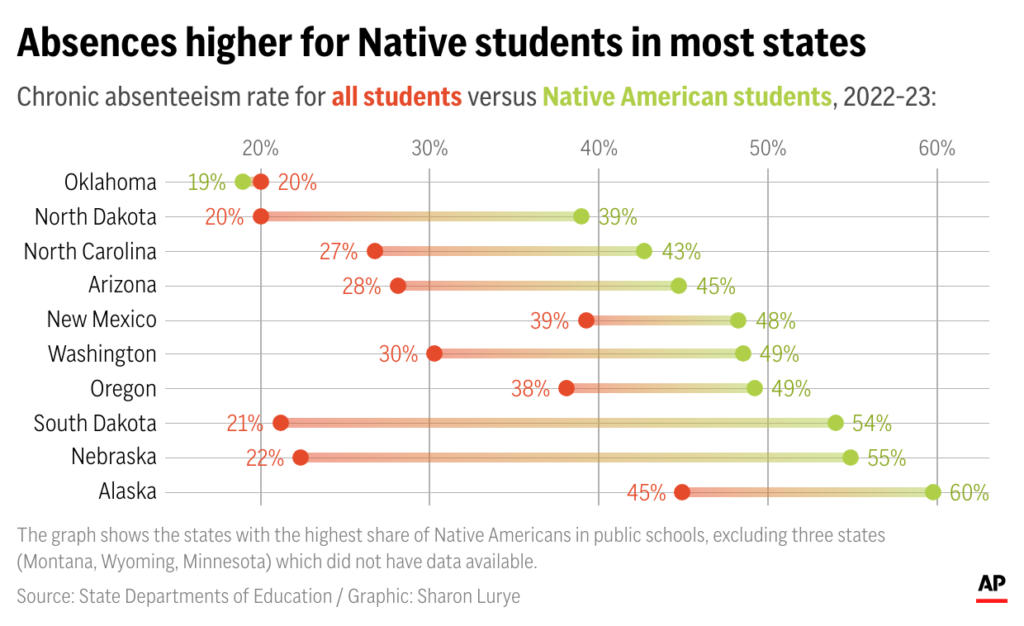
Recent analyses of attendance data from numerous states reveal a stark reality: Native American students are significantly more likely to be chronically absent than their peers.
In many instances, the gap in absenteeism rates is substantial, indicating a systemic issue that requires focused attention.
This trend is not uniform across all regions, but it is a widespread concern that demands a comprehensive understanding of its underlying causes.
The data suggests that for roughly half of the states with available information, the absenteeism rate for Native students was at least nine percentage points higher than the state average.
This is a critical indicator that requires immediate attention and strategic planning from educational leaders and policymakers.
Addressing the Root Causes: Beyond Simple Attendance
The challenges faced by Native American students in attending school are deeply intertwined with historical trauma, socio-economic disparities, and cultural considerations.
For decades, educational policies and practices have, at times, failed to acknowledge or adequately address the unique needs and cultural identities of Native American students.
This has led to a legacy of distrust and a perception that the educational system may not fully serve their interests or respect their heritage.
Research indicates that historical efforts by governments to assimilate Native American populations, including the forced removal of children to boarding schools designed to suppress their culture and identity, have had lasting impacts.
This history can foster a sense of skepticism regarding the value of public schooling, leading some to question whether it truly represents a beneficial investment for their children's future.
As one expert from the Cherokee Nation aptly stated, this historical context may cause individuals to "not see the investment in a public school education as a good use of their time." This perspective highlights the critical need for schools to actively build trust and demonstrate a genuine commitment to cultural understanding and respect.
Furthermore, many Native American communities grapple with higher rates of illness and poverty, which directly impact a student's ability to attend school consistently.
Unstable living conditions, lack of access to healthcare, and the need for older children to assist with family responsibilities can all contribute to absenteeism.
The presence of issues such as alcoholism and drug abuse within some households also presents significant challenges that affect a student's well-being and their capacity to engage in learning.
The Role of Health and Well-being
Studies indicate that a student's physical and mental health are intrinsically linked to their attendance and academic performance.
For students facing anxiety, grief, or trauma, the school environment can feel overwhelming, making attendance a significant hurdle.
Recognizing this, innovative educational programs are beginning to integrate comprehensive support services directly within school settings.
This includes providing access to healthcare, mental health counseling, and even basic necessities like food and hygiene products.
One successful model involves the establishment of on-site care centers within school districts.
These centers often partner with local hospitals, dentists, and food banks to offer a range of essential services directly to students and their families.
This approach not only addresses immediate health and welfare needs but also fosters a sense of community and support.
Cultural success coaches, who are often members of the Native American community themselves, play a vital role in these centers.
They work closely with families, helping to navigate challenges that might otherwise prevent students from attending school.
Their understanding of cultural nuances and lived experiences allows them to build rapport and provide culturally relevant support.
The impact of these integrated care models is demonstrable.
In one district that implemented such a program, the chronic absenteeism rate saw a significant decrease.
This improvement is attributed to the holistic approach of addressing the multifaceted needs of students and families, making the school a more supportive and accessible environment.
The superintendent of this district, a member of the Navajo Nation, emphasized that these community and tribal connections are crucial for creating a school system that truly serves the students, rather than one that feels imposed upon them, a sentiment that resonates with the historical experiences of Native American education.
Culturally Responsive Education: Fostering Belonging and Engagement
A fundamental aspect of improving attendance for Native American students lies in creating educational environments that are not only safe and supportive but also culturally affirming.
This means actively incorporating Native American languages, histories, traditions, and values into the curriculum and school practices.
When students see their own identities reflected and respected within the school, they are more likely to feel a sense of belonging and connection, which in turn can boost their motivation to attend.
Schools that are making significant strides are those that actively engage with tribal communities and incorporate their guidance into educational planning.
This can involve recognizing and respecting traditional ceremonial days by closing schools or excusing absences on these important cultural dates.
This practice acknowledges the significance of cultural heritage and demonstrates a commitment to supporting students' holistic development, both within and outside the classroom.
Language Preservation and Academic Success
The preservation of indigenous languages is a critical component of cultural identity and can also play a significant role in academic engagement.
For schools serving communities where Native American languages are spoken, offering classes in these languages can be transformative.
When parents can communicate with teachers in their native tongue and when students see their language valued in the classroom, it strengthens the home-school connection and can improve academic outcomes.
This is particularly important for families where parents may not be fluent in English, ensuring they can actively participate in their child's education.
One parent shared her experience, noting the profound difference it made when her children attended a school that offered classes in their family's native language.
She recounted how her older children, in a different educational program, were discouraged from speaking their native language, which she felt negatively impacted their academic journey.
In contrast, at Algodones Elementary School, she witnessed a supportive environment where teachers were dedicated to helping all students learn.
Her son, Cameron, now expresses enthusiasm for learning, inspired by his teachers and the positive school experience.
This highlights how embracing native languages can foster a deeper connection to learning and a greater sense of pride in one's heritage.
The Power of Home Visits and Family Engagement
Building strong relationships with families is paramount to addressing chronic absenteeism.
In many Native American communities, traditional methods of communication may differ, and direct, personal engagement can be far more effective than standard outreach.
Schools that prioritize home visits, especially when families may not have reliable phone access, demonstrate a commitment to understanding and supporting students in their home environments.
These visits allow educators to connect with parents on a personal level, understand the unique challenges families face, and collaboratively develop strategies to support student attendance.
When families feel seen, heard, and valued by the school, they are more likely to become active partners in their child's education.
This can involve addressing practical concerns, such as transportation or access to resources, as well as building trust and fostering a shared vision for the student's success.
The impact of these efforts can be seen in the increased enthusiasm of students to attend school.
One grandmother shared how her granddaughter, Brylee, who had previously missed many days, was now excited to go to school.
This shift was attributed to the school's increased engagement with families and the positive atmosphere created.
The grandmother's own commitment to ensuring Brylee's attendance, coupled with the school's supportive approach, created a powerful synergy.
She emphasized the importance of education for her granddaughter's future, stating, "You need to be in school, because who is going to be supporting you?
You've got to do it on your own.
You've got to make something of yourself." This sentiment underscores the vital role of education in empowering students to build independent and fulfilling lives.
Innovative Solutions for a Brighter Future
The challenges of chronic absenteeism among Native American students are complex and require multifaceted solutions.
However, the experiences of schools and districts across the American landscape offer valuable insights and demonstrate that progress is achievable.
By embracing culturally responsive practices, integrating essential support services, and fostering strong partnerships with families and tribal communities, educational institutions can create environments where all students, including Native American students, feel valued, supported, and empowered to attend school and succeed.
The journey of improving attendance is not just about getting students through the school doors; it's about creating an educational experience that respects their identity, addresses their needs, and ignites their passion for learning.
As schools continue to "decolonize" their systems and embrace a more inclusive and equitable approach, the future looks brighter for Native American students, ensuring they have the educational foundation necessary to thrive and contribute to their communities and beyond.
Conclusion
The persistent issue of chronic absenteeism among Native American students is a critical concern that demands our collective attention and innovative solutions.
While historical factors and socio-economic challenges have contributed to this disparity, promising strategies are emerging that prioritize cultural relevance, holistic support, and strong community partnerships.
By implementing culturally responsive curricula, providing on-site health and wellness services, and actively engaging families through methods like home visits, American schools can foster environments where Native American students feel a profound sense of belonging and are motivated to attend.
The ongoing efforts to build trust, preserve indigenous languages, and acknowledge cultural traditions are not merely supplementary but are integral to creating an equitable and effective educational system for all students.
Mentofy is committed to supporting these vital educational endeavors, providing resources and platforms that empower educators and learners alike to overcome challenges and build a more inclusive and successful future for every student.



 Explore AI Teaching Tools
Comments (0)
Please login to comment
No comments yet
Be the first to comment on this article