
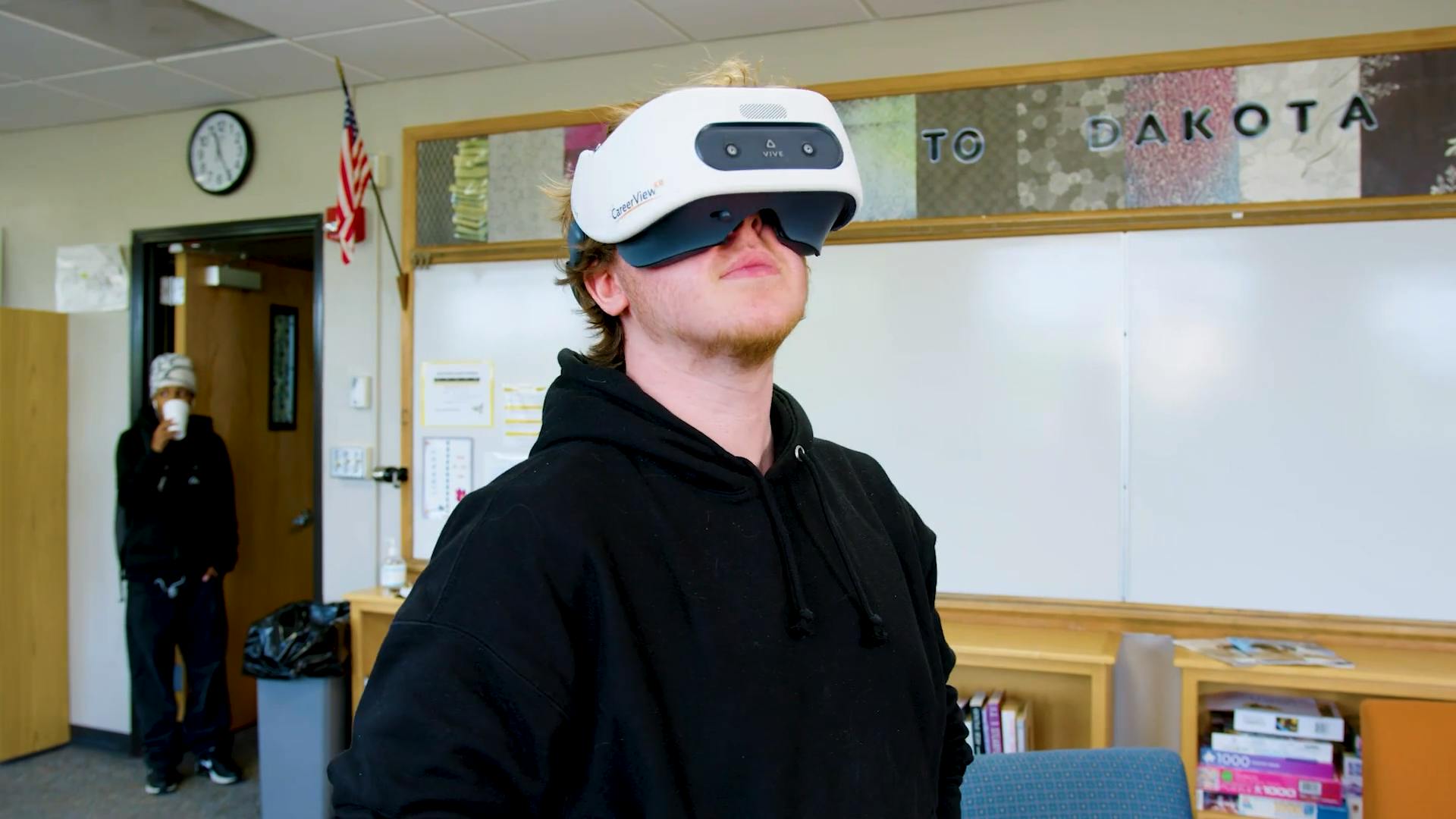
North Dakota Schools Plug into Virtual Reality to Forge Future Workforce
Imagine a fourth grader virtually standing atop a towering wind turbine, the wind whipping past their digital avatar. Just steps away, another student is scrubbed in, assisting surgeons in a high-stakes operating room. Nearby, a third is immersed in the controlled chaos of an autobody shop, learning the intricacies of vehicle repair. These are not field trips to distant, potentially hazardous locations, but rather the groundbreaking reality unfolding in North Dakota classrooms, thanks to a significant investment in virtual reality technology.
While many educational institutions nationwide are grappling with strategies to reduce screen time, North Dakota is boldly embracing digital immersion, aiming to expose its youngest students to a world of career possibilities at an unprecedented scale.
Bridging the Rural Divide with Immersive Exploration
For students in North Dakota's vast rural landscape, the practicalities of exploring diverse career paths can be a significant hurdle. Traditional site visits often involve hours of travel, making them logistically challenging and time-consuming.
Mackenzie Tadych, director of Northern Cass School’s college and career readiness program, highlights this challenge. "Because North Dakota is largely rural, students face significant travel hurdles to visit job sites that could be several hours away," she explains.
This is precisely where the virtual reality initiative steps in, aiming to democratize access to career awareness. Wayde Sick, the state director for the Department of Career and Technical Education, emphasizes the program's core mission. "This was an attempt to engage students at an earlier age and develop an awareness of [the careers] the state has to offer," Sick states. "This is the first glance to show what is out there without throwing a bunch of students on a bus where you drive two hours for a field trip and two hours back."
Tech as a Catalyst for Opportunity in Underserved Areas
The virtual reality program in North Dakota is designed to be a direct bridge between students and employers within the state. Its objective is to illuminate careers and industries that students might otherwise be unaware of or hold misconceptions about, such as the dynamic field of manufacturing.
Launched in 2023, the statewide program received a substantial boost when the North Dakota state legislature allocated half a million dollars to the Department of Career and Technical Education. This funding enabled the purchase of virtual reality headsets, initially for middle and high schools, with a subsequent expansion to all elementary schools across the state late last year.
While traditional career exploration methods, such as aptitude tests, remain valuable, virtual reality offers a uniquely visual and experiential dimension. This initiative, an extension of the RUReady ND career exploration program, now provides 118 distinct modules through Fargo-based CareerViewXR, allowing students to literally step into potential futures.
A Mobile Classroom for Career Discovery
Ann Pollert, a dedicated career exploration coach, operates a mobile van that travels to schools of all levels across six northeastern counties. Her van is equipped with seven VR headsets, and she typically works with groups of five students at a time, guiding them through the modules and helping them uncover their interests.
"I would go into classroom after classroom and give a 50-minute spiel, but they had no visual," Pollert recounts, drawing on her background as a former diesel technician recruiter. "With this, I could take it to the school and show those kids what it means to replace an excavator. It helps me identify the students I need to further encourage."
Pollert is quick to clarify that the VR headsets are not intended to replace the crucial role of guidance counselors or career advisors, particularly in high schools. Instead, they serve as a valuable supplement, especially as counselors often face overwhelming workloads and limited time.
"We still need career counselors, work-based learning counselors, and great teachers that notice something about a student, saying, ‘You would be good at this,’" Pollert asserts. She acknowledges that some smaller schools may lack the resources for dedicated counselors, making VR a vital component of a comprehensive support system. "It’s everything together to make it work. It’s not the van that’s solving the problem."
Measuring the Impact: Early Signs and Future Potential
The question of efficacy is paramount, and while it's still early days, state officials are optimistic about the program's trajectory. Wayde Sick, the state director, acknowledges that concrete data on long-term impacts, such as increased post-graduation retention rates within the state, is not yet available.
The current focus is primarily on students who have yet to graduate high school, with the understanding that early exposure is key. Sick firmly believes the program's greatest value lies in its ability to ignite curiosity and provide a foundational understanding of career options from a young age. "In my eyes, this content is most important for elementary and middle school-aged kids, so the high school students have seen those experiences, have an idea of what they want to pursue and can do so in a series of courses based on what they have seen in virtual reality as a fifth or sixth grader," he explains.
Discovering Likes and Dislikes in the Digital Realm
The virtual reality initiative empowers students in North Dakota to explore a wide spectrum of careers, including lesser-known but vital roles such as veterinary technicians and manufacturing engineers. These immersive experiences are curated to provide realistic insights into the day-to-day demands of various professions.
Interestingly, the virtual environment also proves invaluable for students to discover what they *dislike*. Mackenzie Tadych of Northern Cass School shares a memorable anecdote about a student who had a strong negative reaction to a virtual reality module set in a high-stress operating room.
"It’s just as beneficial being able to find what you don’t want to do," Tadych notes. She adds that her district also mandates job shadowing for students before graduation, allowing them to observe professionals in their actual work environments.
As VR technology continues to advance, the realism and interactivity of these career simulations are expected to increase, providing students with even more nuanced and useful information about potential career paths. Sick envisions a future where augmented reality could further enhance these experiences, allowing for deeper interaction with virtual environments.
He believes that such advancements will not only highlight the wealth of local career opportunities available in North Dakota but also play a crucial role in encouraging students to remain in the state after graduation. "We’re a rural state, and my goal is to make sure every student has the best experience they [can] have, to find what they should become, and try to help them figure it out sooner," Sick states.
Ultimately, providing a rich and diverse range of experiences, beginning at the elementary level, is the most effective strategy for helping students navigate their future career journeys and contribute to the state's economic vitality. The reality of North Dakota's educational landscape is rapidly evolving, with virtual reality technology at the forefront of shaping its future workforce.




 Explore AI Teaching Tools
Comments (0)
Please login to comment
No comments yet
Be the first to comment on this article