
Reimagining Education: Building a Resilient World for Students and teachers
In a world constantly reshaped by innovation and global challenges, the very essence of education demands a fresh perspective.This article delves into the evolving landscape of learning, exploring how students, teachers, and educational systems can adapt to foster critical thinking, emotional well-being, and a culture of peace.
We will uncover what learners truly value, the vital role of educators, and how education can empower individuals to navigate an increasingly complex world.
The Shifting Sands of Learning: Student Perspectives on Essential Skills
The future of our shared world hinges on the foundational principles of education.While education has historically been the bedrock of our cultures, economies, and democracies, enabling us to coexist with ourselves, others, and the planet, past educational paradigms have also revealed significant disconnects.
These include the tension between boundless economic growth and planetary resource limitations, the chasm between financial and real economies, the widening gap between the affluent and the less fortunate, the disconnect between institutional structures and the voices of many, and the disparity between technological advancements and societal needs.
To forge a different world, we must cultivate different educational systems.
A pivotal survey, commissioned for the fifth Summit of First Ladies and Gentlemen, sought to understand how students, teachers, and parents perceive contemporary education and envision its future.
This extensive research, involving students, teachers, and parents across 14 nations, offers profound insights.
Strikingly, it was the students themselves who articulated the most forward-thinking priorities.
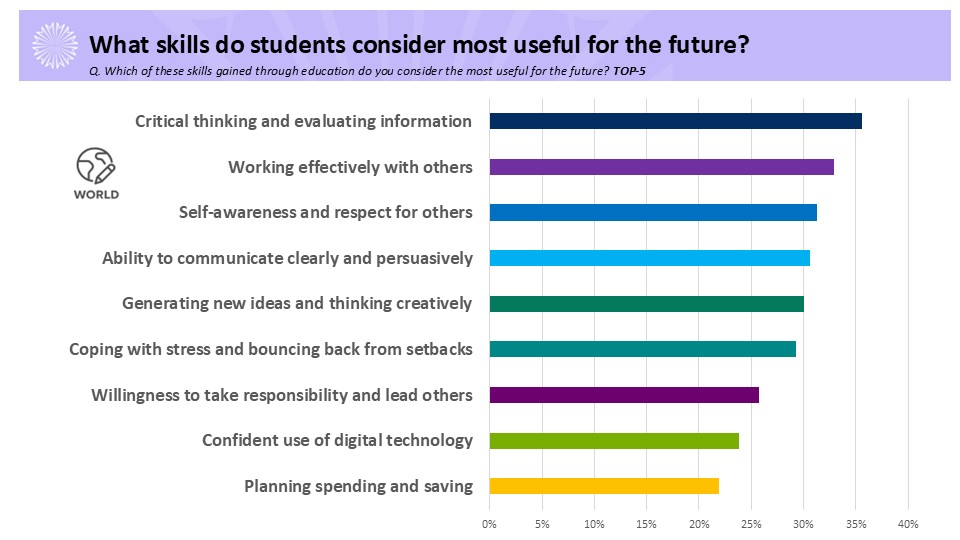
Across the participating countries, students overwhelmingly prioritized critical thinking and the ability to evaluate information as paramount.
In Ukraine, for instance, over half of the students identified critical thinking as the most crucial skill for their future.
This underscores a clear demand for enhanced tools to navigate the pervasive landscape of misinformation and disinformation, where social media, while connecting us, can also create echo chambers that reinforce existing beliefs and exacerbate societal divisions.
Students recognize the imperative to question assumptions, look beyond superficial claims, make reasoned and ethical judgments, weigh evidence, triangulate viewpoints, compare perspectives, and identify biases or gaps in arguments.
Social skills emerged as the second most important priority for students.
In nations like Finland and Estonia, the ability to collaborate effectively with others was ranked as the top choice.
This is particularly noteworthy, as social skills are often not given sufficient emphasis in traditional schooling.
While they might be mentioned in curricula, the practical application often falls short, with students frequently placed in individual settings and assessed through competitive measures that pit them against their peers.
Following closely were self-awareness and respect for others, alongside creativity and resilience.
These are capabilities that modern societies increasingly recognize as indispensable "hard skills" rather than mere "soft skills." A more concerning observation is the comparatively low priority students assigned to taking responsibility and leadership.
This might reflect an educational environment where students are often positioned as passive recipients of knowledge rather than active participants in their own learning journey, and where they are not consistently encouraged to embrace responsibility for themselves and for their peers.
Shifting this paradigm is crucial.
Today's students are the innovators and entrepreneurs of tomorrow; they must be equipped not only to seek jobs but to create them.
This necessitates fostering curiosity, imagination, entrepreneurship, and resilience—the capacity to view failure not as an endpoint but as a catalyst for growth.
This, in turn, depends on students owning their learning objectives and actively participating in the design of their educational environments.
It requires cultivating mastery, the intrinsic desire for continuous improvement; relatedness, the need to feel valued and supported; and autonomy, the ability to employ a diverse range of self-directed learning strategies.
Country-Specific Insights into Student Priorities
The survey revealed fascinating variations in student priorities across different nations: * Ukraine: A significant majority (54%) of students identified critical thinking as the most valuable future skill. * Finland & Estonia: These countries stood out for their students' strong emphasis on teamwork (40-41%), alongside critical thinking. * Lithuania & Denmark: Students in these nations placed the highest value on resilience (42% in both countries), indicating a focus on coping with stress and recovery. * Japan: Japanese students prioritized creative thinking and innovation (44%) considerably more than the global average. * South Africa: A notably lower percentage of South African students (23%) highlighted critical thinking compared to other participating countries. * USA & UAE: Students in these regions strongly emphasized self-awareness and respect for others (38% in the USA, 32% in the UAE), in addition to communication skills. * Mexico: While Mexican students reported lower emphasis on communication (22.5%), they showed a strong preference for teamwork (37%). * Turkey: Nearly half of Turkish students (47%) underscored the importance of critical thinking, aligning with the priorities observed in Northern European countries.Bridging the Gap: Education's Role in Future Aspirations
Beyond skill development, the survey explored the alignment between educational experiences and students' future aspirations.Worryingly, on average, only 26% of students across the 14 participating countries felt that their schools adequately prepared them for independent living.
When questioned about how their schools assisted them in navigating the professional world, a mere 43% reported being introduced to various occupations, 39% felt they understood the skills required for different careers, and only 37% indicated receiving support in identifying their personal strengths relative to diverse professional fields.
While these averages mask considerable national variations, the overall picture is a cause for concern.
In most countries, a student's social background appears to exert a greater influence on their aspirations than their innate talent or motivation.
Furthermore, students' career expectations often bear little resemblance to the actual demands of the labor market.
Many of the jobs young people aspire to remain out of reach, with their career choices concentrated on a limited number of high-status professions often depicted in media but scarce in reality.
Crucially, the majority of young individuals are not receiving sufficient career development opportunities that connect them with relevant professionals and workplaces, thereby limiting their understanding of available opportunities.
This disconnect necessitates a fundamental shift.
Schools should not be isolated environments for children; rather, the entire world should serve as their learning ground.
The past was characterized by fragmentation—teachers and content divided by subjects, and students segregated by differing career expectations.
Schools were designed to keep students within their walls, effectively isolating them from the broader world.
The future, however, demands integration: the merging of diverse experiences, the seamless connection between the world of learning and the world of work, the ability to forge links between seemingly unrelated ideas, and the skill to identify the nexus where the next wave of innovation will emerge.
The Emotional Landscape of Learning: Belonging, Safety, and Personal Growth
The emotional well-being of students is a critical, yet often overlooked, aspect of education.During the data collection period, a majority of students reported experiencing happy and confident emotions at least half of the time.
However, a significant and often silent minority of young people expressed a less positive outlook on life, with nearly a quarter feeling bored and 17% experiencing anxiety.
Regarding fundamental needs, students in the UAE overwhelmingly reported feeling safe in school, a sentiment echoed by around 80% of students in most countries.
In Ukraine, this figure was less than 70%.
However, considering that over 360 Ukrainian schools have been destroyed and ten times that number have been damaged by conflict, this percentage is remarkably high.
It highlights that the sense of safety extends beyond physical security to encompass emotional safety and the quality of social relationships within the school environment.
This is a testament to the extraordinary efforts of teachers in Ukraine, who daily strive to provide students with a sense of security, normalcy, and emotional support amidst profound adversity.
When moving beyond physical safety to the feeling of being accepted for who they are, the numbers decline, dropping to 70% or below in countries like Japan, Lithuania, and Estonia.
These figures warrant serious consideration for several reasons.
Firstly, when students feel accepted, they experience psychological safety, which fosters curiosity and encourages risk-taking in learning.
It reduces anxiety and stress, which can impede cognitive functions, and promotes open communication and collaboration.
Secondly, a sense of acceptance significantly boosts engagement.
Students who feel seen and valued are more inclined to participate actively in class, take ownership of their learning, and persevere through challenges.
Lastly, a sense of belonging is a fundamental human need.
In educational settings, this translates into enhanced motivation and resilience.
Classrooms become richer, more dynamic spaces where students develop empathy and are better prepared to coexist and collaborate with others in their future lives.
Perhaps the most concerning finding is the substantial minority of students who question whether they have a fair opportunity to succeed in school through their own efforts.
This mindset, encompassing equal opportunities and personal growth, is profoundly important.
Among all the judgments we make about ourselves, the most influential is our perceived capability to overcome difficulties.
Research consistently indicates that the belief in personal responsibility for the outcomes of one's actions significantly impacts motivation.
Individuals are more likely to invest effort when they believe it will lead to desired results.
A growth mindset reframes failure as a temporary setback—"not yet"—rather than an inherent lack of ability.
It cultivates grit and a genuine love for learning.
Recognizing effort sends a powerful message to students: progress is attainable and within their control.
This fosters an inclusive classroom culture where all students feel encouraged to strive for their personal best, ultimately building resilience and a belief in the potential for continuous personal development, which is vital for lifelong learning and success.
Importantly, when students were asked about the qualities of their role model teachers, treating all students fairly consistently ranked as the most important attribute across most countries.
Teachers: The Architects of Educational Transformation
Similar to students, teachers and parents alike identified fairness, support, and inspiration as the most valuable qualities in educators.When teachers were surveyed about their priorities in education, preparing students for life emerged as the most frequently cited objective, followed by fostering lifelong learning and acquiring knowledge and skills for future employment.
While this is encouraging, it starkly contrasts with students' perceptions of their school experiences, where they often report boredom, a disconnect between their dreams and the world of work, and insufficient support for career guidance.
This raises the question: are we placing excessive demands on our teachers?
We expect them to possess a deep and broad understanding of both their subject matter and their students, recognizing that a teacher's knowledge and care profoundly impact student learning.
Beyond their formal job descriptions, we anticipate them to be passionate, compassionate, and thoughtful; to foster student engagement and responsibility; to cater to students from diverse backgrounds with varied needs, promoting tolerance and social cohesion; to ensure students feel valued and included; and to encourage collaborative learning.
Furthermore, we expect teachers to collaborate effectively in teams, and with other schools and parents.
Perhaps the most significant expectation is that teachers will embody and practice today the learning, thinking, and values that we hope will shape the world of tomorrow for our children.
So, how are we supporting teachers to meet these multifaceted expectations?
The quality of education is inextricably linked to how we value and support our educators.
In the UAE, South Africa, and the UK, over 70% of both parents and teachers believe that society values teachers' opinions on important issues.
However, in Ukraine, this figure drops below 30% among parents and below 10% among teachers.
A critical question arises: are teachers compensated fairly for their contributions?
The UAE is the only country where more than 70% of parents believe teachers are fairly paid.
In Ukraine, this figure is a mere 23%, and when teachers themselves were asked, only 3% felt they were adequately compensated.
Yet, salaries are rarely the sole determinant of the teaching profession's attractiveness.
In Europe, Luxembourg offers the highest teacher salaries, but it grapples with significant teacher shortages.
Conversely, in Finland, salaries are comparatively modest, yet there are often ten applicants for every teaching position.
This suggests that while financial compensation is important—inadequate salaries can be a significant de-motivator leading to attrition—it is not the primary intrinsic motivator in education.
The attractiveness of a teaching role is a complex interplay of the job's social status, the perceived impact and contribution of the work, and the extent to which educators feel valued and supported.
We understand that the quality of education can never surpass the quality of our teachers, but conversely, the quality of teachers will never exceed the ways in which societies demonstrate their value and provide support.
Regarding governmental support for teachers, views vary across countries.
Apart from the UAE, Austria, and the UK, less than two-thirds of teachers feel that their government genuinely supports their professional development and well-being, with numbers dropping to single digits in some nations.
Education as a Cornerstone for Democracy and Peace
On a more optimistic note, in all but one of the 14 participating countries, over 80% of teachers perceive education as a fundamental pillar for a democratic society and for fostering peace.When asked about nurturing a culture of peace among students, teachers consistently ranked developing empathy, tolerance, and respect for diverse opinions as the highest priorities.
Teaching about human rights and responsibilities followed, with peaceful conflict resolution ranking third.
This emphasis is crucial because the foundations for these qualities are not innate.
While we are born with an inherent sense of belonging to our immediate circle, it requires robust education to cultivate the capacity to relate to individuals who are different from us and to expand our radius of trust to encompass strangers.
Education can equip students to navigate tensions between competing demands—such as equity and freedom, autonomy and community, innovation and continuity, or efficiency and democratic processes.
It can help students develop a strong moral compass, a sensitivity to the needs of others, and an understanding of the limitations inherent in individual and collective actions.
Ultimately, education empowers students to join with others, with empathy, in both their work and their civic responsibilities.
Freedom, democracy, and peace are not mere diplomatic embellishments or abstract ideals; they are the very heart of education and the bedrock upon which we construct our societies.
If education does not actively and determinedly safeguard these principles, the world's most profound tremors risk eroding the very foundations of our collective existence.
Navigating the Future with AI: Enhancing Human Capabilities
In the current era, there is a pervasive temptation to view artificial intelligence as an inexorable force that diminishes human agency.However, this should not lead to a passive retreat, ceding ever more ground to algorithms.
Education can empower us to transcend the sum of isolated, automatable tasks.
The advent of AI should sharpen education's focus on uniquely human capabilities that cannot be replicated by code—our consciousness, our capacity to navigate complex interpersonal relationships and build peace, our ability to exercise ethical judgment in ambiguous situations, and our power to create something genuinely novel.
This is precisely why effective education is never merely a transactional endeavor but is fundamentally a social and relational enterprise.
This lies at the core of the magic of teaching: understanding the students in front of us, recognizing who they aspire to become, and accompanying them on their unique journeys.
It is through authentic dialogue, mentorship, and emotional connection that education transforms into a space where social relationships become the shared heritage of humanity.
In this way, education empowers us to design futures that authentically reflect our values and aspirations, building a more resilient and equitable world for all students and teachers.




 Explore AI Teaching Tools
Comments (0)
Please login to comment
No comments yet
Be the first to comment on this article