
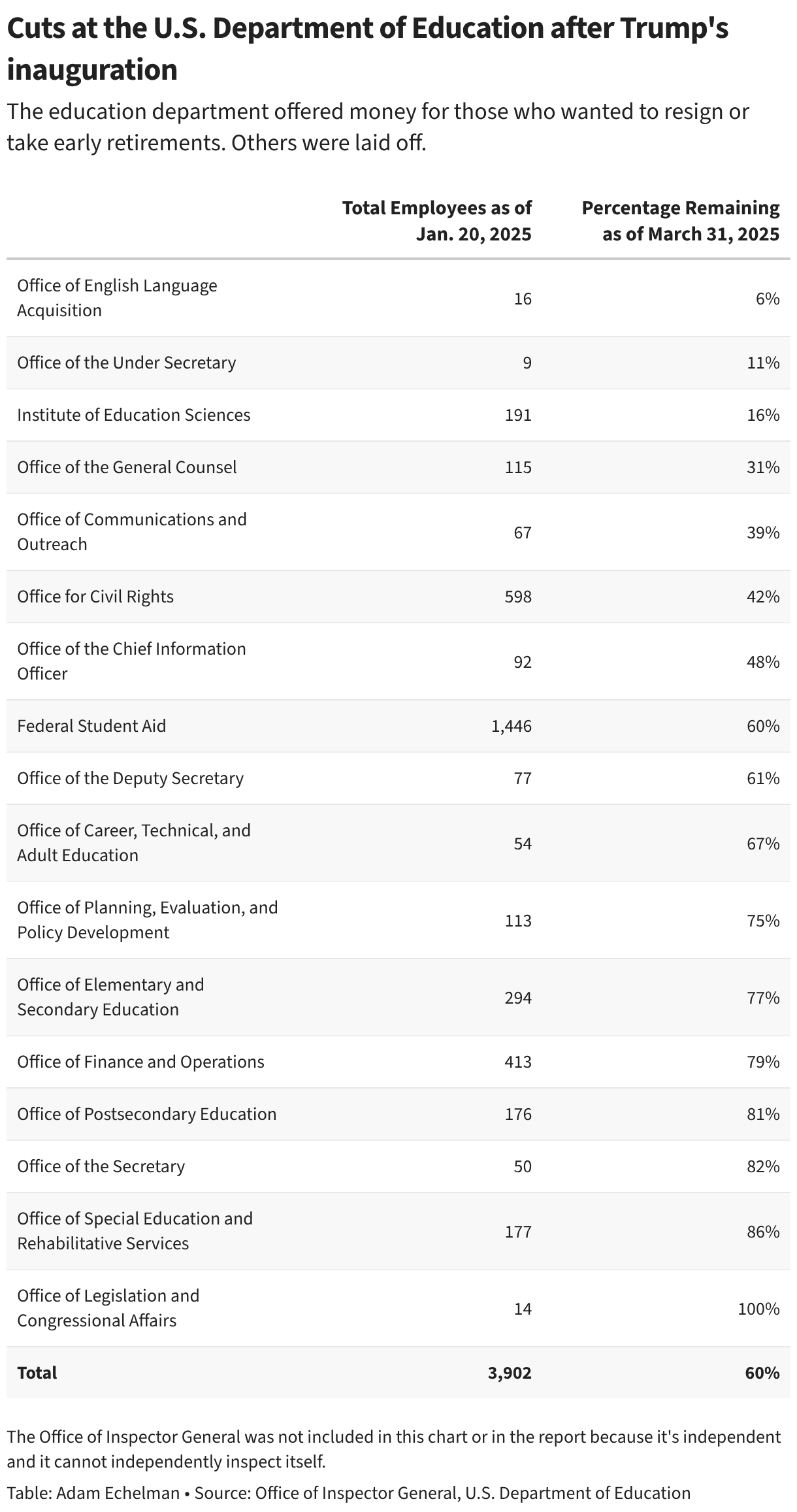
A startling internal report from the U.S. Department of Education reveals a staggering 40% staff reduction in the early months of 2025, a move that raises profound questions about the department's capacity to support students and educators nationwide. This dramatic downsizing, initiated under the Trump administration, has left critical offices decimated and federal oversight functions in jeopardy, directly impacting the educational landscape for millions.
A Department Hollowed Out: The Scale of the Cuts
The scope of the staff losses is immense, with nearly 1,600 positions eliminated between January 20, 2025, and March 31, 2025. These were not merely bureaucratic redundancies; the cuts impacted vital areas such as teacher training, student mental health programs, and essential oversight responsibilities.
The report, compiled by the department’s Office of Inspector General, paints a grim picture of an agency struggling to maintain its core functions. The internal assessment, though acknowledged as incomplete due to non-compliance from some department staff, highlights the severe consequences of these rapid workforce reductions.
"According to the Department of Education's own inspector general, the rapid elimination of nearly 1,600 staff, including those responsible for teacher training, student mental health programs, and legally required oversight functions, raises serious questions about whether the department can still meet its obligations to students."
Critical Offices Left in Ruins
Certain offices within the department bore the brunt of these cuts, leaving them severely understaffed and potentially unable to fulfill their mandates. The Office of English Language Acquisition, crucial for supporting immigrant students, was particularly hard hit, reduced to a single employee at one point.
Similarly, the Institute of Education Sciences, responsible for vital educational research, and the Office of the Under Secretary, overseeing higher education programs, saw over 80% of their staff disappear. This leaves significant gaps in data analysis, research dissemination, and program oversight.
The Devastating Impact on English Language Learners
The decimation of the Office of English Language Acquisition has had palpable consequences. Grants totaling approximately $2 billion were terminated, impacting organizations that provide essential support and training for English language learners. This directly affects the nation's ability to serve a growing and diverse student population.
Edgar Lampkin, chief executive of the California Association for Bilingual Education, described the effects as "devastating." His association, which previously received federal grants to train bilingual teachers, has seen those funds vanish. He emphasizes that the long-term effects of such educational disruptions are felt years, even decades, down the line.
“Those grants are gone,” he said — and the Trump administration won’t see the full impacts of its actions, he added. “The effects of education are normally 10 plus years ahead.”
Federal Oversight and Student Support Imperiled
The report suggests that the department may no longer be able to effectively administer congressionally appropriated funds or oversee federal education law. This includes crucial areas like financial aid distribution, investigations into civil rights violations, and essential data analysis.
The implications for educators and students are profound. Without robust federal oversight, the consistency and equity of educational opportunities across states could be jeopardized. This places an increased burden on state and local education departments to fill the void.
Shifting Responsibilities and Unclear Futures
In an effort to streamline or perhaps dismantle federal involvement, many education-related services have been transferred to other agencies, including the Department of Justice and the Treasury Department. The work previously handled by specialized offices is now being absorbed by broader departments, leading to potential fragmentation and loss of focus.
The report itself notes that many findings are not definitive due to incomplete cooperation from department staff, making it difficult to fully ascertain the total number of layoffs, their precise impact, and the rationale behind contract terminations. This lack of transparency further complicates efforts to understand the full ramifications.
What This Means for Educators: Navigating the New Landscape
The significant cuts to the U.S. Department of Education necessitate a renewed focus on resourcefulness and collaboration at the local level. Educators must be prepared to adapt to potential shifts in federal funding, guidance, and support.
This environment calls for innovative approaches to instruction and student support. Tools that enhance efficiency and engagement can be invaluable in bridging any gaps left by reduced federal resources. For instance, leveraging platforms for effective AI lesson plan generation and AI grading can free up valuable teacher time.
Strategies for Educators in a Leaner Federal Environment
In light of these challenges, educators can implement several strategies to ensure continued student success:
- Embrace Digital Tools for Engagement: Utilize MentofyCove classroom games like trivia or word search games to make learning interactive and fun, boosting student motivation.
- Streamline Planning and Assessment: Explore Mentofy AI teaching tools for efficient lesson planning and exam creator functionalities, saving precious hours.
- Foster Collaborative Learning: Employ smart student grouping tools like MentofyGroups to create dynamic learning environments and utilize AI icebreakers to build community.
- Enhance Classroom Management: Make use of MentofyBoards for interactive classroom displays, timers, and noise monitors to optimize classroom flow.
- Seek State and Local Support: Actively engage with state education departments and local school districts to understand available resources and advocate for necessary support.
- Prioritize Professional Development: Focus on professional development that equips educators with skills to navigate technological advancements and address evolving student needs.
The report's findings underscore a critical moment for American education. While the department's capacity may be diminished, the ingenuity and dedication of educators remain paramount. By adapting and leveraging available resources, the education community can continue to champion student success.





 Explore AI Teaching Tools
Comments (0)
Please login to comment
No comments yet
Be the first to comment on this article