
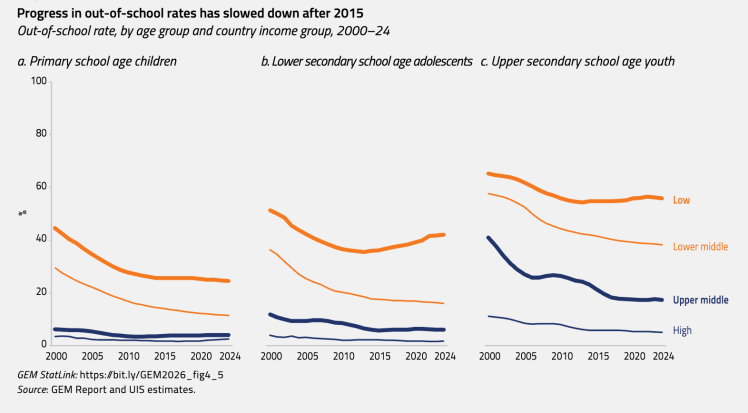
The global population of children and youth out of school has now risen for seven consecutive years, a stark trend impacting an estimated 273 million individuals in 2024. This isn't just a statistic; it's a critical signal for educators worldwide, demanding a re-evaluation of our strategies to ensure every child has access to learning, both within and outside traditional school walls.
The Unseen Surge: Millions More Children Are Now Out of School
For the seventh year running, the number of children, adolescents, and youth not attending school has increased. This growing population, now standing at a staggering 273 million, presents a complex challenge that extends far beyond the classroom. It means millions of young minds are missing out on foundational learning, potentially widening existing inequalities and hindering future development.
While the overall rate of out-of-school children has remained relatively stable at around 17% since 2015, the absolute numbers continue to climb. This is largely driven by population growth, meaning that while the proportion might not be drastically increasing, the sheer volume of learners being left behind is a significant concern. The world is not necessarily moving backward in terms of educational access, but it is certainly not moving forward fast enough to keep pace with demographic shifts.
In 2024, an estimated 273 million children, adolescents and youth were out of school. This figure breaks down into 79 million children of primary school age, 64 million adolescents of lower secondary school age, and 130 million youth of upper secondary school age.
Where the Challenge is Deepest: Low-Income Nations Bear the Brunt
The most alarming increases in out-of-school populations are concentrated in low-income countries. Since 2015, these nations have seen their out-of-school numbers grow by 9 million, a 29% surge. This trend is particularly pronounced when looking back to 2009, with a 41% increase in out-of-school children and youth in these regions.
In stark contrast, the rest of the world has seen its out-of-school numbers remain largely flat. This disparity highlights a critical global equity issue, where the very countries with the fewest resources are struggling the most to provide education for their growing populations. The out-of-school rate in low-income countries stands at a concerning 36%, compared to 20% in lower-middle-income countries, 8% in upper-middle-income countries, and a mere 3% in high-income countries.
Regional Hotspots: Africa and Asia Face the Greatest Hurdles
Two major geographical regions shoulder a disproportionate amount of this global challenge: Sub-Saharan Africa and Central and Southern Asia. Together, these areas account for approximately three-quarters of the world's out-of-school population. This concentration demands targeted interventions and increased international support.
Within these regions, Sub-Saharan Africa has seen a particularly notable rise in out-of-school children and adolescents over the past two decades. It now represents half of the global out-of-school population for these age groups. Rapid demographic growth in Sub-Saharan Africa has outpaced educational expansion, with the school-age population increasing by over 80% at all levels since 2000.
Shifting Gender Dynamics in Out-of-School Populations
Interestingly, the data reveals a shift in gender representation among those out of school. For the first time since 2007, there are now more boys out of school than girls. In 2024, 140 million boys (51%) were not attending school, compared to 133 million girls (49%).
While this trend might suggest progress for girls' education in some contexts, it's crucial not to overlook persistent gender-based challenges. Significant gender gaps remain acute in specific countries and regions, and the specific barriers faced by boys and girls can vary considerably.
Country-Level Variations: Pockets of Progress and Regression
Examining country-specific data reveals a more nuanced picture, with both success stories and areas of significant concern. In low-income countries like Burkina Faso, Chad, Ethiopia, and Niger, which had alarmingly high rates of primary school-age children out of school in 2000, progress was made by 2015. However, a worrying reversal has been observed since then.
Conversely, some lower-middle-income countries have demonstrated remarkable gains. Cambodia, for instance, reduced its out-of-school adolescent rate by 85% by 2015. Nigeria has halved its adolescent out-of-school rate since 2000, and Morocco has continued to make progress. Yet, other countries like Pakistan have seen their gains erode, with rates rising back to previous levels.
The Data Gap: Understanding What We Don't Know
A significant challenge in accurately tracking out-of-school populations lies in the availability and quality of data, particularly in low-income countries. A substantial percentage of these nations lack consistent data points, making it difficult to ascertain the true scale of the problem. This data gap is often most severe in countries already grappling with conflict and instability, suggesting that the estimated figures may actually underestimate the real number of children missing out on education.
In low-income countries, data coverage is seriously limited: 36% of low-income countries and 28% of lower-middle-income countries had observations on out-of-school rates at three points in time (2000–02, 2014–16 and 2022–24), for primary school age children and lower secondary school age adolescents, respectively.
What This Means for Educators: Embracing Out-of-School Opportunities
The rising out-of-school population is a clarion call for educators to broaden their perspective on learning. Traditional schooling is vital, but it's no longer sufficient on its own. We must consider how to engage and support learners who are not physically present in classrooms.
This necessitates exploring innovative teaching methodologies and leveraging technology to bridge the gap. Tools that facilitate flexible learning, provide accessible resources, and foster engagement outside of school hours are becoming increasingly crucial. For instance, platforms offering MentofyCove classroom games can transform revision and concept reinforcement into enjoyable experiences, accessible anytime, anywhere.
Rethinking Engagement and Support Beyond School Hours
Educators can play a pivotal role in identifying and reaching out to out-of-school children and youth within their communities. This could involve:
- Collaborating with local NGOs and community leaders to understand the specific barriers preventing school attendance.
- Developing flexible learning modules or resources that can be accessed through low-bandwidth internet or even offline.
- Utilizing Mentofy AI teaching tools to create differentiated learning materials that cater to varying levels of prior knowledge, essential for students who have missed significant schooling.
- Exploring partnerships with organizations that provide vocational training or alternative pathways to education for older youth.
The challenge of out-of-school children is not solely a problem for governments or international bodies; it is a call to action for every educator. By embracing new strategies and technologies, we can work towards a future where education is truly a right for all, not a privilege for some. Discover how Mentofy can support your efforts; Mentofy is free for teachers and offers a suite of tools designed to enhance teaching and learning.






 Explore AI Teaching Tools
Comments (0)
Please login to comment
No comments yet
Be the first to comment on this article