
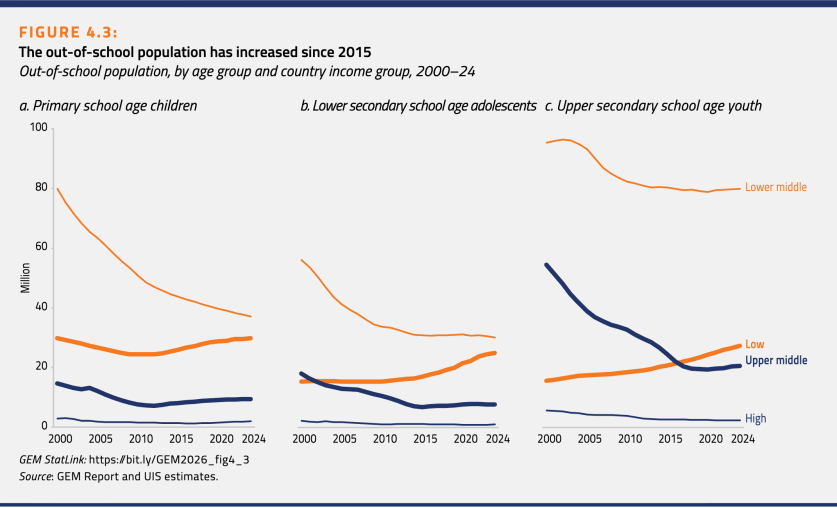
The 2026 Global Education Monitoring (GEM) Report has issued a stark warning: 273 million children, adolescents, and youth are currently out of school, a figure that has risen for seven consecutive years. This translates to one in six young people worldwide being denied an education, a crisis that demands immediate and profound shifts in our approach. For educators, this report isn't just data; it's a call to action, highlighting the urgent need to embed equity at the core of educational policy and practice.
A Global Education Crisis Demands National Ownership and Equity-First Solutions
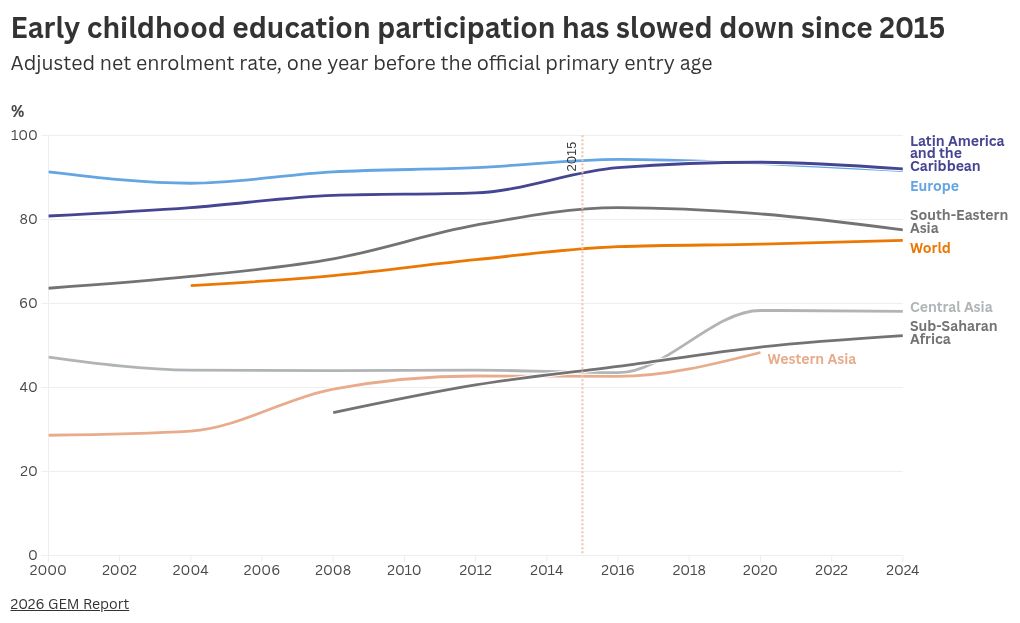
The latest GEM Report, launched at UNESCO headquarters, underscores a fundamental truth: the international education agenda, while noble, has consistently outpaced the pace of real-world expansion. Despite repeated targets for universal access, progress has decelerated across most regions since 2015, with a particularly sharp decline in sub-Saharan Africa. This trend suggests that a one-size-fits-all approach is failing the most vulnerable.
While completion rates are improving, with two in three students finishing secondary school, the report projects that universal secondary completion, a goal originally set for 2030, won't be reached until the next century at the current pace. This sobering statistic highlights the inadequacy of incremental changes and the necessity for bolder, more systemic interventions.
Failing to reach a target does not mean that the agenda has failed. The 2026 GEM Report argues that in a context where multilateralism is under strain, a missed target should prompt re-evaluation, not abandonment.
However, the report also offers a crucial counterpoint: despite the rising numbers of out-of-school children, global enrollment has seen significant increases since 2000. Pre-primary enrollment is up by 45%, primary and secondary by 30%, and post-secondary by an astonishing 161%. This duality—rising enrollment alongside a growing out-of-school population—points to deep-seated systemic inefficiencies and inequities that must be addressed.
Learning from Diverse National Experiences for Sustainable Change
The GEM Report emphasizes the critical importance of learning from the historical experiences of different countries. Instead of relying on quick fixes, the report advocates for understanding what truly sustains change at scale, particularly within diverse national contexts. This requires a fundamental shift towards greater national ownership of the international education agenda.
Countries are urged to set their own ambitious yet achievable targets, grounded in their unique realities and accountable to their own citizens. This approach acknowledges that solutions effective in one nation may not translate directly to another, necessitating context-specific policy bundles and a patient, sustained commitment to equity.
The report highlights examples of countries that have made remarkable progress. Madagascar and Togo, for instance, have reduced out-of-school rates for children by at least 80% since 2000. Morocco and Vietnam have achieved similar success with adolescents, while Georgia and Türkiye have seen significant improvements for youth. Côte d'Ivoire, impressively, halved its out-of-school rates across all three age groups in the same period.
These success stories are not mere anecdotes; they are evidence that transformative change is possible when policies are tailored to specific challenges. They demonstrate that understanding what sustains change requires looking beyond global averages to the granular policy choices, political will, and institutional capacity at play within each nation.
Visualizing Exclusion: The Imperative of Better Data and Equitable Financing
A core argument of the GEM Report is that shifting stubborn global averages requires solutions that tackle the multifaceted barriers learners face. This begins with the ability to visualize exclusion through improved data collection and analysis. Currently, data availability remains a significant hurdle; one in three countries do not report disparities by urban and rural location, and over half fail to report wealth-based disparities in primary and secondary education.
Without granular data, identifying and addressing the needs of the most marginalized becomes exceedingly difficult. Educators and policymakers alike need detailed insights to understand who is being left behind and why. This is where innovative tools and platforms can play a crucial role in making data more accessible and actionable.
Beyond data, the report stresses the prioritization of equitable financing. Targeted financial mechanisms are essential to support regions, schools, and learners most at risk. The PEER platform, for example, maps the increasing use of financing mechanisms such as transfers to subnational governments, schools, students, and households, feeding into a new index on equitable financing.
- Transfers to Subnational Governments: Empowering local authorities to allocate resources based on regional needs.
- Transfers to Schools: Direct funding to educational institutions to implement targeted support programs.
- Transfers to Students and Households: Financial aid, scholarships, and stipends to alleviate economic barriers to education.
While the adoption rate of these mechanisms has increased significantly over the past 25 years, the GEM Report notes that the majority of countries have not yet embedded a sufficiently strong equity focus within them. Even seemingly straightforward interventions like school meal programs, which started from a higher baseline, have only doubled in frequency, indicating room for greater expansion and impact.
Setting National Targets: A Pathway to Genuine Global Ambition
The GEM Report’s most significant call to action for the remainder of the current agenda and beyond 2030 is a fundamental re-evaluation of how global education targets are set and owned. Rather than a single, uniform universal ambition, the report advocates for a model where countries establish and publicly share their own national targets. These targets should be ambitious, achievable, and genuinely country-owned, mirroring the spirit of the SDG 4 benchmarking process.
This shift doesn't necessarily mean reducing ambition; in fact, it could lead to greater collective impact. The proposal is that future global targets should be an accumulation of these national commitments, representing a true collective pledge rather than an aspirational goal that countries find unattainable.
When a country defines its own targets, progress becomes more legible and meaningful. The report illustrates this with compelling comparisons: between 2000 and 2024, Mexico cut out-of-school rates more than 20 percentage points beyond El Salvador. Sierra Leone increased primary completion rates 22 points more than Liberia, and Iraq boosted its secondary completion rate 10 points higher than Algeria.
These comparisons tell a story about policy choices, political will, and institutional capacity – but also circumstance – that global averages obscure.
These country-specific narratives highlight the power of tailored policy. They reveal what sustains change at scale: patience, context-specific policy bundles, and an unwavering commitment to equity. This belief in understanding national realities is why the 2026 GEM Report pairs data analysis with in-depth country case studies, demonstrating the interplay between policy, practice, and the persistent challenges of poverty, conflict, geography, and political change.
Monitoring Policy and Practice: Holding Systems Accountable
The commitment to understanding national realities extends to how policy itself is monitored. Progress requires looking beyond mere outputs and outcomes to the underlying frameworks that shape access to education and the terms on which it is offered. Better documentation and mapping of policy intentions provide a solid foundation for this understanding.
For the equity agenda, knowing which policy choices are being made, by whom, and with what stated intent is a precondition for holding governments accountable. This detailed insight is crucial for reaching those most consistently left behind.
The scale of legislative and policy change in line with the global education agenda over recent decades is considerable, as evidenced by the new PEER website. Since 2000, the share of countries with inclusive education laws has risen from 1% to 24%. Similarly, the proportion of countries whose laws mandate that children with disabilities be taught in inclusive settings has increased from 17% to 29%.
Furthermore, more countries are recognizing education as an entitlement. Between 1998 and 2023, the share of countries with 12 years of compulsory education grew from 8% to 26%, and the average duration of free education has expanded from 10 to 10.8 years. These are tangible steps, but the GEM Report makes it clear that the journey towards equitable access is far from over.
Actionable Insights for Educators: Embracing Equity in Daily Practice
The 2026 GEM Report is a powerful call to action for educators to embrace equity as the organizing principle of their practice. The 273 million children and youth still out of school are not abstract statistics; they are the consequence of systems that have not yet been designed with their diverse needs in mind. Shifting this paradigm requires patience, honesty about past successes and failures, and a commitment, both nationally and internationally, to measure what truly matters.
For educators, this translates into several key areas of focus:
- Data-Driven Differentiation: Actively seek out and utilize data, however fragmented, to understand the specific barriers faced by students in your classroom and school. Advocate for better data collection at the school and district level.
- Contextualized Instruction: Recognize that students come from diverse backgrounds with unique challenges. Adapt teaching methods, materials, and assessments to be relevant and accessible to all learners. This might involve incorporating local contexts into lessons or utilizing differentiated instruction strategies.
- Leveraging Technology for Equity: Explore tools that can support personalized learning and engagement for all students. Platforms offering classroom games like trivia and word searches can help make learning fun and accessible, while AI lesson plan generators and AI grading tools can free up teacher time to focus on individual student needs.
- Advocating for Equitable Resources: Understand the school's or district's budget allocation and advocate for resources that directly benefit marginalized students, such as targeted tutoring, counseling services, or equitable access to technology.
- Fostering Inclusive Learning Environments: Create a classroom culture where every student feels valued, respected, and supported. This includes addressing implicit biases, promoting peer support, and ensuring all voices are heard. Tools for student grouping can be invaluable here.
- Collaborative Problem-Solving: Engage with colleagues, parents, and community members to identify and address systemic barriers to education. Sharing best practices and learning from each other is crucial.
- Setting Ambitious, Achievable Goals: While global targets are important, focus on setting achievable, measurable goals for your students and classroom that contribute to broader equity aims.
The GEM Report is a vital reminder that the pursuit of education for all is not merely a matter of increasing enrollment numbers. It is about ensuring that every child, regardless of their background, circumstance, or location, has the opportunity to access a quality education that empowers them to reach their full potential. This requires a sustained, collective effort rooted in a deep commitment to equity.
The path forward demands a renewed focus on national ownership, context-specific solutions, and a data-informed approach to dismantling the barriers that keep millions out of school. By embracing these principles, educators and policymakers can move closer to a future where education is truly a universal right, not a privilege.




 Explore AI Teaching Tools
Comments (0)
Please login to comment
No comments yet
Be the first to comment on this article