
The stark reality is that a critical investment is being left on the table: early childhood education. Despite overwhelming evidence that quality pre-primary experiences set children up for lifelong success, particularly those from disadvantaged backgrounds, global progress has stalled. This isn't just a missed opportunity; it's a systemic failure rooted in a fundamental lack of effective financing, leaving millions of the world's youngest learners behind. For educators, this translates directly into wider achievement gaps and a persistent struggle to provide equitable opportunities for all children.
The Slow March of Progress in Pre-Primary Education
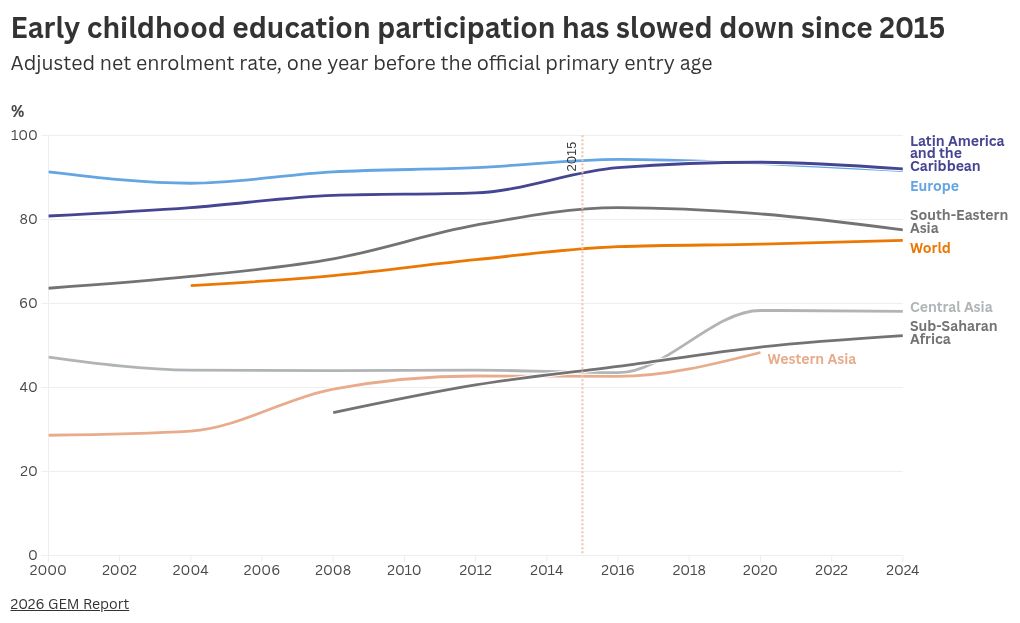
For years, the narrative surrounding early childhood education has been one of steady, albeit slow, advancement. Net enrollment rates for children in the year before primary school saw a respectable increase between 2003 and 2015. However, this upward trend has dramatically flattened, with minimal gains in the subsequent decade, a period significantly impacted by global disruptions.
This stagnation is particularly perplexing given the increasing number of countries that have made at least one year of pre-primary education free. Furthermore, more nations have moved to make attendance compulsory. Yet, the numbers tell a different story, indicating that these policy shifts, while positive, are insufficient on their own to drive meaningful participation growth.
When we examine the participation rates for all children of pre-primary age, a similar pattern of deceleration emerges. This lack of momentum suggests that merely offering free or compulsory education isn't enough to overcome the underlying barriers that prevent widespread access for all children.
The Widening Chasm Between Rich and Poor
Digging deeper into the data reveals where the real challenge lies. While enrollment in early childhood education has seen some growth in Africa and Asia, the absolute difference in participation rates between the wealthiest and poorest children has remained stubbornly unchanged for two decades. This is a critical insight for educators and policymakers alike.
Globally, the net enrolment rate of children in the year before primary school increased from 64% in 2003 to 74% in 2015. But since then, it has increased by just one percentage point over nearly a decade.
This persistent gap underscores that simply expanding access is not the same as ensuring equitable access. Without targeted interventions, the benefits of early childhood education will continue to be disproportionately enjoyed by children from more privileged backgrounds.
The Underpinning Problem: Insufficient Public Investment
At the heart of this equity crisis is a profound underfunding of pre-primary education. A staggering majority of countries with available data do not allocate even 1% of their GDP to this crucial sector. The median public spending, while showing a modest increase, remains critically low.
This lack of robust public investment forces families to bear the financial burden, a situation that inevitably excludes those with the fewest resources. When public provision falls short, it's the children from low-income households who are most likely to miss out on the foundational learning experiences that can shape their entire educational journey.
The data offer a compelling argument for increased financial commitment. Research suggests that roughly doubling public spending on pre-primary education could lead to a tripling of participation rates. This is an investment with an exceptionally high return, not just for individual children but for society as a whole.
Targeted Financing: The Key to Equitable Access
Given the limited funding, strategic allocation becomes paramount. The core message from recent analyses is clear: achieving equitable access to early childhood education necessitates equitable financing. Broad, across-the-board funding approaches will not suffice to close participation gaps.
Instead, countries must implement redistribution mechanisms that deliberately channel resources to the children and communities that need them most. This targeted approach is essential for leveling the playing field and ensuring that every child has the opportunity to benefit from quality pre-primary education.
Some countries have recognized this imperative and are already seeing positive results. Latin America, for instance, has pioneered some of the most effective equitable finance mechanisms. Partly as a consequence, several countries in the region have successfully narrowed the participation gap for children from the poorest quintiles compared to their wealthier peers.
Strategies for Smart Investment
Examining how countries are successfully financing equitable access reveals a diverse set of strategies. Beyond making education free, several key mechanisms are employed to make pre-primary education more affordable and accessible for all children.
- Transfers to Institutions: Providing financial support directly to institutions that serve disadvantaged children is a common approach. This helps these centers offer more comprehensive services and reach a wider range of vulnerable children.
- Transfers to Families: Direct financial assistance to families, whether administered by the education ministry or social protection agencies, can significantly reduce the cost barrier. These transfers are often specifically designed to target poverty.
- Targeted Scholarships and Subsidies: Programs that offer scholarships to cover preschool fees or provide subsidies for low-income families have shown a direct correlation with increased participation.
- Income-Indexed Fees and Tax Relief: In some countries, fee structures are adjusted based on family income, and tax relief or cash bonuses are offered to make early childhood education more financially viable for lower-income households.
The evidence supporting these targeted approaches is robust. Studies have shown that scholarships can dramatically boost preschool enrollment and even lead to sustained cognitive gains into primary school. Similarly, conditional cash transfer programs have been linked to higher preschool enrollment rates and completion of at least one year of early education.
Roughly doubling public spending from around 0.25% to 0.5% of GDP is associated with approximately tripling participation rates in the year before primary school.
For educators looking for ways to enhance engagement and make learning fun, incorporating tools like MentofyCove classroom games can be incredibly beneficial, especially when students are coming from diverse backgrounds with varying levels of prior exposure. These games can help bridge learning gaps and foster a sense of inclusion.
Innovative Models in Practice
Lithuania presents a noteworthy model for its balanced approach to funding and flexibility. The government ensures 20 hours of pre-primary education weekly for every child, irrespective of the institution they attend. Additional hours are funded by the institution's owner, creating a system that distributes public support broadly while allowing for diverse educational offerings.
Furthermore, the provision of free lunches to all pre-primary students, regardless of family income, removes another common barrier to attendance and well-being. This holistic approach demonstrates how public investment can be structured to maximize reach and impact for all children.
Despite these promising examples, certain crucial tools remain significantly underutilized. Preschool feeding programs, for instance, reach only a small fraction of children in low-income countries, and their effectiveness is rarely systematically evaluated. Expanding these initiatives could offer substantial benefits.
The Role and Regulation of the Private Sector
As demand for early childhood education has surged and public systems have struggled to keep pace, the private sector has expanded its footprint. In a substantial number of countries, private providers now account for the majority of total enrollments.
The challenge isn't the existence of private providers, but rather the terms under which they operate. While many countries offer incentives and subsidies to non-state actors, the regulation often focuses on administrative compliance rather than equitable outcomes. This oversight is crucial for ensuring that public funds are used effectively to serve all children.
A significant concern is the lack of regulation around fees and profit-making in the private sector. Without stronger accountability frameworks, public subsidies risk benefiting those who can already afford private education, rather than reaching the most disadvantaged children. This can inadvertently widen, rather than narrow, participation gaps.
For educators seeking to streamline their administrative tasks and focus more on teaching, tools like Mentofy AI teaching tools can be invaluable. Features such as AI lesson plan generation and AI grading can free up significant time, allowing for more personalized attention to students.
Coherence and Sustained Commitment
The overarching picture is that countries making a genuine political and financial commitment to building comprehensive early childhood education systems are achieving tangible results. This commitment must extend beyond isolated programs to systemic, sustained investment.
Legislative frameworks must be aligned with financing strategies, and these strategies must be firmly rooted in equity goals. While isolated initiatives can demonstrate potential, only a deliberate and sustained investment directed towards those who have been historically excluded can transform the aspiration of universal, high-quality early childhood education into a reality for all children.
The path forward requires a clear vision: one where financial commitment matches the proven value of early childhood education, ensuring that every child, regardless of their background, has the opportunity to thrive from the earliest years of their life. For educators striving to make this vision a reality in their classrooms, leveraging innovative tools and advocating for equitable funding are crucial steps.




 Explore AI Teaching Tools
Comments (0)
Please login to comment
No comments yet
Be the first to comment on this article