
In a landscape often dominated by concerns over learning loss, a new report offers a beacon of hope: Tennessee students are nearing pre-pandemic achievement levels in math, with significant gains also seen in reading. This remarkable turnaround, detailed in a comprehensive education scorecard, has profound implications for educators nationwide, suggesting that targeted interventions and high-quality instructional materials can indeed steer students back toward academic recovery.
Tennessee's Strategic Pivot to Academic Recovery
The Sunshine State's educational journey back from the brink of pandemic-induced learning disruptions is a testament to strategic planning and substantial investment. Following the passage of the Tennessee Literacy Success Act in 2021 and the rollout of new math curricula two years later, the state embarked on a comprehensive overhaul of its core subjects.
This dual-pronged approach, backed by over $130 million in state and federal funding, underscores a commitment to not just recovering lost ground but actively building a stronger educational foundation for its students. The work, officials emphasize, is far from over, but the initial results are undeniably promising.
The Pillars of Tennessee's Success
State education leaders attribute the impressive gains to a confluence of factors, all designed to support both students and educators. High-quality instructional materials provide a consistent and effective framework for learning, while ongoing professional development ensures teachers are equipped to implement new strategies.
Crucially, robust summer math programs and high-dosage tutoring have been instrumental in providing students with the intensive, individualized support they need to catch up and excel. These programs are not merely supplementary; they are integrated components of the state's recovery strategy.
High-Dosage Tutoring: A Game Changer
A cornerstone of Tennessee's strategy is its specific requirement for high-dosage tutoring. This intervention mandates a minimum of two to three sessions per week, each lasting 30-45 minutes, delivered by certified teachers or trained tutors in groups of no more than three students.
This intensive, small-group approach ensures that students receive focused attention on their specific needs, a stark contrast to more generalized support. As Kristy Brown, chief academic officer at the state Department of Education, explained, "Tennessee implemented specific high-dosage tutoring requirements which include a minimum of two to three sessions per week for 30-45 minutes delivered by a certified teacher or trained tutor in groups no larger than three students for the entire school year."
"Tennessee implemented specific high-dosage tutoring requirements which include a minimum of two to three sessions per week for 30-45 minutes delivered by a certified teacher or trained tutor in groups no larger than three students for the entire school year."
A National Snapshot of Recovery
The Education Scorecard report, which analyzed both state-level tests and national assessments like the National Assessment of Educational Progress (NAEP) for grades three through eight, paints a national picture of recovery, albeit with varying degrees of success.
While Washington, D.C., led the nation in math gains, followed closely by Tennessee, Louisiana, Delaware, and Maryland, the overall findings were a stark reminder of the lingering effects of the "learning recession" that began in 2013. This trend, the report notes, has coincided with increased social media use among children and a decline in school accountability measures.
The report's findings highlight that the U.S. has been in a prolonged period of academic stagnation, making Tennessee's progress all the more significant. It serves as a powerful case study for other states grappling with similar challenges.
Decoding Tennessee's Math Proficiency Surge
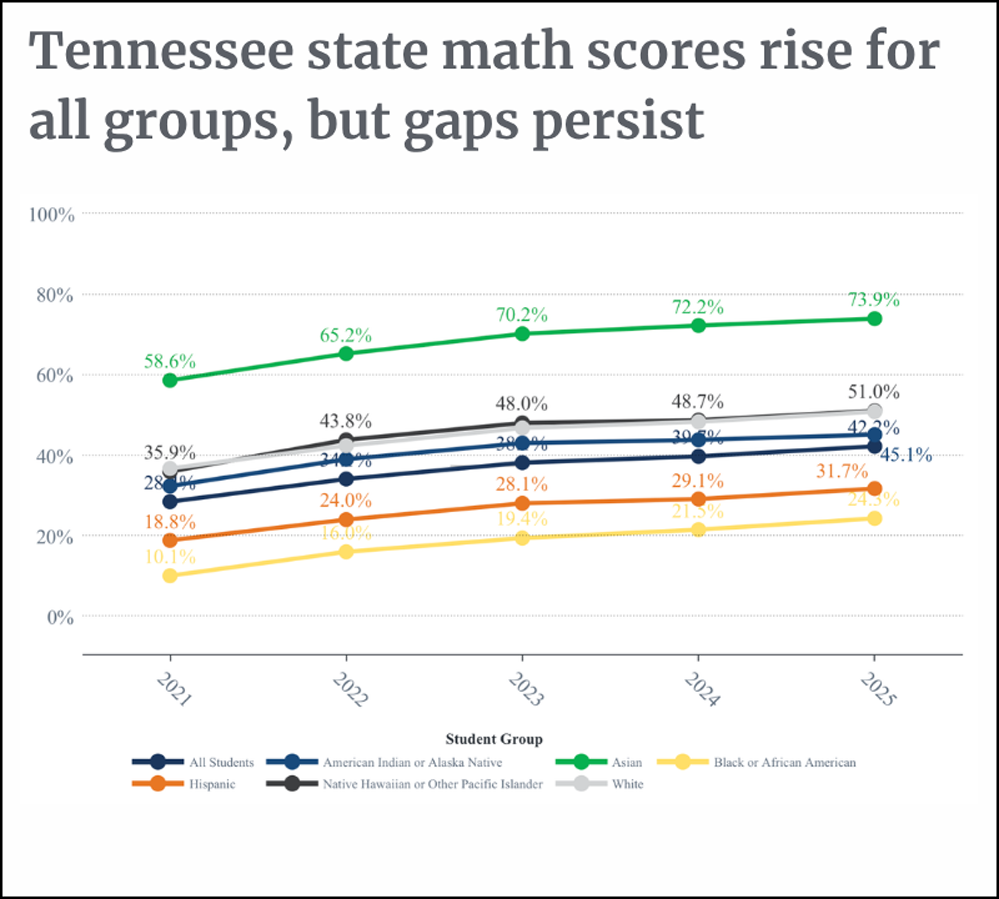
Between 2021 and 2025, Tennessee saw a dramatic improvement in math proficiency rates for grades three through eight on state assessments, climbing from 28% to an impressive 42%. This nearly 14-percentage-point increase demonstrates the tangible impact of the state's focused educational initiatives.
This surge in math achievement is a direct result of the state's commitment to evidence-based practices and strategic resource allocation. The investment in curriculum, professional development, and targeted interventions appears to be yielding significant returns.
Persistent Gaps Despite Progress
Despite the overall positive trend, the report also shines a light on persistent achievement gaps among historically underserved students. While nearly 51% of white children met the math proficiency benchmark last year, the figures for other demographic groups remain considerably lower.
Specifically, only 24% of Black students, 32% of Hispanic students, 26% of English learners, and 24% of economically disadvantaged children achieved proficiency. These disparities underscore the ongoing need for equitable resource distribution and culturally responsive teaching practices across all districts.
The report's overall findings were bleak. It concluded the U.S. has been in a “learning recession” since 2013, a trend that has run alongside kids’ skyrocketing use of social media and the decline of school accountability measures.
Lessons Learned from Literacy to Math
Christy Wall, the state’s assistant commissioner of academics and instructional strategy, emphasized that Tennessee learned valuable lessons from the successful implementation of its literacy initiative, applying those winning strategies to mathematics.
A key takeaway was the importance of involving school leaders and staff in the planning process, ensuring they felt supported and prepared for the changes. This collaborative approach helped to mitigate resistance and foster a sense of shared ownership over the new curricula.
The state also prioritized a predictable cadence of tools and resources, ensuring that educators weren't overwhelmed by constant shifts. This measured approach allowed for deeper adoption and more effective implementation of the new math standards.
Identifying "On the Rise" Districts
The scorecard analyzed data from roughly 10,000 school districts nationwide, identifying 450 that showed improvement in either math or reading, and a notable 108 labeled "on the rise" for gains in both subjects.
These "on the rise" districts, defined as those serving over 1,200 students in grades three to eight with at least four peer districts in their state, and demonstrating an achievement increase of at least 0.3 grade levels in reading and math from 2019–2025, represent pockets of exceptional progress.
Within Tennessee, districts like Johnson City, Putnam County, White County, and Maury County were recognized in this elite category, showcasing the effectiveness of localized implementation strategies aligned with state goals. These districts serve as models for others striving for similar academic recovery.
The Role of COVID-Era Funding and Beyond
Much of Tennessee's recovery efforts were initially supported by COVID-era federal relief funds, with the state receiving approximately $3.86 billion in aid for K–12 schools. While this funding has since dried up, the state has demonstrated a commitment to sustaining successful programs.
This includes continuing support for summer learning and high-dosage tutoring in both English and math, proving that the state is invested in long-term academic success beyond the availability of emergency funds. This sustained commitment is crucial for embedding these effective practices into the educational fabric.
Mandatory Tutoring for Retained Students
State regulations in Tennessee now mandate tutoring for students who have been retained in kindergarten through second grade. Furthermore, students who do not score proficient on the third-grade reading assessment are also provided with targeted tutoring support.
This proactive approach ensures that students facing academic challenges receive immediate and intensive interventions, preventing further academic slippage and providing a clear pathway toward grade-level proficiency. This is a critical step in closing achievement gaps early.
The Impact of Swift Reopening
Chelsea Crawford, executive director of TennesseeCAN, an advocacy organization focused on educational equity, credits another significant factor for the state's success: a swift return to in-person learning.
The vast majority of Tennessee districts reopened their doors by the fall of 2020, allowing students to resume direct instruction and in-person collaboration much sooner than in many other states. This early return minimized the prolonged disruption of remote learning.
"Not all of our districts opened on that timeline, but the vast majority of them did," Crawford stated, highlighting the state's collective effort to prioritize in-person education.
Incentivizing Educational Investment
Beyond state mandates, Tennessee also implemented financial incentives to encourage districts to invest strategically in their students' academic needs. A recognition program required districts to submit plans for spending COVID-era funds, with a focus on dedicating at least 50% to student academic needs.
Districts that demonstrated a strong commitment to addressing areas where students needed the most help received additional funding from a state agency's set-aside pool. This created a powerful incentive for districts to align their spending with evidence-based interventions.
This approach not only ensured that funds were used effectively but also fostered a culture of innovation and accountability within districts, driving them to proactively seek solutions for academic challenges.
Understanding the National Economic Divide in Achievement
The report also highlighted a trend in national achievement data, noting larger gains among the highest-income and lowest-income school districts. Conversely, middle-income districts, defined as those where 30% to 70% of students receive federally subsidized lunches, saw the least improvement on average.
This finding suggests that both well-resourced and highly supported communities, as well as those with the most significant needs and targeted interventions, may be more agile in their recovery efforts. It raises questions about the support structures available to middle-income districts.
The data for this analysis was drawn from the Stanford Education Data Archive, produced by The Educational Opportunity Project at Stanford University, underscoring the rigor of the research.
The Pre-Recession Academic Landscape
It's important to remember that the current "learning recession" did not emerge in a vacuum. Before this period, between 1990 and 2013, U.S. students saw significant academic gains.
Math achievement in grades four and eight improved by more than two grade equivalents during that time. Fourth graders in 2013 were performing at a level comparable to sixth graders in 1990, indicating a period of sustained academic growth prior to the recent challenges.
This historical context is vital for understanding that academic decline is not an inevitable outcome, and periods of robust improvement are achievable with the right strategies and sustained commitment.
Tennessee's journey offers a compelling blueprint for educators and policymakers. By focusing on high-quality instruction, targeted interventions like high-dosage tutoring, and strategic investment, states can indeed navigate the complexities of academic recovery and foster a brighter future for all students. For tools that can support educators in implementing such targeted strategies, exploring resources like Mentofy AI teaching tools and engaging MentofyCove classroom games can be invaluable.






 Explore AI Teaching Tools
Comments (0)
Please login to comment
No comments yet
Be the first to comment on this article