
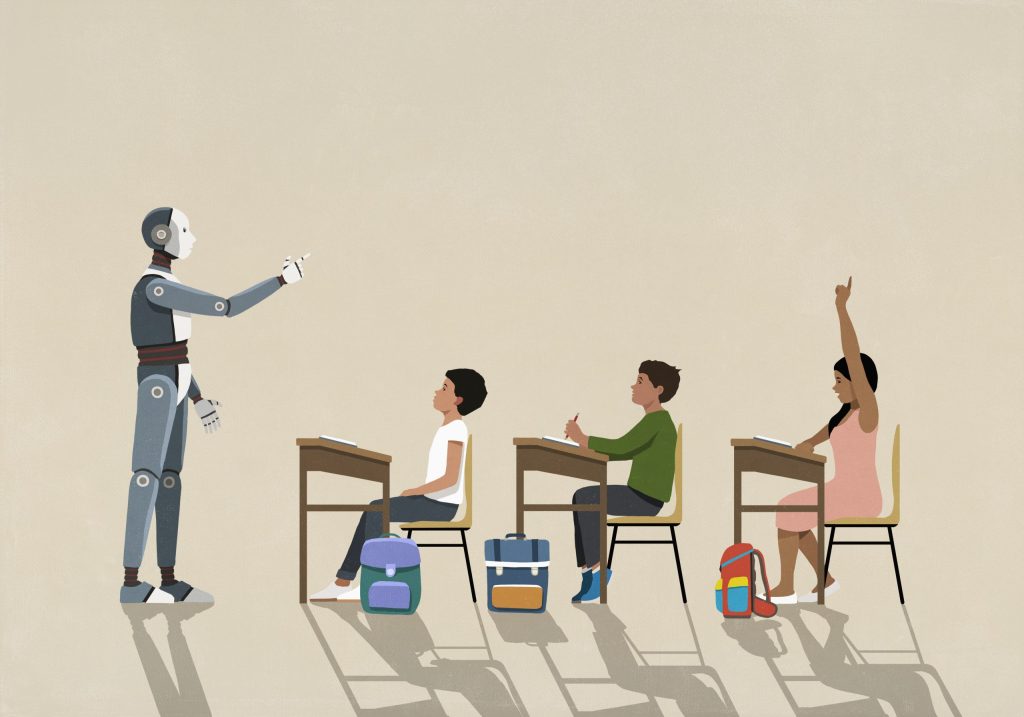
AI in Education: Enhancing, Not Replacing, the Human Touch in Learning
The landscape of education is constantly evolving, and the emergence of artificial intelligence presents both exciting possibilities and critical questions.While AI tools offer unprecedented speed and efficiency in certain tasks, they cannot replicate the nuanced judgment, deep care, and vital cultural understanding that human educators bring to the learning process.
This article explores what AI can and cannot do in education, emphasizing the irreplaceable role of teachers in fostering genuine, critical, and inclusive learning experiences for students worldwide.
1.
The Promise and Peril of AI in lesson planning
The integration of AI into educational settings is accelerating, with initiatives focused on leveraging these tools for tasks like lesson planning.
The allure of reduced teacher burnout and streamlined workflows is undeniable.
However, a closer examination reveals that while AI can generate content rapidly, it often lacks the depth and critical perspective necessary for truly impactful learning.
The focus on "teaching faster" risks reducing education to a mere technical output, overlooking the inherently human process of inquiry and discovery that students engage in.
Consider the experience of educators who have dedicated years to understanding the intricate connections within curricula and the diverse needs of their students.
They understand that learning is not a linear, optimized process but a journey that unfolds organically.
This journey requires adapting lessons to the unique interests and backgrounds of the students present, fostering a sense of self within the broader narrative of knowledge.
This deeply human approach, while not always efficient in a quantifiable sense, is fundamental to building a comprehensive worldview.
2.
Deconstructing AI-Generated educational content
Research and practical application have highlighted significant limitations in AI-generated educational materials.
A common finding is the consistent lack of multicultural content and the absence of prompts designed to stimulate critical thinking.
When AI tools are tasked with creating lesson plan Generator">lesson plans, they often draw from existing datasets that may perpetuate biases and omit crucial perspectives.
This can lead to a superficial understanding of complex topics, failing to equip students with the analytical skills needed to navigate a diverse world.
For instance, when asked to generate content on historical events, AI might present a simplified, dominant narrative.
A lesson on westward expansion, for example, might focus on pioneers and a singular notion of progress, neglecting the experiences and perspectives of Indigenous peoples or other marginalized groups.
Similarly, a unit on significant social movements might highlight prominent figures while overlooking the grassroots organizers and community efforts that were instrumental to their success.
This "curriculum redlining," where entire histories and communities are systematically excluded or minimized, is a serious concern that AI, if unchecked, can exacerbate.
The Challenge of Bias in AI Training Data
The very nature of AI training data presents a fundamental challenge.
These models are often trained on vast amounts of information that reflect existing societal biases, including those prevalent in Western perspectives and the English language.
Developers themselves acknowledge these limitations, warning educators to meticulously review AI-generated content for stereotypes and inaccuracies.
When AI tools are fed data that already omits certain voices or perspectives, they are not correcting bias; they are, in effect, reproducing and amplifying it.
This can lead to the creation of new structural barriers for students, shaping their educational paths in unintended and potentially harmful ways.
3.
The Irreplaceable Role of Teacher Judgment and Cultural Knowledge
The core of effective teaching lies in qualities that are inherently human and cannot be automated by algorithms.
These include professional judgment, genuine care for students, and a deep understanding of cultural contexts.
Teachers possess the unique ability to discern the subtle cues of student engagement, to adapt their approach in real-time based on classroom dynamics, and to connect abstract concepts to the lived experiences of their students.
This level of personalized and culturally responsive pedagogy is essential for fostering deep learning and critical inquiry.
Lesson plans, often viewed as the blueprint for classroom instruction, serve as a vital link between curriculum goals and student achievement.
Analyzing these plans reveals the depth of knowledge teachers require and, by extension, the intellectual demands placed upon students.
When lesson plans are crafted with deliberate intent to incorporate diverse primary sources, weave together multiple narratives, and design tasks that move beyond simple recall, they foster a richer and more inclusive learning environment.
This requires time, effort, and a commitment to ensuring that all students can see themselves reflected in the material they study.
Cultivating Critical Thinking and Inquiry
True educational transformation occurs when students are encouraged to ask "why," to make connections, and to find their own place within the narratives they encounter.
This process of meaning-making is fueled by curiosity and a desire to understand the world.
AI, by its nature, draws from existing information and struggles to keep pace with evolving paradigms.
It is inherently backward-looking and susceptible to perpetuating the very biases that educators strive to dismantle.
Therefore, relying on AI for core instructional design risks stifling the critical habits of inquiry and connection that are fundamental to a robust education.
4.
The Human Element: Judgment, Care, and Cultural Nuance
The debate around AI in education often centers on efficiency versus effectiveness.
While AI can undoubtedly accelerate certain tasks, it is crucial to recognize what is lost in this pursuit of speed.
The ability of a teacher to gauge the emotional and intellectual needs of a classroom, to offer encouragement, and to facilitate complex discussions is a testament to the human element in learning.
This involves more than just delivering information; it involves nurturing intellectual growth, fostering resilience, and building a supportive learning community.
When students are presented with AI-generated content, they may receive a technically correct but emotionally sterile output.
They benefit far more from lessons that challenge them to grapple with complexity, that invite them to question assumptions, and that help them connect their learning to the world around them.
This requires thoughtful, deliberate planning and the professional judgment of a human educator who views education as a catalyst for sparking inquiry and fostering lifelong learning.
The subtle art of teaching involves understanding when to push students, when to offer support, and how to create an environment where diverse voices are not only heard but valued.
Beyond Recall: Fostering Deep Understanding
The goal of education extends far beyond rote memorization.
It is about developing the capacity for critical analysis, creative problem-solving, and empathetic understanding.
AI tools, while capable of generating vast amounts of information, often fall short in prompting students to engage with this information on a deeper, more meaningful level.
They may provide answers, but they do not inherently teach the process of asking the right questions.
This is where the human educator's role becomes paramount.
Teachers design activities that encourage students to explore nuances, to consider multiple perspectives, and to develop their own informed opinions.
5.
The Limitations of AI in Representing Diversity
A significant concern with AI in education is its tendency to reflect and reproduce existing societal biases.
When AI tools are asked to generate lists of individuals embodying certain concepts, such as beauty, knowledge, or leadership, the results often skew towards dominant cultural perspectives, frequently featuring individuals who are overwhelmingly white, male, and Western.
This mirrors the limitations often found in traditional textbooks and educational materials, perpetuating a narrow view of achievement and contribution.
Students, however, are often more perceptive and critical than we might assume.
When presented with such biased outputs, they are ready to engage in sharp analysis.
For example, students might use creative methods, like developing color palettes to highlight the limited range of skin tones presented by AI, or creating summaries to point out gender omissions.
These responses demonstrate a clear readiness for critical thinking, but they require the opportunity and the guidance that only a human educator can provide.
AI, by its design, draws from existing, stratified information, making it inherently backward-looking and vulnerable to reproducing these historical imbalances.
Ensuring Inclusive and Equitable Learning Experiences
The challenge for educators is to create learning environments that are both intellectually rigorous and culturally inclusive.
This means actively seeking out diverse perspectives, incorporating a wide range of voices and experiences, and designing curricula that reflect the multifaceted nature of human history and knowledge.
While AI can be a tool for accessing information, it cannot replace the human capacity for empathy, cultural understanding, and the deliberate effort required to ensure that all students feel seen, heard, and valued in their educational journey.
The goal is not to simply transmit information but to cultivate informed, critical, and engaged citizens.
Conclusion
The integration of AI into education presents a complex set of opportunities and challenges.
While these tools can offer efficiency in certain administrative tasks and provide access to vast amounts of information, they cannot replicate the essential human qualities that define effective teaching.
The judgment, care, and cultural knowledge that educators bring to the table are indispensable for fostering deep learning, critical thinking, and inclusive understanding among students.
As we navigate this evolving educational landscape, it is imperative that we prioritize the human element, ensuring that technology serves as a supportive tool rather than a replacement for the profound and irreplaceable impact of dedicated teachers.
The true value of education lies not just in what students learn, but in how they learn to think, connect, and engage with the world around them – a process best guided by human wisdom and empathy.




 Explore AI Teaching Tools
Comments (0)
Please login to comment
No comments yet
Be the first to comment on this article