
A striking 70% net favorability rating among California Democrats towards teachers unions, as reported by a recent PPIC survey, underscores a profound shift in political alignment. This isn't just about collective bargaining; it's about how the Democratic party, and its voters, now perceive organized labor in education. For educators, this evolving landscape presents both challenges and opportunities, demanding a nuanced understanding of the political currents shaping their profession.
Democrats Have Found a New Ally in Teachers Unions
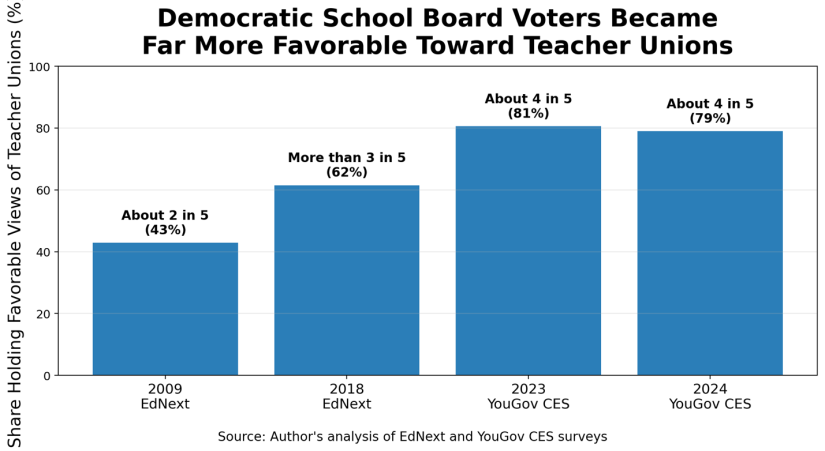
The historical narrative of the Democratic party often involved a delicate balancing act between advocating for student outcomes and supporting organized labor. However, recent data reveals a significant departure from this equilibrium. Democratic voters have demonstrated a dramatic increase in their support for teachers unions, particularly in the wake of the pandemic.
This surge in favorability means that traditional reform agendas, once championed by Democrats, now face a more complex political calculus. The party's base is increasingly aligned with the interests of teachers unions, creating a powerful bloc that cannot be easily dismissed.
"Democratic support for teachers unions rose steadily during the first Trump administration before accelerating sharply after the pandemic."
Understanding this shift is crucial for educators. It suggests that the political leverage of teachers unions within the Democratic party is at an all-time high. This could translate into greater advocacy for policies that directly benefit teachers, but it also raises questions about the party's ability to pursue broader educational reforms that might be met with union resistance.
The Shifting Sands of Voter Sentiment
For decades, Republican attitudes toward teachers unions have remained remarkably stable, consistently registering negative favorability. The real story of change, however, lies within the Democratic party's evolving stance. What was once a more ambivalent relationship has transformed into strong, unwavering support.
This transformation is not a recent phenomenon. Democratic favorability began a steady climb during the Trump administration, but it was the pandemic that truly ignited an exponential rise. By 2023, net favorability had soared to over +60, indicating a deep and widespread endorsement among Democratic voters.
This makes it increasingly difficult for Democrats to champion accountability measures that might be perceived as adversarial to union interests. The political capital required to push for such reforms is now significantly higher, given the party's strong ties to organized teachers.
Beyond the Classroom: Unions as Progressive Standard-Bearers
Teachers unions have strategically expanded their political agenda beyond traditional workplace concerns. They are increasingly seen by Democratic voters not just as advocates for teachers, but as vital components of the broader progressive movement.
From advocating for immigration reform and racial justice to mobilizing against political figures, unions have woven themselves into the fabric of the Democratic party's progressive coalition. This expanded role has resonated deeply with Democratic voters, solidifying their support.
Consider the social media activity of a major teachers union affiliate. A significant portion of their posts focus on national political issues like immigration and opposition to Donald Trump, rather than solely on student academic achievement. This demonstrates a clear alignment with the broader progressive agenda that appeals to the party's base.
The Impact on Educational Policy Debates
This integration of unions into the progressive movement has profound implications for education policy. When teachers unions champion issues beyond their immediate professional concerns, they gain broader political traction and support from a wider array of Democratic voters.
This can create a powerful synergy, where the concerns of teachers are amplified by a larger progressive base. However, it also means that debates about educational reform are now framed within a more ideologically charged context, potentially overshadowing discussions about student outcomes.
For educators looking to leverage this political alignment, it means understanding that their unions are often seen as champions of a larger set of progressive values. This can be an advantage when advocating for resources and policies that benefit the teaching profession and, by extension, students.
The Politically Engaged Educator and Union Support
The data reveals a compelling correlation: Democrats who are most actively engaged in education politics are also the most supportive of teachers unions. This suggests a self-reinforcing cycle where active participation in school board elections, for example, amplifies pro-union sentiment.
Voters who participate in these often low-turnout elections show a marked increase in their favorable views of teachers unions over time. This trend is particularly pronounced among Democrats, indicating that those most invested in the education system are also most aligned with its organized labor.
This is a critical insight for educators. It highlights that those who are most vocal and active in local education politics are likely to be strong allies of teachers unions. This can be a powerful force for advocating for improved working conditions and resources within schools.
A Growing Divide in Reformist Circles
This increasing alignment between Democratic voters and teachers unions presents a significant challenge for Democrats who advocate for a more traditional, accountability-focused reform agenda. The party's base now sees unions as integral to the progressive cause, making it difficult to pursue reforms that might be viewed as critical of union power.
The days when Democrats could easily champion school choice or performance-based evaluations without alienating a significant portion of their base are likely over. The political landscape has fundamentally shifted, requiring a new approach to education policy within the party.
For educators, this means that the conversation about education reform is likely to be heavily influenced by the strong support for teachers unions within the Democratic party. This can be an opportunity to advocate for policies that strengthen the profession, but it also necessitates a careful consideration of how these reforms are framed to resonate with the broader progressive agenda.
Geographic Strongholds of Pro-Union Sentiment
The political alignment between Democratic voters and teachers unions is not uniform across the country. It appears to be strongest in deeply liberal areas, precisely where Democratic education policy is most likely to be shaped.
In states and cities with a strong Democratic presence, support for teachers unions among party voters is exceptionally high. This concentration of pro-union sentiment can create powerful political blocs that significantly influence local and state education policy.
This phenomenon is particularly relevant for educators in these areas. It suggests that their voices, amplified by union advocacy, can have a substantial impact on the direction of education policy. Understanding these regional dynamics is key to effective advocacy.
The Virginia Exception and the "Consumer vs. Producer" Dynamic
While the trend towards strong Democratic support for unions is clear, there are occasional exceptions that highlight the complexities of education politics. The recent veto of a collective bargaining bill by a Democratic governor in Virginia, despite union backing, serves as a notable instance.
Historically, education politics have sometimes been framed as a "consumer versus producer" conflict, with parents and students on one side and school systems and unions on the other. However, the current political climate has increasingly polarized these issues along partisan lines.
This suggests that while partisan alignment is a dominant factor, other dynamics can still influence policy decisions. For educators, it's a reminder that while union support is a powerful force, navigating the broader political landscape requires understanding these nuanced exceptions.
A New Era of Democratic-Union Symbiosis
The traditional framing of education politics as a simple "red versus blue" divide is insufficient. The data indicates a more asymmetric shift, with Republican attitudes remaining relatively stable while Democratic support for teachers unions has surged dramatically.
This isn't merely about unions being caught in partisan crossfire; it's about their deeper integration into the institutional identity of the Democratic Party itself. They are no longer just stakeholders; they are increasingly seen as integral to the party's core values and mission.
This symbiotic relationship means that policies and initiatives that benefit teachers unions are likely to find strong backing within the Democratic party. For educators, this presents a significant opportunity to advocate for their profession with a powerful political ally.
The Challenge of Reconciling "Abundance" with Producer Interests
This close alignment between the Democratic Party and producer interests, particularly in the public sector like education, creates a significant tension. Some commentators argue that Democrats struggle to balance an "abundance" politics—focused on building and institutional effectiveness—with the demands of organized labor.
In education, this tension manifests as a potential conflict between the desire for broad-based reforms that enhance student learning and the need to maintain strong relationships with powerful teachers unions. The party's base, now so supportive of unions, makes it politically challenging to prioritize reforms that might be perceived as challenging union prerogatives.
For educators, this dynamic underscores the importance of framing their needs and aspirations in ways that align with both the progressive agenda and the interests of the broader student population. Tools like Mentofy AI teaching tools can help educators create engaging lessons and assessments, demonstrating their commitment to student success while also supporting their professional growth.
The Obama-Era Balancing Act: A Fading Memory?
During the Obama administration, Democrats could more plausibly balance support for organized labor with a reform agenda focused on accountability and school performance. This era represented a period where the party could seemingly have it both ways.
Today, however, that balancing act appears far more precarious. Teachers unions are no longer just one voice among many within the Democratic coalition; they have become, for many Democrats, symbolic defenders of the progressive project itself.
This shift means that the political landscape for education reform has fundamentally changed. The strategies and approaches that worked in the past may no longer be effective in the current environment. Educators need to be aware of this evolving political reality when advocating for change.
Embracing the Opportunity: A Forward Look for Educators
The strong political alignment between Democratic voters and teachers unions presents a unique moment for the education sector. While it complicates traditional reform narratives, it also offers a powerful platform for advocating for the profession.
Educators can leverage this support to push for better resources, improved working conditions, and greater professional autonomy. Understanding the political currents at play is the first step in effectively navigating this landscape.
The future of education policy will undoubtedly be shaped by this evolving relationship. By staying informed and engaged, educators can ensure that their voices and needs are central to the ongoing conversation. Whether it's through innovative teaching strategies, utilizing tools like MentofyCove classroom games for engagement, or advocating for systemic change, educators are at the forefront of shaping the future of learning.
The current political climate, with its strong Democratic support for teachers unions, offers a compelling opportunity for educators. By understanding this dynamic and harnessing its potential, teachers can work towards a more supportive and effective educational environment for all. And for those looking to enhance classroom engagement and streamline their teaching workflow, Mentofy is free for teachers, providing valuable resources to get started.





 Explore AI Teaching Tools
Comments (0)
Please login to comment
No comments yet
Be the first to comment on this article