
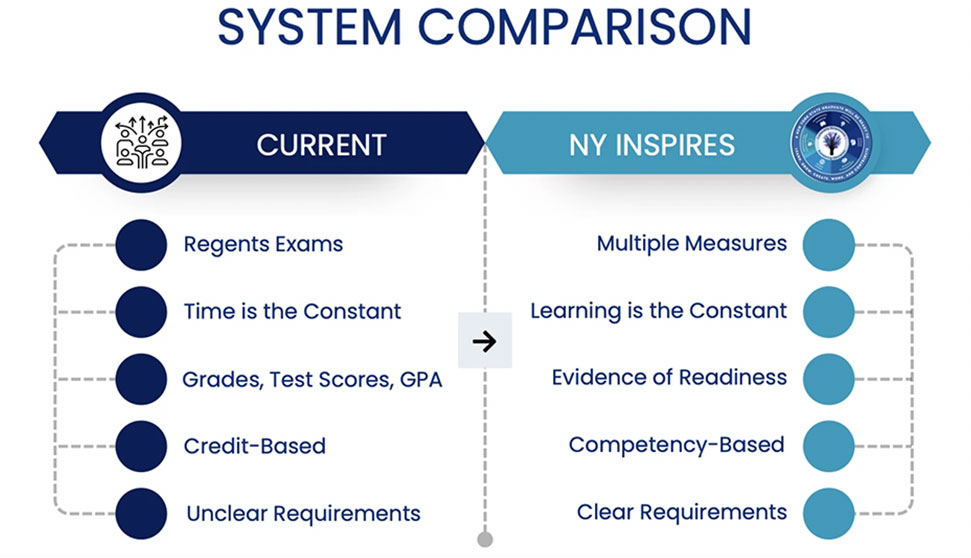
New York's education landscape is on the cusp of a seismic shift. State education officials have unveiled plans for a new high school diploma, one that moves beyond the traditional credit-based system to a model emphasizing demonstrated skills and knowledge. This ambitious overhaul, part of the "New York Inspires" initiative by the State Education Department, aims to equip students with the competencies needed for modern careers and higher education, potentially redefining what it means to graduate high school in the Empire State.
Graduation Requirements Are Set for a Radical Rethink
For generations, New York's high school graduation has been largely dictated by seat time and performance on standardized Regents exams. This proposed competency-based model seeks to dismantle that structure, recognizing that learning isn't confined to classroom walls or measured solely by a single test score.
The current framework offers three diploma types: a standard Regents diploma, an advanced Regents diploma with additional testing, and a local diploma with alternative testing pathways. This new direction promises a more flexible and personalized approach to demonstrating mastery.
"The big idea is that New York is moving away from an outdated factory-style education model toward a model system built for how students actually learn."
This signals a fundamental departure from the factory-model approach, prioritizing genuine understanding and application over rote memorization and time spent in a seat. Educators across the state will need to adapt their teaching strategies and assessment methods to align with this new philosophy.
What Exactly is Competency-Based Education?
At its core, competency-based education (CBE) means students progress by proving they've mastered specific skills and knowledge, rather than simply accumulating credits based on course duration. This allows for a more individualized learning journey, catering to diverse learning paces and styles.
Students will still engage in traditional coursework, but their path to graduation will be broadened. They can leverage experiences like internships, capstone projects, community service, and career and technical education programs to demonstrate their acquired competencies.
Instead of relying on a singular, high-stakes exam, students will have multiple avenues to showcase their learning in each subject. This could include presentations, portfolios, project-based assessments, and other authentic demonstrations of understanding.
Shifting the Focus from Time to Mastery
The State Education Department envisions a system where the "quality and substance of the evidence that a student produces" becomes paramount. This marks a significant departure from a system that has historically valued the process (time spent) over the product (demonstrated learning).
This shift necessitates a re-evaluation of how we define and measure academic success. It challenges educators to think creatively about how students can authentically prove their knowledge and skills.
The Future Transcript: A Dynamic Learner Profile
Current high school transcripts, often a simple list of courses and grades, are seen by the department as inadequate in reflecting a student's true capabilities. The proposed "universal transcript or learner profile" aims to provide a richer, more comprehensive picture of a graduate's achievements.
This new transcript will be designed to align with state learning standards and the six attributes outlined in the state's "Portrait of a Graduate" blueprint. It will serve as a dynamic record of a student's journey and accomplishments.
While the exact format is still under development, the intention is clear: to create a document that truly communicates what a student knows and can do, beyond just a GPA. This could significantly benefit students as they transition to higher education or the workforce.
Implications for College Admissions
The move toward competency-based diplomas is unlikely to hinder college applications. In fact, many higher education institutions are increasingly adopting more holistic admissions practices that value a broader range of student achievements.
The department is actively collaborating with colleges and universities across New York to ensure they understand and trust the value of this new diploma. This proactive approach aims to ease the transition for students applying to post-secondary programs.
A 2024 survey of 1,200 K–12 educators indicated that 78% believe a competency-based approach would better prepare students for post-secondary success, but 65% expressed concerns about the resources and training required for implementation.
This statistic highlights a key challenge: ensuring educators are adequately supported through this transition. Professional development and access to innovative tools will be crucial for successful implementation.
Navigating the Transition: What It Means for Students
The implementation timeline for these changes is phased, ensuring a gradual shift rather than an abrupt overhaul. Students who began ninth grade in 2023 will be the last cohort to graduate under the existing requirements.
For students entering high school in the 2024, 2025, and 2026 academic years, the current credit requirements and Regents exam mandates will still apply. However, a significant change for these cohorts is that passing the Regents exams will no longer be a prerequisite for graduation.
The 2027 and 2028 cohorts will face a yet-to-be-determined credit requirement, bridging the gap to the full implementation of the new flexible system. The complete elimination of time-based credits and the widespread adoption of the competency-based model are slated for students entering high school in 2029.
Key Takeaways for Educators and Districts:
- Understand Competency-Based Education (CBE): Familiarize yourselves with the principles of CBE, focusing on mastery of skills and knowledge over seat time.
- Rethink Assessment Strategies: Explore diverse assessment methods beyond traditional tests, such as portfolios, projects, presentations, and performance-based tasks. Tools like Mentofy AI teaching tools can assist with innovative assessment design.
- Embrace Experiential Learning: Integrate opportunities for internships, community service, and career-focused projects that allow students to apply their learning in real-world contexts.
- Develop a "Portrait of a Graduate": Align curriculum and assessments with the state's outlined graduate attributes to ensure students develop a well-rounded skill set.
- Collaborate and Share Best Practices: Engage with colleagues, attend professional development sessions, and share insights on implementing CBE effectively.
- Leverage Technology: Explore educational technologies that can support personalized learning, diverse assessments, and efficient tracking of student progress. Platforms like MentofyCove classroom games can offer engaging ways to reinforce learning.
The Road Ahead: Next Steps and Implementation
The State Education Department is actively engaged in refining learning standards, competency rubrics, and the universal transcript. These crucial components are expected to be released within the next year, providing clearer guidance for schools.
Ongoing engagement through working groups and advisory panels will continue to gather feedback and ensure the plan is robust and responsive to the needs of the education community. Updates to the state's data systems are also underway to effectively track student progress within this new framework.
Districts are encouraged to begin piloting programs for the upcoming school year. These pilot initiatives should focus on hands-on learning, varied assessment methods, and expanded career-related opportunities, potentially incorporating tools for lesson planning and exam creator functionalities.
The vision for New York's high school diploma is one of adaptability, relevance, and a deep commitment to preparing every student for success in a rapidly evolving world. While challenges remain in implementation, the potential for a more equitable and effective education system is significant.




 Explore AI Teaching Tools
Comments (0)
Please login to comment
No comments yet
Be the first to comment on this article