
A seismic shift is underway in global education, driven not by curriculum reforms or pedagogical fads, but by the undeniable economic realities faced by mothers worldwide. As more women seek to re-enter or enter the workforce, the demand for accessible, quality early childhood education is skyrocketing. This trend has profound implications for educators and policymakers alike, reshaping the landscape of pre-primary enrolment and, consequently, the future of our youngest learners.
The Unseen Hand of Maternal Labour Driving Early Education
The expansion of pre-primary education is often viewed through the lens of educational policy, but the data reveals a powerful, interconnected story. A significant catalyst for this growth is the increasing desire of mothers to participate in the paid labour market. This fundamental socioeconomic change is directly fueling demand for early childhood care and education services.
This relationship is not one-sided; it's a dynamic interplay. The availability of robust early childhood education acts as a crucial enabler, freeing women to pursue their careers. When affordable and high-quality care is a reality, mothers gain the flexibility to balance work and family responsibilities.
In high-income countries, women's employment rates rose from 47% in 1995 to 54% in 2024, a surge significantly facilitated by expanded early childhood care and education provision.
Countries that have prioritized investment in this sector have seen tangible benefits. For instance, Quebec's universal, low-cost childcare initiative is estimated to have boosted maternal labour force participation by a notable eight percentage points. Similarly, reforms in Poland, which lowered the primary school starting age and guaranteed preschool for five-year-olds, led to a 4% rise in maternal employment.
These gains are not confined to developed nations. In Spain, the rollout of public preschool for three-year-olds correlated with a three to seven percentage point increase in mothers' employment probability. Argentina has also witnessed similar positive outcomes following expansions in its public preschool system.
However, the picture is starkly different in many lower-income countries. Here, women's employment rates have either declined or stagnated. Limited full-day provision, high transportation costs, and inadequate regulatory oversight create significant barriers, making it far more challenging for mothers to return to work.
Policy Intersections: Labour Market Needs Shape Education
It is imperative for policymakers to recognize the bidirectional nature of this connection. Historical data from Europe clearly illustrates that shifts in the labour market, rather than purely pedagogical considerations, were the primary drivers behind the initial expansion and formalization of early childhood provision.
In the Nordic countries, the rise of dual-earner households, coupled with a strong political commitment to gender equality, laid the groundwork for near-universal access to early childhood education. This provision not only supported mothers in continuing their careers but also began to address the unequal burden of care that disproportionately falls on women.
The Data Speaks Volumes: Maternal Employment and Childcare Access
The correlation between mothers' likelihood to work and the number and ages of their children is undeniable. Across a sample of 80 countries, an increase in pre-primary enrolment from 60% to 90% is associated with a rise in the female employment rate from 40% to 50%.
Globally, while the overall female labour force participation rate stands at 52%, it varies dramatically based on family structure. For women living alone without children, this rate reaches 82%. It falls to 64% for those with a partner but no children, and further drops to 49% for those with a partner and a child under six.
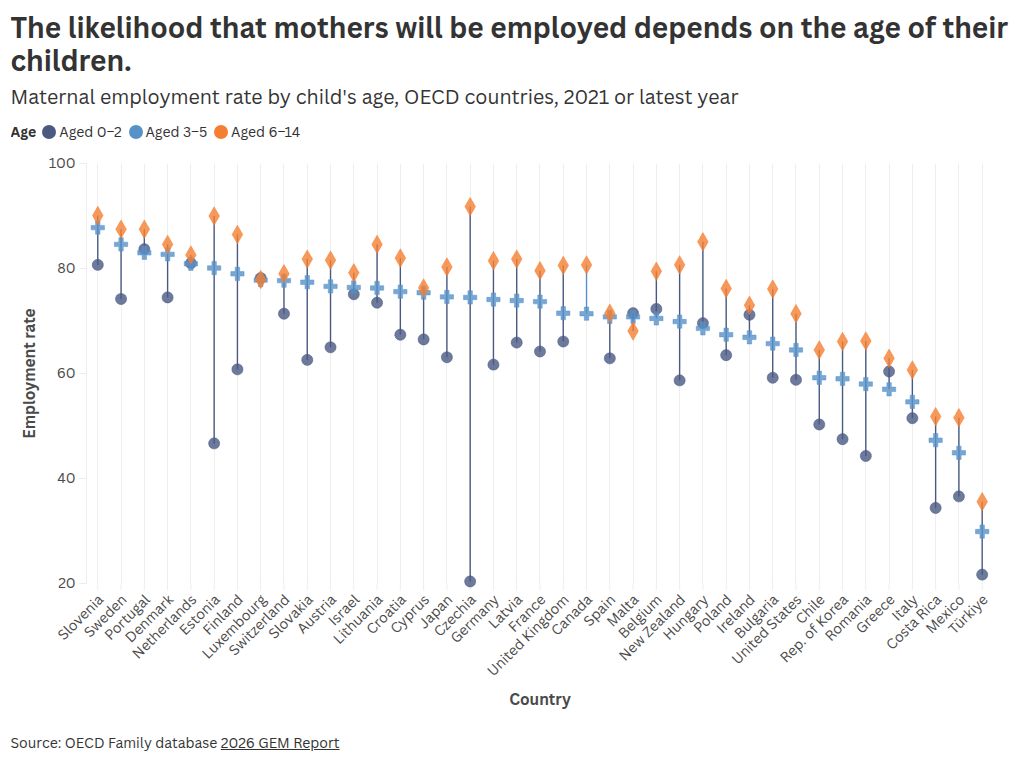
Maternal employment also shows a clear decline as children age. In OECD countries in 2021, the share of employed mothers rose from 61.5% for those with a child under two, to 70.2% for those with children aged three to five, and 76.3% for those with children aged six to fourteen. This pattern is reinforced by data from 36 middle-income countries, where female labour force participation averaged 68% with no children under six, dropping to just 44% with three or more.
Across a sample of 80 countries, an increase in pre-primary enrolment from 60% to 90% is associated with a rise in the female employment rate from 40% to 50%.
Actionable Insights for Educators and Policymakers
These patterns highlight a critical reality: when formal childcare is unavailable, unreliable, or unaffordable, women bear the brunt of the cost through career interruptions, reduced working hours, or complete exit from the labour market.
Therefore, policymakers must focus not only on the supply of early childhood care and education – its accessibility, affordability, and quality – but also on its design. Short daily sessions or provision tied to traditional school calendars will not adequately support mothers seeking to work.
For educators, understanding these broader socioeconomic forces can inform how they advocate for resources and how they can best serve families. Integrating tools that support efficient teaching and engagement can be crucial in demonstrating the value of early education.
For instance, utilizing Mentofy AI teaching tools for lesson planning and generating diverse assessments can free up valuable teacher time, allowing for more focus on individual student needs and parent communication. Platforms offering MentofyCove classroom games can also enhance engagement and provide valuable insights into early learning progress.
The expansion of early childhood care and education is intrinsically linked to labour market dynamics, gender inequalities, and household decisions. Effectively advancing this sector requires grappling with demand as much as supply. For many parents, the decision to enrol a child in preschool is directly tied to their ability to participate in the workforce, underscoring the vital role of early education in supporting both child development and economic empowerment.




 Explore AI Teaching Tools
Comments (0)
Please login to comment
No comments yet
Be the first to comment on this article