
Imagine a school district where eliminating remedial math courses led to nearly 100% of students mastering Algebra II, a dramatic increase from just 67% two decades prior. This isn't a hypothetical scenario; it's the reality in Calvert County, Maryland, a district that has successfully raised the bar for its students by phasing out lower-level math classes. This bold move, spearheaded by educators like Joe Sutton, challenges conventional wisdom and offers a powerful lesson for educators nationwide on how to truly prepare students for future success.
Calvert County's Bold Leap: Phasing Out Remedial Math
For years, many school districts, including Calvert County, offered a range of "foundational" math courses like pre-algebra and business math. The intention was to provide students with extra time and support to grasp fundamental concepts before advancing to more challenging material. However, a closer examination revealed a stark reality: these courses, while seemingly supportive, were inadvertently limiting students' potential and hindering their access to higher-level mathematics.
In 2014, Calvert County Public Schools, a district serving 15,000 students, embarked on a deliberate strategy to dismantle these lower-level math courses. The final course to be removed from the curriculum was intermediate algebra, which was discontinued in 2021. This systematic approach was driven by a commitment to ensure all students were on a trajectory toward advanced mathematical understanding.
The Data Doesn't Lie: Unprecedented Gains in Math Proficiency
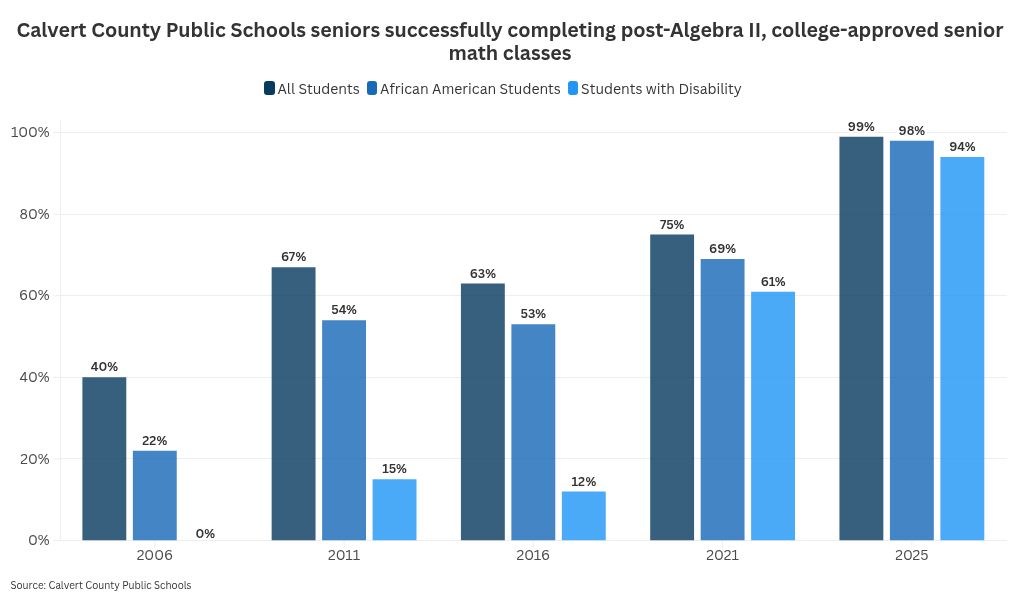
The results of Calvert County's strategic shift have been nothing short of remarkable. The district observed significant improvements across the board in students' mathematical achievements. In 2025, nearly all students successfully completed Algebra II, a stark contrast to the 67% success rate in 2006.
"We couldn't find any evidence these courses were increasing students’ subsequent grades, their graduation rates or their state test passing scores. After two or three, we started to recognize this is a pattern: Erring on the side of caution ended up underpreparing our students — particularly those from historically underserved groups."
The advancements were particularly pronounced among historically marginalized student groups. For Black students, the success rate in Algebra II jumped from 51% in 2006 to an impressive 99% in 2025. Similarly, students with disabilities saw a dramatic increase, with 94% completing Algebra II in 2025, compared to a mere 20% in 2006.
This data underscores a critical point: by removing perceived barriers, educators can unlock untapped potential in students who might otherwise be underestimated. The focus shifted from providing what was thought to be necessary support to ensuring all students had access to rigorous academic pathways.
Redefining Rigor: Access to Advanced Courses Soars
The elimination of remedial courses meant that a greater number of students were exposed to and successfully navigated more challenging mathematics. In 2025, 99% of seniors completed courses recognized by the University System of Maryland as rigorous for 12th graders, a significant leap from the 40% recorded in 2006. These advanced courses included honors precalculus, advanced mathematics, and Advanced Placement Statistics.
Once again, the gains were disproportionately beneficial for historically underserved populations. A remarkable 98% of Black students completed these rigorous 12th-grade courses in 2025, up from 22% in 2006. Students with disabilities also experienced a transformative shift, with 94% achieving this benchmark in 2025, compared to 0% just 19 years prior.
While not a direct one-to-one replacement, subjects like statistics and advanced mathematics have largely taken the place of the previously offered business math, Algebra III, and academic precalculus. This indicates a fundamental reorientation of the math curriculum towards higher-order thinking and problem-solving skills.
The Teacher's Role: Professional Development and Mindset Shifts
This ambitious curriculum overhaul placed increased demands on educators. Teachers in Calvert County were tasked with meeting the academic needs of all students, including those who might initially struggle with more complex material. The district recognized the critical need for robust professional development to equip teachers with the strategies and knowledge necessary to support this higher standard.
Beyond formal training, a significant aspect of this transition involved a profound shift in mindset among educators and staff. The district actively encouraged a departure from practices that underestimated students' capabilities and inadvertently limited their academic trajectory. This meant fostering a culture of high expectations for every child.
"The call to eliminate these kinds of classes is not new, but that a district leader would do it — I don't know how often that really happens."
Joe Sutton, a key architect of this change, acknowledged the challenges. He spent years navigating concerns from teachers and counselors who initially viewed the removal of "easier" courses as a step in the wrong direction. Sutton understood that placing more students into advanced classes would initially make teaching more demanding, but he firmly believed in the long-term benefits.
Casie Reynolds, a math teacher with extensive experience in the district, echoed this sentiment. She recalled teaching intermediate algebra courses that were predominantly filled with students who had special education classifications or learning difficulties. Reynolds observed that these courses, while intended to help, did not push students to their full potential. She noted that in subsequent years, students from similar backgrounds were successfully placed in Algebra II and other rigorous courses, suggesting that the previous limitations were more about perception than capability.
Rethinking Access: From Past Performance to Future Aspirations
The paradigm shift in Calvert County extended beyond the curriculum to how students were placed in courses. Previously, course recommendations were primarily based on a student's historical academic performance. The new approach prioritizes a student's future aspirations and career goals.
Each February, students engage in counseling sessions to discuss their academic and professional objectives. This conversation then informs their course selections, ensuring that their educational path is aligned with their long-term ambitions. Algebra I now stands as the lowest-level math course offered at the high school, a testament to the district's commitment to rigor.
For students who require additional support, Calvert County offers a semester- or year-long Algebra Lab course. This lab can be taken concurrently with Algebra I, providing targeted practice and reinforcement without segregating students into lower-track courses. This blended approach ensures that students receive the scaffolding they need while remaining integrated within the core curriculum.
Andrew Brantlinger, an associate professor at the University of Maryland, College Park, highlighted the broader movement towards de-tracking classes, a concept that has gained traction since the 1980s. He noted that influential organizations like the National Council of Teachers of Mathematics have long advocated for the removal of "low track" or "terminal" courses. This aligns with a growing understanding that all students benefit from access to advanced mathematics, regardless of their background.
The Power of High Expectations: Evidence from Research
Research consistently supports the efficacy of high expectations and rigorous coursework. A 2024 Stanford study, for instance, examined below-grade-level ninth graders enrolled in mixed-level Algebra I classes. The study found that these students, when taught by well-trained educators, performed significantly better on 11th-grade math tests compared to their peers placed in remedial courses.
Furthermore, the Stanford researchers observed that participation in mixed-level classes not only improved test scores but also increased attendance and the likelihood of students completing college-ready math courses. Crucially, there was no negative impact on the performance of higher-achieving students within these mixed groups, dispelling concerns that advanced material might hold back stronger students.
David Kung, executive director of Transforming Post-Secondary Education in Mathematics, lauded Calvert County's approach, emphasizing that many districts fall prey to the misconception that success in math is solely about innate ability. This belief, he argues, can lead educators to prematurely shunt students into dead-end courses, assuming they "just don't belong" if they struggle.
Beyond the Classroom: Preparing for Postsecondary Success
The shift away from remedial math courses in Calvert County has fundamentally altered the academic trajectory for its students. Instead of a predictable path through lower-level courses like pre-algebra, Algebra 1A, Algebra 1B, and geometry, students are now more likely to engage with Algebra I, geometry, Algebra II, and statistics.
While not every student may reach calculus, the experience of navigating these more challenging courses provides a far richer foundation for postsecondary education and future careers. The district's intentional decision to steer students toward rigor, even with the best of intentions, has ultimately served them better than offering numerous options to avoid challenging content.
This transformation in Calvert County serves as a compelling case study for educators seeking to elevate student achievement. By embracing high expectations, providing robust teacher support, and rethinking course placement strategies, districts can empower all students to reach their full mathematical potential. The success of this Maryland district demonstrates that sometimes, the most supportive path forward is the one that challenges students the most.





 Explore AI Teaching Tools
Comments (0)
Please login to comment
No comments yet
Be the first to comment on this article