
The latest National Assessment of Educational Progress (NAEP) Long-Term Trends data paints a starkly divided picture of student achievement, offering a glimmer of hope for younger learners while deepening concerns for adolescents. While 9-year-olds show encouraging gains in reading and math, their older peers, particularly 13-year-olds, are grappling with stagnant or declining performance, underscoring a widening chasm in educational outcomes. This divergence has profound implications for educators, demanding tailored strategies to support both recovery and sustained growth across different age groups.
Youngest Learners Show Signs of Post-Pandemic Recovery
For the nation's 9-year-olds, the NAEP Long-Term Trends assessment reveals a welcome rebound, with average scores in both reading and math showing significant improvement since 2022. This progress is particularly noteworthy as it marks the first substantial leap for struggling students in decades, suggesting that targeted interventions and a return to more stable learning environments are beginning to yield results.
This cohort, largely in preschool when the COVID-19 pandemic began, was somewhat shielded from the most disruptive educational shifts. Their current gains offer a crucial indicator that foundational skills can be re-established, providing a much-needed positive narrative amidst broader concerns about learning loss.
"We’re very excited by the progress made by 9-year-olds," stated Kirsten Baesler, who leads the Office of Elementary and Secondary Education at the U.S. Department of Education, acknowledging the positive momentum while still recognizing the challenges ahead.
The Power of Progress at the Lower Percentiles
A truly remarkable aspect of the gains seen in 9-year-olds is their origin: the students who were previously performing at the lowest levels. Those scoring at the 25th percentile saw gains of 7 points in math and 6 points in reading since 2022. Even more striking, students at the 10th percentile surged by 9 points in math and 8 points in reading.
This pattern starkly contrasts with the trends of the 2010s, a period where only the highest-achieving students consistently demonstrated significant academic growth. The current data suggests a potential recalibration, where foundational support is lifting those who need it most.
What does this mean for educators? It reinforces the vital importance of early intervention and foundational skill-building. Strategies that focus on phonics, early numeracy, and consistent reading practice are not just beneficial; they are proving to be transformative for our youngest learners.
Boys Lead the Way in Reading Gains
While overall progress is encouraging for 9-year-olds, a closer look at gender reveals a nuanced picture. Boys demonstrated statistically significant gains in both reading and math, averaging an increase of 7 points in reading and 5 points in math. Girls also saw improvement, though at a more modest pace, with a 1-point increase in reading and a 3-point increase in math.
This observation prompts educators to consider differentiated approaches that cater to the specific needs and learning styles of both boys and girls. Understanding these subtle differences can help optimize instruction and ensure equitable progress for all students.
Adolescents Face Persistent Learning Plateaus
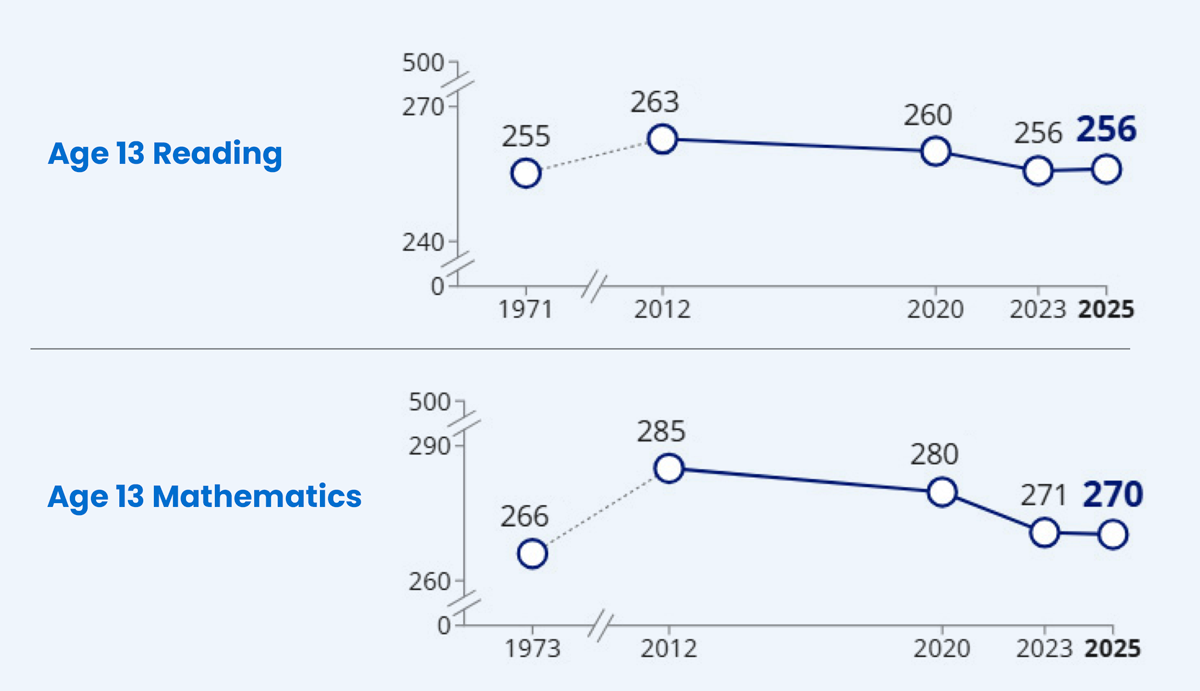
In stark contrast to the optimism surrounding younger students, the NAEP data reveals a disheartening stagnation for 13-year-olds. Their performance in both math and reading has remained flat since 2022, and in some demographic groups, has statistically declined. This lack of progress for a critical age group raises serious concerns about their long-term academic trajectories.
These students were in their formative elementary years when the pandemic hit, experiencing prolonged periods of virtual learning and disruption. The cumulative effect of this upheaval appears to be a significant impediment to their academic development, a challenge that will require sustained and innovative solutions.
The Shadow of Pre-Pandemic Challenges
The struggles of today's adolescents are not solely a product of the pandemic. Experts point to a broader "learning recession" that predates COVID-19, suggesting that the middle grades have been a particularly challenging period for student success for over a decade. The pandemic, therefore, may have exacerbated existing issues rather than creating them anew.
John White, CEO of Great Minds, noted, "We have plenty of evidence that a learning recession in the middle grades predates the pandemic. You can imagine two compounding problems: One, a general challenge in the success that American schools are having with adolescents, and two, a pandemic that hit this group of soon-to-be adolescents particularly squarely."
Declining Proficiency Benchmarks
The data highlights a concerning drop in the percentage of 13-year-olds meeting specific proficiency benchmarks. For instance, in math, the proportion of test takers scoring 250 points or higher—a level indicating the ability to solve basic word problems—has fallen from 85% in 2012 to just 70% in the latest assessment. Similarly, reading proficiency at this benchmark has declined from 66% to 58% over the same period.
This trend suggests that a significant portion of adolescents are not developing the fundamental mathematical and literacy skills necessary for future academic and career success. The implications for their long-term prospects are considerable.
Factors Contributing to the Divergent Trajectories
Several interconnected factors likely contribute to the striking differences in performance between 9-year-olds and 13-year-olds. Understanding these influences is crucial for educators seeking to develop effective strategies.
The Impact of the Pandemic's Timing
The age at which students experienced the pandemic's disruptions appears to be a critical differentiator. Nine-year-olds were younger and less entrenched in formal schooling, allowing for a more adaptable return to in-person learning and potentially easier remediation of foundational skills. In contrast, 13-year-olds were in a more advanced stage of their education, where the disruption to consistent instruction and social-emotional development had more profound and lasting effects.
Shifting Homework and Reading Habits
Accompanying survey data reveals significant shifts in student behaviors. The proportion of 9-year-olds reporting no homework the previous night has nearly doubled over two decades, from 19% to 39%. More concerningly, the number of students reporting reading for pleasure has plummeted. In 2025, only 37% of 9-year-olds and a mere 14% of 13-year-olds stated they read for fun "almost every day," a sharp decline from peaks over 40 years ago.
Julia Rafal-Baer, a member of the National Assessments Governing Board, expressed concern over the decline in reading for pleasure, linking it to increased screen time: "We’ve got to put real books back into kids’ hands. Libraries matter so much, and we’ve got to have adults helping kids to be curious."
This decline in reading for pleasure is particularly troubling, as it is a strong predictor of academic success and lifelong learning. Educators must find ways to reignite a passion for reading, integrating it into the curriculum and encouraging it as a leisure activity.
The Role of Technology and Screen Time
While not explicitly detailed as a cause in the NAEP report, the rise of digital media and smartphones is widely seen as a contributing factor to decreased reading engagement and potential impacts on attention spans. The shift away from sustained reading and towards shorter, more stimulating digital content may be affecting adolescents' ability to engage with longer texts and complex ideas.
This necessitates a thoughtful approach to technology integration in the classroom. While tools like MentofyCove classroom games can enhance engagement, educators must also guide students toward balanced media consumption and the enduring value of deep reading.
Strategies for Navigating the Educational Divide
The divergent NAEP results call for a multi-faceted approach that acknowledges the unique challenges faced by different student populations. Educators can implement a range of strategies to address both the recovery of younger learners and the persistent hurdles for adolescents.
Reigniting Foundational Skills for Younger Learners
For 9-year-olds, the focus should remain on reinforcing and building upon the foundational skills that are showing improvement. This includes:
- Intensifying phonics and early literacy instruction.
- Providing ample opportunities for reading practice with engaging texts.
- Utilizing interactive math games and manipulatives to solidify concepts.
- Leveraging tools like MentofyCove word search game and MentofyCove trivia game to make learning fun and reinforce vocabulary and concepts.
- Ensuring consistent and effective AI lesson plan development that targets essential skills.
The success seen in the lower percentiles underscores the power of targeted support. Educators should continue to identify students who need additional help and provide them with the necessary resources and personalized attention.
Addressing the Needs of Older Students
For 13-year-olds, the challenge is more complex, requiring strategies that address both academic remediation and engagement. Key approaches include:
- Implementing diagnostic assessments to pinpoint specific skill gaps in math and reading.
- Offering targeted intervention programs and tutoring.
- Integrating project-based learning that connects academic content to real-world applications.
- Utilizing Mentofy AI teaching tools for differentiated instruction and personalized feedback.
- Creating a supportive classroom environment that fosters student voice and agency.
The decline in meeting proficiency points highlights the need to re-evaluate how we assess and teach core academic competencies. It may be time to explore innovative assessment methods, perhaps through tools like Mentofy Academia's exam creator, to gain a more nuanced understanding of student mastery.
Fostering a Love for Reading
Regardless of age, cultivating a genuine enjoyment of reading is paramount. This can be achieved through:
- Creating vibrant classroom and school libraries.
- Encouraging student choice in reading materials.
- Modeling reading for pleasure as educators.
- Integrating diverse genres and formats, including graphic novels and audiobooks.
- Using MentofyCove's interactive games to build vocabulary and reading comprehension in a playful way.
When students see reading as an enjoyable pursuit rather than a chore, their engagement and comprehension are likely to soar. This is a long-term investment that pays dividends across all academic areas.
Leveraging Technology Thoughtfully
Technology can be a powerful ally in addressing the educational divide. Tools that promote engagement, provide personalized learning paths, and streamline administrative tasks can free up educators to focus on instruction.
For instance, MentofyGroups can assist in creating effective student grouping for collaborative activities, while MentofyBoards can enhance classroom displays with interactive widgets. The efficient use of AI grading tools can also allow teachers more time for direct student interaction and lesson planning.
The NAEP Long-Term Trends data serves as a critical barometer, reflecting the complex realities of education in America. While the gains among 9-year-olds offer a hopeful glimpse of recovery, the persistent challenges faced by adolescents demand our urgent attention and a renewed commitment to innovative, student-centered approaches. The path forward requires understanding these divergent trajectories and implementing strategies that support every student's journey toward academic success.



 Explore AI Teaching Tools
Comments (0)
Please login to comment
No comments yet
Be the first to comment on this article