
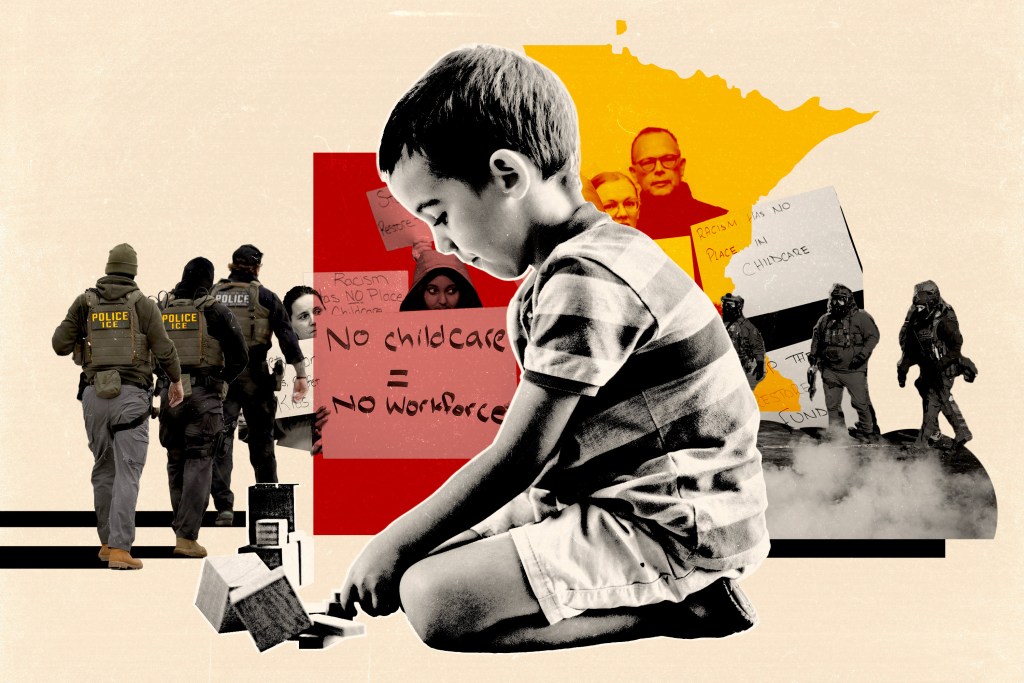
Minneapolis Child Care Center Navigates Fear and Resilience Amidst Immigration Enforcement Surge
On a biting February afternoon, the air at a Spanish-immersion child care center in Minneapolis was filled with the cheerful chaos of children preparing to go home. Toddlers wrestled into puffy coats, their parents fumbling with mittens and hats. Yet, down a quiet hallway, a different kind of vigilance was underway. Michael, husband to the center’s director, was glued to a computer screen, monitoring security camera feeds, his eyes scanning for any sign of U.S. Immigration and Customs Enforcement (ICE) agents.
Since January, when federal agents descended upon the Twin Cities as part of a sweeping operation, Michael has been leaving his job early each day to volunteer. His presence, along with a growing contingent of other volunteers, has become a crucial, if unexpected, part of the center’s daily operations. These new helpers, many in their 70s, have earned the affectionate nickname "abuelitas" from the staff, a testament to their unwavering support, even though their own grandchildren do not attend the center.
A Community Mobilizes Against Fear
The mission of these dedicated volunteers is multifaceted and vital: to provide safe transportation for ten of the center’s staff members and to act as observers and translators should federal agents attempt to stop them. The staff members are immigrants, and despite assurances that they are all legally authorized to work in the country, the aggressive enforcement tactics had instilled a profound fear, making them reluctant to drive themselves to work.
“I’m just doing what I can do. And I obviously feel less vulnerable than she would be,” shared Sarah, one of the volunteer drivers, her voice tinged with a mix of determination and concern. “I’m white, I’m 71. I think I would not be treated like she might be treated.” The fear of reprisal was so palpable that those interviewed for this report agreed to speak only on the condition of anonymity for the center and to withhold their full names, a stark indicator of the climate of apprehension.
This elaborate system of mutual aid represents a remarkable feat of organization, though it also entails a significant daily commitment. Approximately 60 volunteers, many commuting from suburban areas, have been working in shifts to ferry the center’s staff to and from their homes across the city. This effort highlights a critical reliance on immigrant workers within the child care sector nationwide, where one in five employees are immigrants, underscoring the disproportionate impact of enforcement actions on providers.
The Shadow of Operation Metro Surge
The immigration surge in Minnesota was fueled by unsubstantiated claims that child care programs in Minneapolis and St. Paul were misusing public funds and neglecting the children they served. This narrative placed the entire sector under intense scrutiny, creating a climate of suspicion that extended beyond the alleged issues.
For this particular center, the challenges were compounded by fearful employees, anonymous threatening phone calls, and a concerning number of families withdrawing their children. The resilience shown by this center offers valuable lessons for child care facilities in other communities that might face similar pressures. As Minneapolis and its dedicated staff slowly work towards a semblance of normalcy, other regions may need to cultivate their own networks of support.
“You literally have to have a good network to survive, because it’s not as though there is a government organization coming to help,” remarked Lily Crooks, director of a child care center in St. Paul and an active participant in local provider support networks. At her own center, Crooks organized a fundraiser that generated $5,000 for ride-sharing gift cards, enabling employees and parents to travel without relying on public transport, where ICE agents had reportedly been observed.
“It’s both really amazing to see the way that people are sticking up for their neighbors and supporting them, and then it also kind of feels bleak realizing that there isn’t going to be some saving entity coming,” Crooks added, her words reflecting a complex mix of admiration for community action and a somber acknowledgment of systemic gaps.
While anthems of mass resistance echo across the Twin Cities, celebrating the solidarity shown towards immigrant neighbors, some express concern about the sustainability of these volunteer efforts once the immediate surge recedes from public view. “This is not over,” stated Diana, the director of the child care center, her voice carrying the weight of experience. “And maybe it’s going to take years.”
Seeds of Doubt and Escalating Fear
The unease began to permeate the Minneapolis child care center in November, as whispers circulated about immigration agents detaining individuals even if they possessed legal status. “They are not respecting the due process — like, what is happening?” Diana recounted, her center serving approximately 50 children ranging from three months to five years old.
This growing apprehension led some teachers to express their reluctance to leave their homes. Diana emphasized that all her employees were authorized to work in the country, but their limited English proficiency fueled anxieties about their ability to explain their legal status if stopped by ICE. The fear was so pervasive that the center had to cancel its annual holiday party, as employees were too afraid to venture out after dark.
Diana, who immigrated from South America and is now a U.S. citizen, found herself carrying her passport at all times, a precautionary measure born out of necessity.
The Viral Accusation and its Fallout
The situation escalated dramatically on the day after Christmas when a prominent right-wing influencer posted a video on YouTube alleging widespread fraud within Somali-run daycares in Minneapolis. The video, which contained numerous demonstrably false and misleading claims, rapidly gained traction, amplified on social media by influential political figures.
Suddenly, the child care system in the Twin Cities found itself at the epicenter of a national controversy. Reporters visited some of the targeted centers, only to find them operating normally. Nevertheless, the administration announced a freeze on federal child care payments for low-income families in Minnesota, citing alleged widespread fraud. While only a few families at Diana’s privately owned center relied on public assistance, she was acutely aware of the devastating financial impact this freeze would have on numerous other centers, potentially affecting an estimated 23,000 children statewide.
Shortly after the freeze announcement, on New Year’s Eve, Diana’s center received a chilling anonymous phone call. “You guys are not safe. You guys have to leave,” the caller threatened before abruptly hanging up. Diana’s immediate concern was for the safety of her staff and the children, wondering if the threat was a prelude to violence.
She reported the call to the police, but officers indicated there wasn’t enough detail to launch a formal investigation. Undeterred, Diana informed her families about the potential risks, prioritizing transparency. She also heard from other center directors who had received more direct threats against their staff and faced social media influencers attempting to record children at their facilities.
Operation Metro Surge and the Height of Anxiety
On January 5th, the administration officially cited the influencer’s video as justification for deploying an additional 2,000 ICE and Border Patrol agents to Minnesota as part of Operation Metro Surge. This influx brought the total number of federal agents to approximately 3,000, a force more than triple the combined police presence in St. Paul and Minneapolis.
Just two days later, a tragic event sent shockwaves through the community. An ICE agent fatally shot Renee Macklin Good, one of the thousands of residents who had stepped up to serve as volunteer observers during the enforcement surge. The incident plunged many of Diana’s employees into a state of deep fear, leading to widespread absences.
So many staff members stayed home that Diana was forced to close the center for six days as she grappled with how to move forward. The climate of fear also affected families, with twelve children being withdrawn from the center, necessitating the layoff of one staff member. To encourage her remaining employees to return, Diana reached out to her network of contacts and nonprofit organizations for assistance in ensuring their safety.
The Unsung Heroes: Volunteer Drivers
A local immigrant rights group stepped forward, offering to coordinate a system of volunteer drivers to escort staff to and from their homes. The staff members, despite their apprehension, agreed to the arrangement. Each morning, Diana would anxiously await confirmation that everyone had arrived safely. “We say on the radio, ‘Everyone is here,’” Diana shared, her voice thick with emotion. “The kids don’t know what we mean. But every day it’s: Who is going to make it? Are we all going to make it?”
The volunteer drivers themselves acknowledged the inherent risks involved in their efforts, even though most did not consider themselves activists. “Oh, it’s risky,” admitted Sarah, who regularly drove one of the child care employees home, often with her 76-year-old husband providing backup. “I still need to find the strength and courage to do what I know is right.”
These volunteers were provided with guidance on how to respond if stopped by ICE: keep the window slightly open, be truthful, and inquire if the agents possess a warrant signed by a judge and dated. Sarah explained her protocol: “I would do the best I can. I would follow the protocol. I would ask all those questions — and what would happen, would happen.”
Sarah took meticulous precautions to avoid being tracked, disabling her smartphone’s location services during her volunteer drives. She also expressed a wish for a second vehicle to vary her mode of transport. Her carefulness extended to her conversations, as she was aware that not everyone shared her perspective. She recounted a recent book club meeting where one member stated, “The Somalis don’t belong here,” while another asserted, “They’re only rounding up criminals.” “It’s really disheartening to me that people can see things and interpret it so differently,” she lamented.
Drawing parallels to her youth during the Civil Rights Movement, Sarah felt this was a similar moment for her generation to stand against oppression. She has also formed a deep bond with the child care worker she drives, P. “We’ve kind of adopted her — we really want to protect her,” Sarah said, adding that she and her husband have provided P with food and are leveraging their network to help her husband find employment.
A Glimmer of Hope and Enduring Resilience
The 30-minute car rides were often quiet due to the language barrier; P’s English was limited, and Sarah did not speak Spanish. “She’s so shy,” Sarah observed, “But she’s hard-working — a real asset to this community.”
P expressed profound gratitude for the assistance, stating she would be unable to work or sustain herself without it. However, in an interview conducted partly in English and partly with the aid of a Spanish interpreter, she voiced her frustration that such support was even necessary. “It’s not OK that someone feels unsafe in a safe country,” she remarked, emphasizing the word “safe” with air quotes.
As a substitute teacher, P seamlessly transitions between changing diapers for the youngest children and assisting pre-K students. Engaging with the children allowed her to momentarily escape the pervasive anxiety. Yet, she yearned for the freedom to move about without constant worry. “I’m free,” the staffer stated, again using air quotes, “But I can’t do anything. It’s very hard.”
While officials announced the winding down of Operation Metro Surge, residents began to notice a subtle shift. Crowdsourced platforms continued to document ICE activities, and local media reported that agents were becoming more discreet, shifting their focus from urban centers to suburban areas.
Despite these changes, leaders of the volunteer driving initiative started to monitor for signs indicating it was safe to scale back their operations. By early March, all but two of the employees felt comfortable enough to resume driving to work independently. P, while still receiving rides, anticipates returning to driving herself soon. “I need a job. It’s not possible to stop for me,” she declared. “We have to try and just do it. We have to survive. We have to ‘resistir.’”
Diana, the center director, explained the significance of the Spanish word “resistencia,” a term that embodies both resistance and endurance. “It means that you don’t give up, you keep fighting,” she said. “We are going to get through it. This is going to pass.”






 Explore AI Teaching Tools
Comments (0)
Please login to comment
No comments yet
Be the first to comment on this article