
In a surprising pivot from traditional summer break, over 20 educators in Honolulu recently traded classrooms for gardens, immersing themselves in a professional development workshop focused on bringing the natural world to life for their students. This hands-on experience underscores a growing recognition among teachers that experiential learning, especially outdoors, can significantly enhance student engagement and understanding of complex environmental issues.
Hawaiʻi Teachers Cultivate New Learning Strategies Amidst Native Plants
The Mānoa Heritage Center, a hub for cultural and environmental education, recently hosted a unique workshop designed to equip teachers with innovative tools for their classrooms. The initiative, a collaboration between Trees for Honolulu’s Future, Mānoa Heritage Center, and Hanafuda Hawaiʻi, aimed to bridge the gap between academic learning and the rich biodiversity of the islands.
Mālama Mānoa, a local nonprofit dedicated to preserving the valley's heritage, generously sponsored the event, ensuring teachers received not only valuable instruction but also the necessary learning materials. The investment in these educators is a testament to the belief that empowering teachers directly benefits the future of environmental stewardship among students.
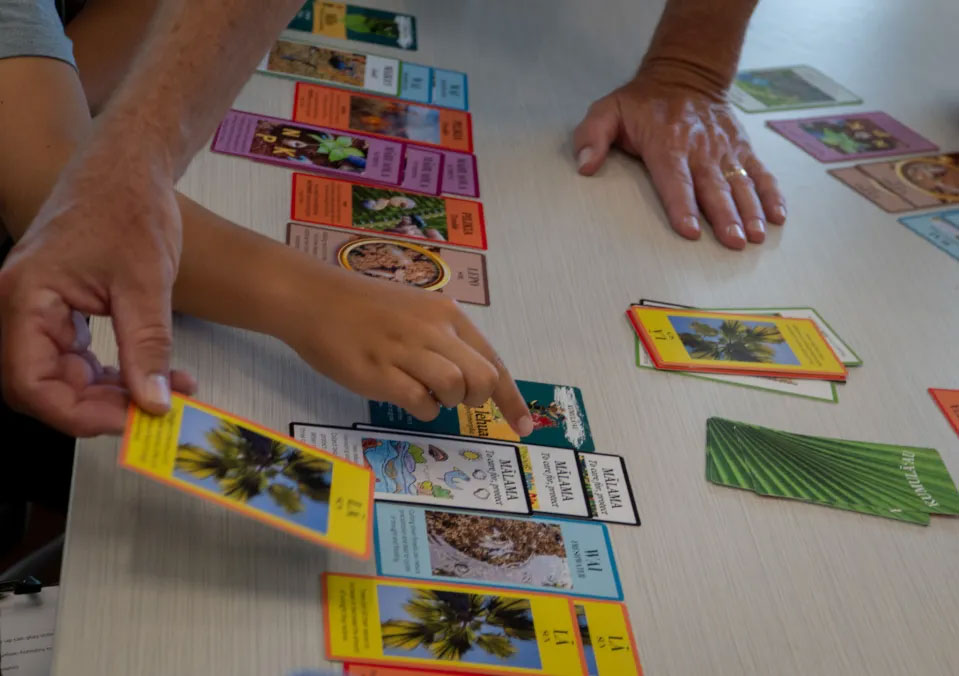
A key component of the workshop involved introducing educators to engaging classroom games that simulate the challenges and rewards of nurturing native ecosystems. These games are designed to make learning about plants, climate change, and natural resources not just informative, but also interactive and memorable for students.
A Card Game Teaches the Art of Growing Trees
The workshop kicked off with an energetic session of Kumulāʻau, a card game that uses the Hawaiian word for tree as its inspiration. Participants learned to collect specific cards representing essential resources needed for tree growth, such as water and fertile soil, mimicking the real-world factors that influence plant life.
The game also incorporated elements of unpredictability, with cards depicting natural disasters like wildfires or environmental challenges, illustrating the delicate balance and inherent risks in ecological development. This aspect of the game proved particularly insightful for the teachers, highlighting the complexities of conservation.
“I’m learning that it’s hard to grow a tree!” one teacher exclaimed with a laugh, drawing a card that indicated a tree had been planted too close to a building, limiting its access to sunlight.
Daniel Dinell, president of Trees for Honolulu’s Future, explained that while Kumulāʻau is a quick game, typically lasting five to 10 minutes, its true value lies in sparking deeper discussions. He encouraged teachers to use the game as a springboard for conversations about threats to native plants, like the coconut rhinoceros beetle, or to practice Hawaiian vocabulary related to nature.
This innovative approach to learning transforms abstract concepts into tangible, playable experiences, making the educational process more accessible and enjoyable for students of all ages.
Harnessing the Power of Play for Environmental Education
The learning continued with another engaging game station featuring Hanafuda cards, adorned with vibrant illustrations of Hawaiʻi’s native and invasive plant and animal species. Teachers rotated through, diligently matching cards and accumulating points, all while absorbing information about the local ecosystem.
Phillippe Fernandez-Brennan, an educator at Hālau Ku Mana Public Charter School, expressed enthusiasm for integrating these games into his curriculum. He emphasized the importance of seeing native plants and the Hawaiian language represented in such engaging formats, noting it’s a powerful way to connect students with their heritage and environment.
“There’s joy in learning,” Fernandez-Brennan remarked, highlighting the intrinsic motivation that comes from playful exploration. He sees these games as a vital tool to encourage face-to-face interaction among students, offering a welcome alternative to screen time.
The workshop also provided a valuable opportunity for teachers to explore the Mānoa Heritage Center grounds. This guided tour allowed them to learn firsthand about the care and unique uses of various native plants, enriching their understanding and providing practical examples for classroom lessons.
Integrating Nature and Games into the Curriculum
Danielle Montano, a fourth-grade teacher at Mānoa Elementary School, shared how her annual field trips to the Mānoa Heritage Center with her students are a highlight of the school year. However, this workshop has inspired her to infuse her lessons with even more game-based learning and hands-on activities for the upcoming academic year.
She is particularly interested in incorporating the use of kukui tree parts as a natural dye for student art projects, a concept sparked by her tour of the center's gardens. This practical application demonstrates how learning about plants can extend beyond identification to encompass cultural and artistic uses.
“Students are eager to learn more about the environment and native plants, especially those that are growing in their own communities,” Montano observed. “They know what’s in their area. It’s not just something far out of reach.”
This sentiment underscores the power of localizing learning. When students can connect educational content to their immediate surroundings, the learning becomes more relevant and impactful. The workshop successfully demonstrated how to transform local flora into engaging learning opportunities.
The educators left the workshop equipped with not only new games but also a renewed sense of purpose and practical strategies. The experience highlighted the potential of combining outdoor exploration with playful learning to foster a deeper appreciation for Hawaiʻi's natural heritage and to inspire the next generation of environmental stewards.
The integration of such experiential learning, amplified by tools like MentofyCove classroom games, can transform abstract environmental concepts into tangible, engaging experiences. This approach not only makes learning fun but also cultivates a lasting connection to the natural world, empowering teachers to inspire curiosity and action in their students.



 Explore AI Teaching Tools
Comments (0)
Please login to comment
No comments yet
Be the first to comment on this article