
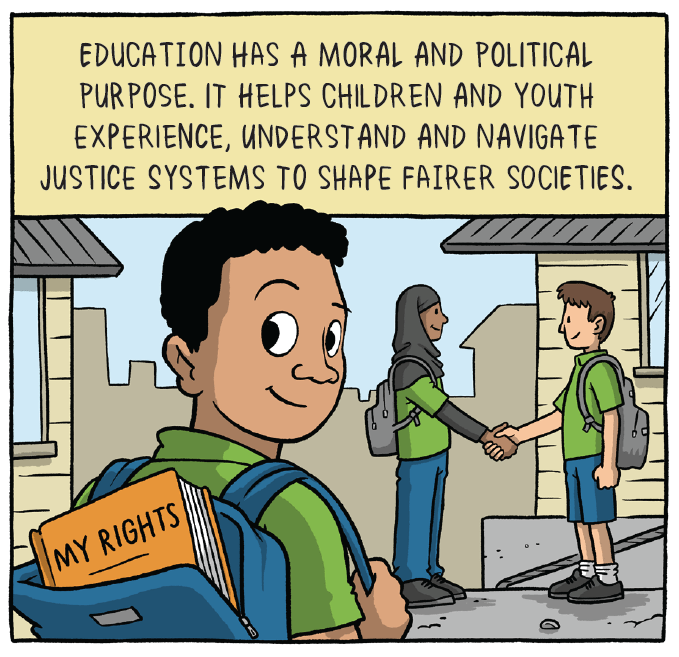
A staggering 1.4 billion people globally lack meaningful access to justice, unable to resolve everyday legal problems. This statistic, highlighted in a groundbreaking new report, underscores a profound disconnect between individuals and the systems designed to protect them. For educators, this means a critical re-evaluation of our role: education isn't just about imparting knowledge; it's about empowering people with the understanding and tools to navigate complex legal landscapes and claim their fundamental human rights.
Education: The Unsung Architect of Just Societies
The prevailing view often positions education as a social good, a pathway to personal advancement. However, a recent, comprehensive report from the GEM Report and Namati reframes this perspective, arguing forcefully that education is a cornerstone for building resilient, fair, and accountable societies. In an era marked by rising inequality and declining trust in the rule of law across many countries, this report asserts that education is not merely a right but a potent force for societal justice.
The report, titled "Learning to build just societies," arrives at a critical juncture. With billions lacking basic legal tools and access to justice, the gap between the law on the books and the law in practice is widening. This chasm leaves countless people vulnerable to exploitation and violence. The report’s central thesis is that education is the most powerful lever we possess to bridge this divide, equipping people to understand their rights, engage with legal systems, and ultimately, shape the laws that govern them.
"Education is not only a human right in itself, but also one of the strongest tools societies have for strengthening fairness, trust and accountability."
When Injustice Becomes a Barrier to Learning
The relationship between justice and education is a two-way street, and the report meticulously details how injustice actively hinders educational access. Discrimination, whether ethnic, racial, or socio-economic, remains a significant impediment, preventing millions of children and youth from attending school. Furthermore, pervasive issues like forced labor and child marriage trap young people in cycles of exploitation, denying them their fundamental right to education.
While most countries constitutionally guarantee the right to education, the report reveals a troubling reality: in roughly half of these nations, this right cannot be effectively enforced through legal channels. This leaves millions without recourse when their educational rights are violated. The report calls for stronger accountability mechanisms and robust legal protections to ensure that the right to education is not just a promise, but a lived reality for all people.
How Stronger Education Systems Fortify Justice
The positive impact of education extends far beyond the classroom, profoundly influencing the very fabric of justice systems. By equipping individuals with knowledge and confidence, education empowers them to understand and assert their rights. This is particularly crucial in legal systems that often rely on complex language, inadvertently favoring those with higher levels of education.
Research cited in the report indicates a clear correlation between education levels and trust in justice institutions. In countries surveyed, higher education attainment is linked to increased trust in judges and a greater likelihood of seeking legal advice when facing problems. This suggests that a more educated populace not only understands its rights but also feels more empowered to engage with and rely upon the justice system.
Education as a Crime Prevention Tool
Beyond individual empowerment, education plays a vital role in fostering broader social stability and reducing crime. Evidence from countries like Sweden and the United States demonstrates that increased schooling is associated with significant decreases in violent crime conviction rates and youth arrests. This highlights education’s preventative power, diverting individuals from pathways that could lead to criminal activity.
The report also emphasizes the critical, yet often overlooked, role of education in prisoner rehabilitation. While education is a proven factor in reducing reoffending rates and facilitating successful reintegration into society, many countries fail to incorporate it into their correctional strategies. Investing in educational opportunities for incarcerated individuals is presented not as a lenient approach, but as a necessary component of restoring dignity and enabling productive participation in society.
Peacebuilding Through Shared Understanding
In regions grappling with conflict, education emerges as a powerful catalyst for peacebuilding. Across numerous countries, education is recognized as a key contributor to peace, fostering conflict resolution skills and promoting understanding. Despite this, education’s role in peace agreements and justice discussions is frequently marginalized.
The report notes that a minuscule fraction of peace agreements signed globally explicitly mention the right to education. This oversight reflects a broader tendency to view education in isolation, rather than as an integral component of democratic development and social cohesion. Embedding peace and human rights education within curricula is essential for cultivating a generation capable of building and sustaining peaceful societies.
"Across 15 countries, education ranked as the second most important factor contributing to peace."
Schools: The Frontline for Cultivating Just Citizens
To truly leverage education’s potential for justice, schools must actively prepare learners for participation in just societies. This requires a curriculum that moves beyond rote memorization to foster critical thinking about inequality, discrimination, and conflict. Teachers, often lacking adequate training and support, need to be equipped to facilitate these sensitive discussions effectively.
The report advocates for a comprehensive integration of human rights, peace, and legal education across all levels of schooling. This means not only dedicated subjects but also embedding justice-related themes throughout the curriculum. Creating safe, inclusive classroom environments where students can openly discuss their experiences and perspectives is paramount to fostering a sense of justice and civic responsibility.
Empowering Educators with Justice-Focused Pedagogy
Teachers are on the front lines of shaping future citizens, but they often face significant challenges in teaching about justice, rights, and power. Insufficient professional development, inappropriate teaching methods, and political sensitivities can hinder their efforts. The report stresses the need for high-quality teacher training that goes beyond factual knowledge transfer to encompass action-oriented and experiential learning approaches.
Tools and resources that support educators in creating engaging and impactful lessons are crucial. For instance, platforms offering AI lesson plan generation and interactive activities can help teachers design lessons that encourage critical discussion and problem-solving around justice issues. Utilizing classroom games like trivia or word searches can also make complex topics more accessible and engaging for students.
Strengthening Justice Systems Through Education
The benefits of education are not limited to the general populace; they extend directly to the professionals who operate within justice systems. Judges, prosecutors, lawyers, police officers, and prison staff require training that encompasses ethical considerations, human rights, and effective communication, in addition to technical legal expertise.
Evidence from Latin America suggests that better-qualified judges lead to measurably improved judicial decisions. Similarly, police academies that prioritize rehabilitation and human dignity, as seen in Norway, are associated with lower reoffending rates. This underscores the importance of a holistic approach to professional development within the justice sector, focusing on people-centered principles and human rights.
Prioritizing Education for Rehabilitation and Prevention
The report strongly advocates for prioritizing education in crime prevention and youth offender rehabilitation strategies. Investing in early childhood and school education in disadvantaged areas, which are often prone to higher crime rates, can serve as a powerful preventative measure. For individuals already in conflict with the law, education and skills development are presented as central to effective rehabilitation.
This includes ensuring that correctional facilities offer robust educational programs. Such initiatives not only aim to reduce reoffending but also to restore dignity and enable individuals to reintegrate successfully into society. The report argues that rehabilitation should focus on restoring capabilities, not solely on punishment.
Promoting Legal Empowerment for All People
A key recommendation from the report is the promotion of legal empowerment, particularly for marginalized individuals who face significant barriers to accessing and utilizing the justice system. The justice system, with its often discriminatory language and norms, can feel inaccessible and even hostile to those who lack formal education.
Formal education curricula need to be designed with practical applications in mind, helping disadvantaged individuals navigate their interactions with judicial institutions. Furthermore, supporting civil society organizations that deliver legal empowerment training and recognizing community paralegals as vital bridges to underserved populations are critical steps in ensuring that legal rights are not just theoretical but practically accessible to all people.
The Imperative of Monitoring the Education-Justice Nexus
Finally, the report calls for improved monitoring of the intricate relationship between education and justice. Many countries still lag in tracking key indicators related to peace, justice, and strong institutions, as outlined in SDG 16. This lack of data hinders effective policy development and implementation.
Disaggregating access to justice indicators by education attainment and learning achievement is crucial for making the reduction of inequality a central driver of policy. Developing clear definitions of legal literacy and capability will enable more accurate assessments of the effectiveness of both formal and non-formal legal education programs. By systematically measuring progress, we can ensure that the vital link between education and justice remains a high priority on the global policy agenda.
Ultimately, the report serves as a powerful call to action for educators, policymakers, and civil society. By recognizing and actively cultivating education's role as a fundamental pillar of justice, we can begin to build societies where fairness, accountability, and human rights are not just aspirations, but lived realities for everyone.




 Explore AI Teaching Tools
Comments (0)
Please login to comment
No comments yet
Be the first to comment on this article