
Imagine a nation, once lagging in early childhood education, now boasting participation rates that rival upper-middle-income countries. Uzbekistan's journey from a post-Soviet educational landscape to a beacon of early learning innovation is not just a national success story; it's a powerful testament to what focused policy, strategic investment, and creative problem-solving can achieve for children. For educators worldwide, this transformation offers invaluable lessons in expanding access, particularly for the most underserved populations.
Uzbekistan's Astonishing Leap in Early Childhood Education
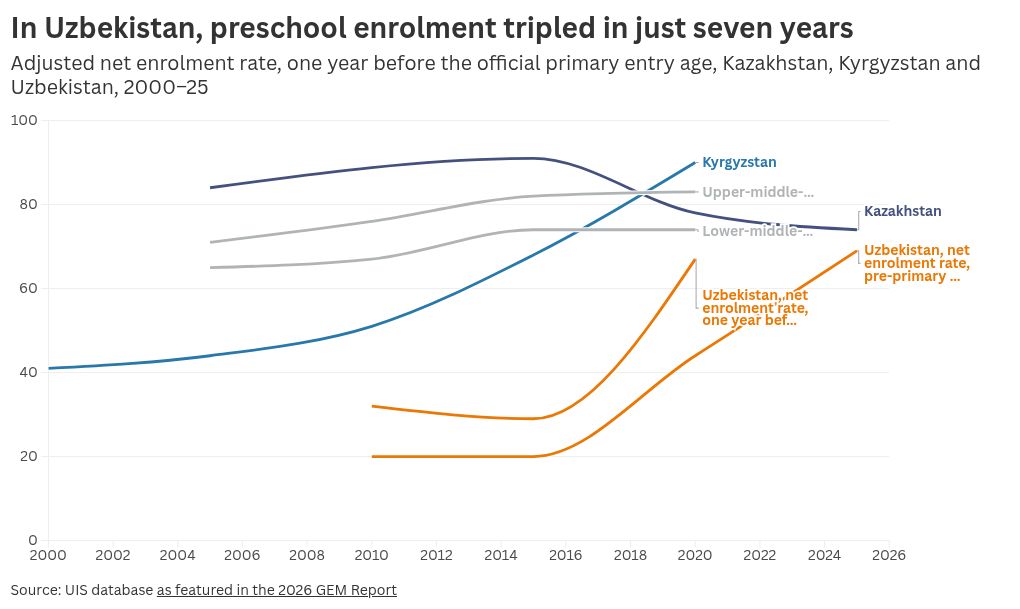
In a remarkably short period, Uzbekistan has dramatically reshaped its early childhood education (ECE) landscape. Between 2016 and 2024, participation rates for one year before primary education surged from a mere 28% to an impressive 84%. This isn't just about numbers; it signifies a fundamental shift in how the nation values and provides for its youngest citizens.
This dramatic increase means that a far greater proportion of Uzbekistan's children are now entering primary school with a strong foundation. The country's progress places it not only above the average for its income group but also on par with some of its more developed neighbours, demonstrating a commitment to equitable early learning opportunities for all children.
From Disrepair to National Priority: The Legislative Foundation
The story of Uzbekistan's ECE renaissance is deeply rooted in deliberate legislative action. Following the collapse of the Soviet Union, the nation inherited an ECE system in significant decline, with drastically reduced enrolment and a severe lack of investment in teacher training and infrastructure. Access, especially in rural areas, became a critical challenge.
A pivotal moment arrived in late 2016 with a Presidential Decree aimed at improving the pre-school education system. This decree set the stage for a comprehensive national strategy, leading to the establishment of a dedicated Ministry of Preschool Education in 2017. This move centralized coordination and management, providing a clear focus for reform efforts.
Further solidifying this commitment, a Law on Preschool Education was enacted in 2019, guaranteeing every child at least one year of preschool education before primary school. This legislation established clear standards for facilities, teacher qualifications, and funding, assigning responsibilities across different levels of government.
“In 2012, only 23% of children aged 3 to 6 attended preschool. Plans at that time were modest: a government strategy aimed to raise that share to 32% by 2016/17. Yet what followed was something considerably more ambitious. Preschool participation reached 84% in 2024.”
The ambition continued to grow. The 2022-2026 Development Strategy of New Uzbekistan set even higher targets, aiming for pre-primary coverage of 3 to 6-year-olds to reach at least 80%, with full access for 6-year-olds by 2024/25. By February 2026, a ministerial decision made one year of preschool attendance compulsory, underscoring the nation's unwavering dedication to early childhood education.
Mobilizing Private Sector Power for Public Good
Uzbekistan's expansion was significantly fueled by a strategic embrace of private sector involvement. Recognizing the need for rapid growth, the government introduced a framework for public-private partnerships (PPPs) in 2018. This initiative offered substantial incentives, including free land, buildings, and subsidies, to encourage private entities to establish preschools, particularly in urban centres.
The model extended to family-based non-state preschools, designed to serve disadvantaged children with guaranteed reduced parental payments for at least three years. This dual approach ensured that both market-driven expansion and targeted support for vulnerable populations were prioritized.
The financial commitment was substantial. Between 2018 and 2022, approximately USD 400 million in subsidies were channeled to non-governmental preschools. The subsidy rates were carefully calibrated, ranging from 30% in the capital, Tashkent, to as high as 75% in remote and marginalized areas, ensuring that investment was directed where it was most needed.
These partnerships proved highly effective. In 2022 alone, over 1,600 agreements led to the creation of 172,000 new preschool places, supported by preferential commercial loans with an exceptionally low annual interest rate of just 1% over 15-year terms. This made it significantly easier for private providers to invest and scale their operations.
The impact on private sector participation has been transformative. The proportion of pre-primary students enrolled in private institutions skyrocketed from a mere 2% in 2016 to 41% by 2024. By this year, Uzbekistan had 27,162 non-state providers operating alongside 6,780 state preschools, collectively serving approximately 2.4 million children.
Public spending also saw a concurrent rise. In 2024, the government allocated the equivalent of USD 270 million to public preschools, part of a broader education budget. International partnerships further supplemented these resources, with the National Partnership Compact for 2023-2026 channeling multilateral support into ECE expansion and quality improvements.
Bridging the Divide: Reaching Every Child, No Matter Where They Live
A cornerstone of Uzbekistan's success lies in its proactive approach to addressing disparities. Deliberate strategies were implemented to tackle inequalities across geography and income levels, ensuring that the benefits of early childhood education reached all children.
The gap in pre-primary enrolment between Tashkent city and other regions has been significantly narrowed. While a difference remains between the highest and lowest participation rates in different regions, the overall trend shows a remarkable convergence towards equity.
For children in rural and remote areas, the development of mobile kindergartens, affectionately known as "aqlvoy" (meaning "wise") buses, has been a game-changer. These buses are not just transport; they are fully equipped learning environments, complete with educational materials, toys, sanitation facilities, and screens for digital content.
“It wasn’t economically feasible to build traditional preschools in rural areas. We have villages in the mountains where you cannot build anything. There are only three, five, or ten children in a village. That’s why we decided to develop alternative models to reach them, including kindergartens on wheels.”
— Azimjon Abdulkhaev, Head of the International Relations Department, Ministry of Education
These mobile units offer a cost-effective and flexible solution, allowing a single bus to serve multiple villages in shifts. Currently, over 142 mobile buses operate daily, reaching more than 11,000 children across over 640 locations. The buses stop at designated playgrounds, enabling children to engage in both indoor and outdoor learning activities.
The impact of this early intervention is being recognized through national and international assessments. For the first time, Uzbekistan participated in PISA research, which indicated that children who attended preschool performed significantly better than those who did not. Similar research with the World Bank has demonstrated better results in mathematics and science for children with preschool education.
Income-related disparities, while persistent, are also being actively managed. All preschools are mandated to reserve subsidized seats for households earning less than 1.5 times the minimum wage. This ensures that economic status does not become a barrier to accessing quality early learning.
Furthermore, significant strides have been made to improve access for children with disabilities. Specialized preschools and rehabilitation centers, known as "Imkon" (Opportunity) and "Umid" (Hope), cater to children aged 2 to 7, with 91% attending these facilities free of charge. Inclusive education is also being fostered through community-based programs, Sunday schools, and short-stay groups.
Looking Ahead: Sustaining Momentum and Quality
Uzbekistan's remarkable progress has positioned it as a leader in early childhood education globally. The nation hosted the UNESCO World Conference on Early Childhood Care and Education in 2022 and has now signed an agreement to establish a Category 2 UNESCO Centre for pre-school education within the country. This centre is poised to promote best practices, foster regional cooperation, and advance modern approaches in ECE.
Achieving the ambitious target of 80% enrolment for 3 to 6-year-olds will necessitate continued investment, particularly in family preschools and innovative delivery models for the most remote areas. The income participation gap, though narrowing, requires ongoing attention and targeted interventions.
As the system continues to grow and diversify, maintaining and enhancing educational quality across a wide range of providers will be a critical ongoing task. This involves robust teacher training, curriculum development, and effective monitoring mechanisms.
However, the overarching narrative from Uzbekistan is one of profound possibility. It demonstrates that rapid, large-scale transformation in early childhood education is not only achievable but can be accomplished within a relatively short timeframe when there is a confluence of political will, clear legislation, active private sector engagement, and innovative approaches to reach every child.




 Explore AI Teaching Tools
Comments (0)
Please login to comment
No comments yet
Be the first to comment on this article