
Ohio's Public Universities: A New Era of Ideological Centers Sparks Debate
A surprising scholarship offer, tucked away in an orientation packet at Ohio State University, promised freshmen a significant discount on tuition for engaging with civics-focused coursework and extracurricular events. What wasn't immediately apparent was the driving force behind these incentives: the Salmon P. Chase Center for Civics, Culture, and Society, a newly established entity with a distinct ideological mission, funded by state tax dollars.
The Rise of State-Funded Ideological Centers
Created through legislation championed by Ohio's Republican lawmakers, the Chase Center and four similar institutions across the state are designed to introduce students to a slate of conservative scholars. These centers, housed within public universities, are part of a broader national trend where state legislatures are actively shaping academic discourse under the banner of "intellectual diversity." The explicit goal is to counter what proponents perceive as a left-leaning bias on college campuses.
In 2023 alone, Ohio allocated a substantial $24 million to establish these five centers. This move represents a significant shift in how public universities are influenced by political power, a level of intervention that was largely unthinkable just a few years ago. The strategy is straightforward: leverage state funding to hire faculty with specific ideological viewpoints and offer incentives to students, ensuring their ideas reach a wider audience.
This approach is not unique to Ohio. At least eight other states, including North Carolina, Florida, and Utah, have seen similar centers or schools emerge at their public universities, often with strong backing from Republican politicians. These initiatives are projected to receive nearly $50 million in taxpayer funding for the 2025-26 academic year, with further substantial investments, such as the University of Texas System's $100 million allocation for a School of Civic Leadership, signaling a significant national push.
Ohio, with its five operational centers, is emerging as a key model for this burgeoning movement. The Chase Center, for instance, has already benefited from federal grants totaling over $8 million, earmarked for training K-12 teachers in civics education. Additionally, it received a significant $5 million non-competitive grant from the National Endowment for the Humanities, intended to bolster faculty recruitment, scholarships, and curriculum development.
Balancing the Scales or Imposing an Agenda?
Critics view these state-funded centers with deep concern, arguing they inject politics into faculty hiring and divert crucial resources from existing academic departments and essential campus needs. They contend that this legislative intervention undermines academic freedom and the traditional university governance structures.
Proponents, however, maintain that these centers are a necessary corrective measure, aiming to introduce a much-needed balance to campuses they believe are overwhelmingly dominated by left-leaning perspectives. Adam Kissel, a former deputy assistant education secretary, has described the situation in many universities as suffering from "curricular rot," necessitating legislative action to ensure a more robust and traditional college education focused on the "American and Western tradition."
Kissel argues that universities have lost public trust due to faculty activism, making legislative oversight of public funds and curriculum appropriate. "It's right for the legislature to come in and say 'It's the public's money, it's the public's accountability. We have something to say about curriculum,'" he stated.
Even some conservatives who dispute the notion of widespread "indoctrination" acknowledge that students may be exposed to a disproportionate number of left-leaning ideas. Data from 2023 indicated that approximately half of professors identified as liberal, compared to a quarter who identified as conservative and 17 percent as moderate. However, researchers also point out that many students arrive at college already leaning left, suggesting peer influence might be more significant than faculty ideology.
Student Perspectives on Intellectual Diversity
Many students interviewed expressed that they have not experienced the "left-wing indoctrination" that supporters of these new centers claim is prevalent. Danielle Fienberg, a junior at Ohio State, challenged the idea of indoctrination, stating, "Professors want you to challenge them, they want you to disagree."
Fienberg was initially drawn to the Chase Center's classes by the scholarship opportunities. She found the discussion-based format valuable, appreciating the civil discourse even when encountering viewpoints she might not encounter elsewhere. "I can’t watch Fox News, but I can sit in that class and hear ideas discussed civilly," she remarked.
While acknowledging the conservative slant of some reading materials, Fienberg emphasized that her professors' personal opinions did not influence her grading. This sentiment was echoed by other students who found the open debate and intellectual challenge to be a positive aspect of their experience, even if they questioned the center's formation.
The Chase Center's Expanding Reach
The Salmon P. Chase Center has rapidly expanded its academic offerings. After sponsoring two classes in its inaugural fall semester, it offered seven in the spring and planned for fourteen in the fall. The center's long-term goal is to hire 50 new faculty members, many with joint appointments in existing university departments, to foster "diversity of thought" across the institution.
Christopher Green, the center's associate director and a constitutional law scholar, stated, "We want to conserve and consider what's good about America." The center aims to cultivate an academic community through reading groups and personalized faculty attention, exposing students to ideas they might not encounter through traditional university channels.
To attract students, the Chase Center employs a range of incentives, including scholarships, formal dinners, and funded study abroad programs. For instance, to receive the full scholarship amount in the upcoming academic year, students will be required to declare an academic minor offered by the Chase Center, further solidifying student engagement with its programs.
Inside the Classroom: A Case Study
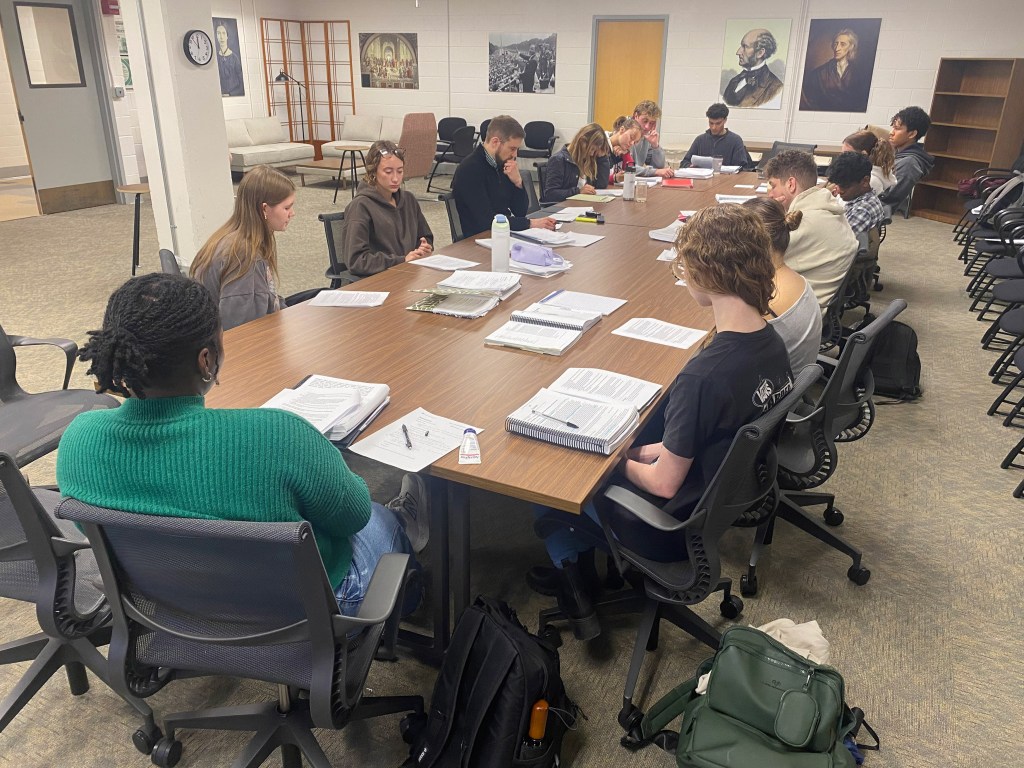
During a recent class session of "The American Civic Tradition: Then and Now" at the Chase Center, seven students engaged in a spirited debate about Frederick Douglass's views on the Constitution. The discussion, moderated by lecturer David Little, touched upon concepts like "civic friendship," encouraging respectful engagement with differing opinions.
Freshman Evelyn Wan suggested that a prominent political figure embodied civic friendship ideals, a notion that amused Little but led to further exploration of philosophical arguments from figures like Alexis de Tocqueville and scriptural references in Abraham Lincoln's speeches. Wan later commented that the Chase Center could be a valuable tool for students to "get outside of the echo chamber," though she also noted its distinctly "Republican and very patriotic" tone, suggesting that newcomers might emerge with a more conservative outlook.
Amiri Rice, a junior majoring in political science, described how Little sometimes "baits me into pushing back against him," which he found to be a productive method for generating robust discussions. These student accounts highlight a dynamic classroom environment that encourages critical thinking, even within a framework designed to present specific viewpoints.
Legislative Roots and Structural Independence
The genesis of these centers can be traced back to efforts by figures like law professor Lee Strang, who, after a stint at Princeton's privately funded James Madison Program, sought to replicate such models in Ohio. He found a receptive audience in state Senator Jerry Cirino, who expressed a long-held belief that university faculty leaned too far left and that students needed exposure to a more balanced set of perspectives on politics and economics.
Senator Cirino's initial legislative ambitions included a broader overhaul of higher education, proposing to eliminate mandatory diversity, equity, and inclusion training, ban faculty strikes, and reduce tenure protections. His focus on "intellectual diversity centers" at Ohio State and the University of Toledo College of Law was a more targeted approach that ultimately gained traction.
Cirino collaborated closely with Strang to craft legislation that would grant these centers significant autonomy from the host universities. This independence was seen as crucial, drawing lessons from programs like Princeton's Madison Program, where departmental affiliation could limit hiring flexibility. When Cirino's broader reform bill stalled, he expanded the scope of the civic center legislation, successfully embedding it within the state's legislative budget.
The model legislation proposed by the conservative National Association of Scholars, which advocates for centers run independently from universities and faculty perceived as having "abandoned their commitments to intellectual freedom, the Western heritage, and the American heritage," appears to have influenced these developments. The association argues that simply mandating courses is insufficient and that structural changes are needed to alter the substance of what professors teach.
Iowa has already followed suit, passing legislation to create the Center of Intellectual Freedom at the University of Iowa, seemingly based on this model legislation. These laws are fundamentally altering traditional faculty hiring and firing procedures. Instead of the usual multi-layered academic approval process, each campus center in Ohio has its own academic council, with members requiring state legislative approval. This council then recommends a director with extensive authority over faculty recruitment and hiring, a process described by some as "legislatively directed hiring."
Concerns Over Hiring and Academic Integrity
Critics, like Ashley Hope Pérez, an associate professor at Ohio State and a member of the university senate steering committee, view this as a move towards "political loyalty for tenure." While Ohio State's administration stated that the board of trustees approves all faculty hires, including those at Chase, Pérez and others suggest that trustee approval often functions as a mere formality without deep vetting of individual candidates.
The structure of the academic councils themselves has drawn scrutiny. In Ohio, these councils have members approved by the state legislature, and in at least one instance, state senators overruled university presidents' nominees. The council for the Chase Center includes prominent conservatives but notably lacks any prominent liberal scholars, raising questions about the genuine commitment to diverse viewpoints.
Despite these concerns, Chase Center leadership maintains that there is no political litmus test for hiring. Senator Cirino has stated the goal is not to create a "conservative faculty" but to teach students "how, rather than what, to think." Strang echoed this, asserting that the center welcomes faculty from all backgrounds and that the new hires represent a broad spectrum of academic thought, making the Chase Center "much more diverse than almost any academic unit in a large public university."
However, the ideological spectrum appears to be largely confined within conservative thought, encompassing neoconservatives, Trump supporters, and those with religiously informed conservative views. While Strang doesn't track staff political leanings, he suggests that a higher proportion of right-leaning professors is unsurprising, given the perceived lack of equal opportunity for conservative academics in traditional hiring processes.
Amy Reid of PEN America's Freedom to Learn project criticizes the use of "intellectual diversity" as a "Trojan horse for the imposition of ideological stances," arguing that such initiatives are designed to create space for conservative ideology. Furthermore, critics point to demographic data indicating that the majority of new hires at these centers are white and male, a stark contrast to the broader university faculty demographics. An analysis of publicly funded civic centers reveals that approximately 75 percent of their faculty are male and over 85 percent are white, compared to 52 percent male and 65 percent white across all public and nonprofit four-year universities.
Resource Diversion and Future Mandates
Concerns are also being raised about the potential for these centers to duplicate courses already offered by existing university departments. Faculty members like Pérez argue that the scholarships offered by the Chase Center incentivize students to enroll in its courses, potentially diverting enrollment and, consequently, funding away from departments that rely on student numbers for their budgets. This, they contend, represents a "diversion of funding from actual educational needs while dumping money into these centers."
The long-term financial sustainability of these centers is also a point of discussion. The cost of new tenure-track positions, including salaries and benefits, is projected to run into tens of millions of dollars over several years, and there is uncertainty about future state legislative commitments to funding.
Ohio State University has indicated that the Chase Center operates with a projected five-year budget that includes fundraising, tuition revenue, and state support. The university's spokesperson, Benjamin Johnson, stated that President Carter supported the Chase Center's creation and that the university structured it to align with the state's mission of "educating for citizenship."
Looking ahead, a significant legislative development in Ohio, spearheaded by Senator Cirino, mandates that all students earning a bachelor's degree must complete an American Civic Literacy course. This new requirement, set to take effect in 2025, will feature foundational American historical texts and lessons on capitalism. The state-funded civic centers, including the Chase Center, are poised to be instrumental in delivering this mandated curriculum, reflecting a deliberate effort to shape the civic education of future graduates across Ohio.







 Explore AI Teaching Tools
Comments (0)
Please login to comment
No comments yet
Be the first to comment on this article