
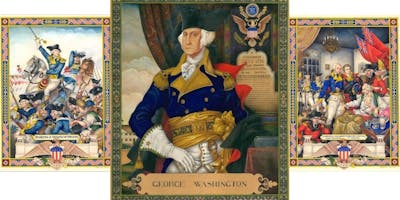
Washington's Enduring Blueprint for Navigating a Fractured America
In an era marked by heightened political polarization and a palpable sense of unease following acts of violence, the wisdom of America's founding figures offers a surprising, yet vital, roadmap for fostering constructive dialogue. As the nation approaches a significant anniversary of its foundational declaration, the very principles that birthed the United States are being tested in classrooms and public squares alike.
The summer of 1776 was a crucible, forging a nation from disparate colonies through armed conflict and the bold articulation of ideals. This period, culminating in the Declaration of Independence, saw the rise of George Washington, a figure whose leadership transcended the battlefield to shape the nascent republic. His ability to govern in peace proved as profound as his prowess in war, offering timeless lessons for American students and citizens grappling with division.
The Shadow of Violence and the Silence It Breeds
Tragedy struck close to home on September 10, 2025, at Utah Valley University. Colleagues and I were engaged in a series of Constitution Day events, focusing on George Washington's constitutional legacy, when news of a violent incident reverberated across the nation. The timing lent a visceral urgency to our discussions on courage, moderation, wisdom, and civic charity – virtues embodied by Washington.
The aftermath of such events often casts a chilling effect on open discourse. Early indicators suggest that a recent, highly publicized assassination has amplified anxieties within educational settings. Rather than spurring a renewed commitment to open dialogue, this act has, for many, intensified a culture of silence.
A survey conducted in October 2025 by the Foundation for Individual Rights and Expression revealed a significant shift in student comfort levels. A notable percentage of college students reported feeling less at ease expressing their views on controversial topics. This discomfort extended across various environments: in classrooms, in common campus spaces, and even on social media platforms.
Lessons from the Commander-in-Chief: Law, Order, and Common Ground
While a military leader might seem an unconventional model for civil discourse, particularly in the wake of violence, American history offers compelling examples. George Washington, our nation's first commander-in-chief, provides a powerful case study in navigating profound disagreements with steadfast principle and unwavering respect for foundational law.
At its core, Washington's unwavering devotion to the rule of law and constitutional self-government is paramount. This framework serves as the bedrock upon which Americans can navigate their political differences. It is the common bond that, even amidst vigorous debate and disagreement over the common good, must bind us.
Washington demonstrated this commitment through his actions. In 1783, he quelled a potential mutiny among his own officers at Newburgh, upholding the principle of civilian control. Later, he twice relinquished immense executive power – first as Commander-in-Chief and then as President – underscoring his dedication to constitutional governance over personal authority.
In his farewell address, Washington emphasized the sacred obligation of citizens to uphold the existing Constitution. "The basis of our political systems is the right of the people to make and to alter their constitutions of government," he stated. "But the Constitution which at any time exists, till changed by an explicit and authentic act of the whole people, is sacredly obligatory upon all." This principle remains a vital anchor for American civic life, reminding us of our shared commitment to the constitutional order.
The Art of Disagreement: Washington's Pragmatic Approach
Beyond his foundational commitment to law, Washington possessed a remarkable capacity for navigating constant opposition with grace. As President, he presided over a cabinet rife with political division and personal animosity. Yet, he consistently sought to speak to his fellow citizens across these divides, reminding them of their shared American identity and common humanity.
His correspondence, such as his letter to the Hebrew Congregation at Newport, exemplifies this ability to connect with diverse communities. However, Washington's true genius lay not just in finding commonality, but in his capacity to disagree fundamentally while maintaining respect and fostering understanding.
Though famously skeptical of political parties, Washington was not one to shy away from controversy. He understood that advancing the common good sometimes necessitated engaging in robust debate, rather than avoiding it for the sake of superficial harmony. His willingness to contend for his principles offers a crucial lesson for students and educators alike.
Civil discourse, Washington's example suggests, does not demand the abandonment of disagreement. It is not about surrendering convictions or concealing objections to laws, policies, or ideas simply to maintain an outward appearance of agreement. Instead, it is about engaging with differing viewpoints constructively.
Empowering Educators and Students in the Discourse Arena
It is tempting to lament the current state of our fractured discourse. However, as educators, we bear the responsibility of actively working to repair it. School leaders and administrators must champion civil discourse, providing robust support for educators who cultivate it and creating safe forums for students to voice their perspectives.
Fostering this courage is not about asking students to become martyrs for their beliefs. It is about cultivating an environment where productive disagreement can flourish. This requires a deliberate and thoughtful approach to classroom discussions and a commitment to intellectual rigor.
For robust civil discourse to thrive, we must cultivate three essential qualities: courage, humility, and civic charity. Teachers can foster courage by strategically scaffolding debates. This involves starting with topics that carry lower social risk, gradually building towards more challenging questions, ensuring every student has an opportunity to be heard.
Instilling humility is equally critical. The primary objective of discourse should be to understand a problem from multiple perspectives, rather than to definitively "win" a debate. Humility acknowledges the possibility of being wrong and recognizes that there is always more to learn. Human beings are finite, and our understanding of complex issues is rarely complete.
Nurturing Humility and Sharpening Reasoning Skills
Civic charity can be nurtured by framing classroom debates as a collaborative endeavor aimed at finding solutions, rather than a confrontational battle. The parliamentary model, where students address the chair rather than directly engaging individuals, can help shift perceptions. This approach encourages students to view their peers not as adversaries, but as partners working towards a common objective.
A crucial practice is to press students to "steel man" arguments – to articulate opposing viewpoints with their strongest possible form, even for positions they do not personally hold. This exercise builds intellectual humility, sharpens critical reasoning skills, and helps detach contentious ideas from the individuals who espouse them.
Engaging in intellectually serious, fact-based comparisons between our present challenges and historical precedents is indispensable. Dismissing opposing views with flippant labels like "fascist" or "communist" does little to advance the truth-seeking enterprise. Such rhetoric shuts down dialogue and hinders genuine understanding.
In essence, we can guide students to emulate Washington's approach. He utilized civil disagreement among his cabinet members to forge compromises where feasible. When compromise was not possible, he proceeded with decisions on controversial matters only after ensuring all sides had been treated with due respect.
Beyond Partisan Divides: A Shared Inheritance
The strategies outlined thus far aim to support civil discourse amidst our present divisions and concerning the issues that divide Americans. However, perhaps the most profound contribution civic educators can make is to help students transcend our current political schisms. Our founding principles and institutions represent a pre-partisan constitutional inheritance, crafted long before the left-right ideological frameworks and red-blue partisan divides became the dominant lenses through which we sort ourselves into political tribes.
Examining the historical debates within our country about how best to live up to our constitutional principles engages students with scenarios and questions for which their current partisan frameworks offer no easy answers. This process reminds them, as Washington sought to do in his farewell address, of the profound inheritance they hold in common with each other as Americans. It is a legacy that transcends the ephemeral nature of contemporary political contests and offers a stable foundation for a more unified and engaged citizenry.





 Explore AI Teaching Tools
Comments (0)
Please login to comment
No comments yet
Be the first to comment on this article