
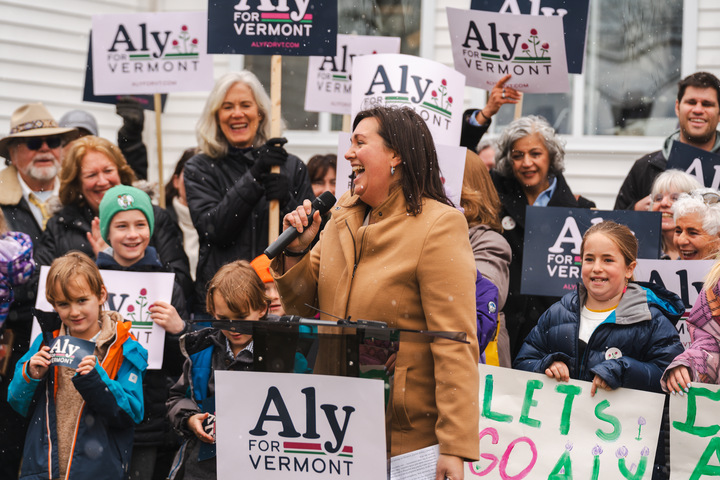
When a former president vetoed a landmark childcare bill in 1971, it set the United States on a path away from a national childcare infrastructure. Decades later, as families increasingly rely on dual incomes and women's workforce participation soars, the challenge of affordable, quality childcare remains a persistent hurdle. Now, a leading advocate for early care and education in Vermont is bringing her expertise to the governor's race, arguing that this issue is not just about families, but about the economic vitality of the entire state and country.
A Governor Who Understands the "Lego Ceiling" of Childcare
For nearly a decade, Aly Richards led Let’s Grow Kids, a statewide organization dedicated to improving access to high-quality childcare in Vermont. Her work culminated in the passage of Act 76, a significant legislative achievement that injected substantial investment and policy reform into the state's early care and education system. This legislation, funded by a new payroll tax, raised reimbursement rates for early childhood programs and provided financial relief to most families struggling with childcare costs.
Richards's campaign for governor is built on the premise that tackling childcare issues is a powerful "upstream" solution to broader economic challenges. She believes that the lessons learned in Vermont can serve as a model for other states grappling with similar issues, and that the governor's office is the ideal platform to scale these solutions.
"I spent my last decade working to solve this deep crisis that dogged Vermont and has dogged the rest of the country. I grew up in Vermont. I went out of state to change the world, working on Obama's first campaign. I was so excited by his leadership potential, and yet I was so dismayed by the lack of action in D.C. because people who didn't agree with each other didn't speak to each other anymore."
This experience, Richards explains, solidified her belief that real change requires collaboration and a willingness to find common ground, even amidst disagreement. She returned to Vermont, inspired by the state's capacity for dialogue, and saw early childhood education as a critical area where common ground could yield profound, positive change.
The Core Pillars of Vermont's Childcare Success
The transformation of Vermont's early care and education system under Richards's advocacy hinged on several key strategic shifts. These weren't just incremental adjustments; they represented a fundamental re-evaluation of how childcare is funded and supported.
Dedicated Public Investment: The Cornerstone of Sustainability
The most critical change, Richards emphasizes, is the establishment of dedicated public investment in childcare. For too long, the system has been overwhelmingly reliant on parents as the sole payers, a model that is inherently unsustainable and fails to meet the needs of educators or families.
A permanent, dedicated funding stream is essential to ensure the system can function effectively. This allows for adequate reimbursement rates for early childhood educators, ensuring they receive a livable wage, and provides the capacity to meet the growing demand for childcare services across the state.
Mechanisms for Affordability and Access
Beyond securing funding, Act 76 implemented specific mechanisms to make childcare more accessible and affordable for Vermonters. The legislation expanded eligibility for childcare subsidies, significantly increasing the income threshold at which families qualify for support. This means that a larger segment of the population, including many middle-income families, can now access reduced childcare costs.
Simultaneously, reimbursement rates for early childhood education programs were increased. This crucial step provided much-needed financial stability to childcare providers, enabling them to operate more effectively, offer competitive wages to their staff, and ultimately expand the availability of spots for children.
- Dedicated Funding Stream: Securing consistent public investment is paramount.
- Expanded Subsidies: Increasing income eligibility for childcare assistance makes care affordable for more families.
- Higher Reimbursement Rates: Supporting providers financially allows them to improve quality and capacity.
- Economic Stimulus: Investing in childcare creates jobs and boosts local economies.
The dual impact of reducing costs for families and injecting capital into providers has created a virtuous cycle. This approach has not only made life more affordable for Vermonters but has also spurred economic growth by creating more childcare spaces and supporting businesses within the sector.
Childcare as an "Upstream" Solution for 21st-Century Challenges
Richards views the childcare crisis not in isolation, but as a symptom of deeper structural issues facing the country. She argues that by addressing childcare needs, policymakers can simultaneously tackle a range of interconnected problems, from workforce shortages to economic inequality.
The notion of a "Lego ceiling" – a barrier constructed from fragmented policies and chronic underinvestment – perfectly encapsulates the challenge. Richards believes that by shifting priorities and dismantling these barriers, significant progress can be made. This requires leaders who are willing to make childcare a signature issue, recognizing its far-reaching implications.
"I paint this picture for you because to me that is the whole basis of the answer to your question. [Childcare] needs to take the country by storm, and it's starting to in places like Vermont."
Her experience in advocating for Act 76 demonstrated the power of bringing diverse stakeholders together to find solutions. This collaborative spirit, she contends, is essential for navigating the complexities of the 21st century. By focusing on "upstream" interventions like childcare, policymakers can address root causes rather than merely treating symptoms.
Addressing Workforce Shortages Through Childcare
In Vermont, as in many parts of the country, a significant challenge is the mismatch between available jobs and the workforce to fill them. Richards identifies the lack of affordable and accessible childcare as a primary driver of this issue. When parents, particularly mothers, cannot secure reliable care for their children, their ability to participate in the workforce is severely hampered.
Investing in childcare infrastructure directly addresses this problem by enabling more parents to seek and maintain employment. This not only benefits individual families but also strengthens the overall labor market and contributes to economic productivity. The availability of quality childcare becomes a critical component of a robust economic development strategy.
The Governor's Role in Elevating Childcare
Should she be elected governor, Richards sees a unique opportunity to elevate the conversation around childcare on a national stage. By sharing Vermont's successful model, she can inspire and guide other states in their own efforts to reform their childcare systems. This could foster a national movement towards prioritizing and investing in early care and education.
The National Governors Association, for instance, could become a forum for states to share best practices and accelerate progress. Richards envisions a collaborative environment where governors can learn from each other's successes and failures, ultimately leading to more effective policies across the country. This approach leverages the fact that many states have already demonstrated the feasibility and benefits of robust childcare investment.
The prospect of a governor whose career has been dedicated to this critical issue offers a compelling vision for the future of early childhood education and its role in broader societal well-being. Her campaign signifies a potential turning point, where a foundational aspect of family life and economic stability is championed as a central policy priority.
The ongoing success of Vermont's childcare reforms, and the potential for them to be replicated elsewhere, underscores the transformative power of focused advocacy and strategic policy. As more states look for solutions to complex economic and social challenges, the lessons learned in Vermont, championed by leaders like Aly Richards, offer a promising roadmap for a more equitable and prosperous future for all.





 Explore AI Teaching Tools
Comments (0)
Please login to comment
No comments yet
Be the first to comment on this article