
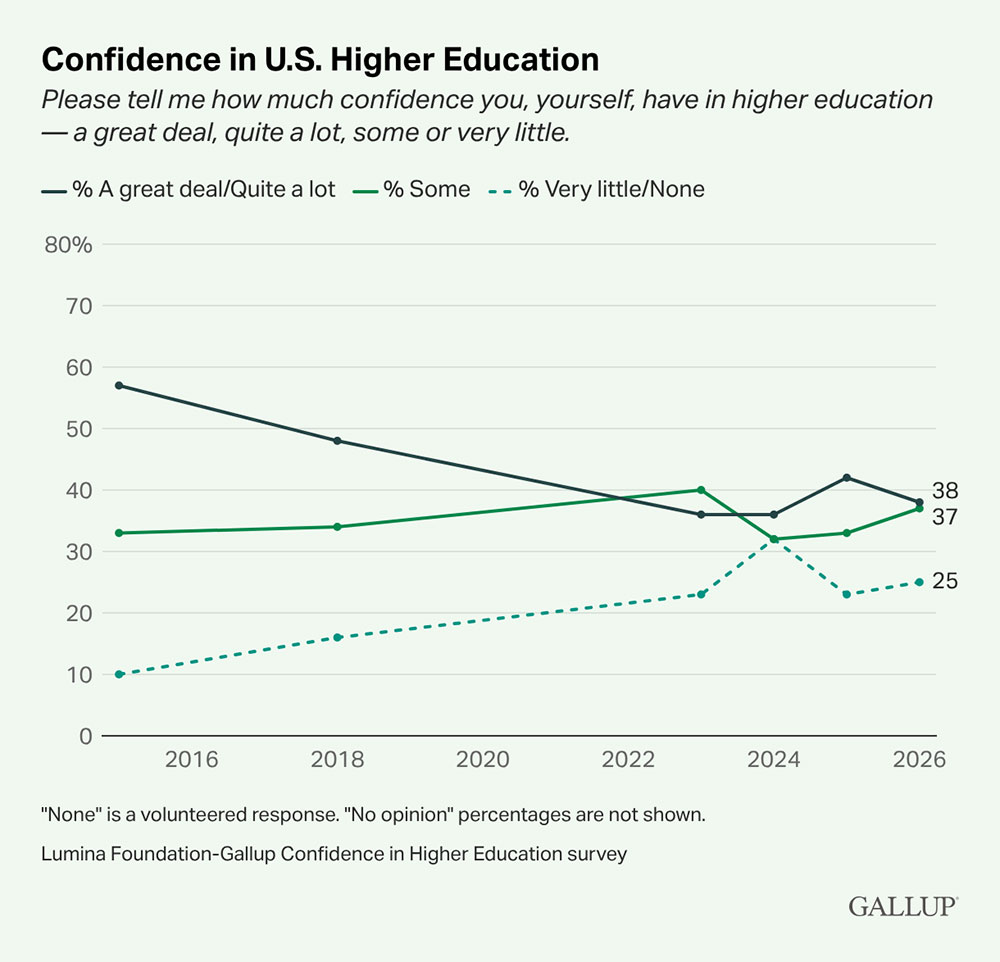
The bedrock of societal progress, higher education, is facing an unprecedented crisis of confidence. A recent Gallup poll reveals that public trust in colleges and universities has plummeted, falling at a rate four times steeper than that for other core civic institutions. This erosion of faith isn't a fleeting trend; it's a profound shift that demands immediate attention from educators and policymakers alike, signaling a critical juncture for how we perceive and value academic institutions in the coming year.
The Steep Slide: Confidence in Higher Education Hits New Lows
For years, the narrative surrounding higher education has been one of upward mobility and intellectual growth. However, recent data paints a starkly different picture. Confidence in American colleges and universities has seen a dramatic decline, a trend that shows little sign of immediate reversal.
“Confidence in higher education is still very fragile,” said Courtney Brown, vice president of impact and planning at Lumina.
The numbers are sobering. A decade ago, a significant majority of Americans held a high degree of confidence in higher education. This year, however, that figure has dipped significantly, underscoring a widespread skepticism about the value and purpose of these institutions. This decline is not uniform; it reflects complex societal shifts and evolving expectations.
This erosion of trust isn't happening in a vacuum. It mirrors a broader disillusionment with many established institutions, yet the speed and severity of the decline in higher education are particularly alarming. It suggests a deeper, more fundamental questioning of what colleges and universities offer and their role in society.
The Shifting Sands of Political Support
Political polarization has emerged as a significant driver of the declining confidence in higher education. The landscape of support has shifted dramatically, particularly among Democrats, who have historically been strong advocates for academic institutions.
The latest Gallup poll indicates a notable drop in confidence among Democrats, a segment of the population that has consistently shown higher levels of trust in colleges and universities compared to Republicans. This shift is a critical development, suggesting that even traditional bastions of support are not immune to the prevailing skepticism.
Conversely, while Republican confidence has remained relatively low, the decline among Democrats signifies a broader, cross-party concern. This suggests that the issues driving this loss of faith are not solely partisan but are resonating across the political spectrum, albeit with different intensity and reasons.
Ideological Battles and Curricular Concerns
A primary concern cited by the public revolves around the perceived ideological leanings and content of college curricula. This has become a focal point of national debate, influencing how individuals view the educational experience offered by universities.
Disagreements over what is taught in classrooms and the extent to which ideology plays a role are significant contributors to this skepticism. These debates often overshadow discussions about academic rigor and the actual learning outcomes for students.
The perception that colleges are becoming too politically charged can deter students and parents alike, leading them to question the objectivity and value of the education provided. This creates a challenging environment for institutions striving to maintain their academic integrity and public trust.
The Cost-Benefit Conundrum: Is College Worth It?
Beyond ideological debates, the escalating cost of higher education and doubts about its return on investment are major factors contributing to the decline in public confidence. Americans are increasingly scrutinizing whether the significant financial commitment aligns with tangible career and life benefits.
The question of value is paramount. With tuition fees soaring, students and their families are demanding clearer evidence that a college degree translates into better job prospects and higher earning potential. The current economic climate, with a challenging job market for recent graduates, only exacerbates these concerns.
“Americans across the political spectrum are asking harder questions about value and affordability, and whether higher education is actually preparing people for the workforce,” Brown noted. “Those questions aren’t going away.”
This financial anxiety is not new, but it has intensified as the perceived benefits of a degree seem less guaranteed. The traditional promise of a college education as a direct pathway to economic security is being re-evaluated in light of current realities, prompting a demand for greater transparency and demonstrable outcomes from educational institutions.
The Broader Institutional Trust Deficit
The decline in confidence in higher education is part of a larger trend of diminishing trust in many of America's core institutions. While colleges and universities have experienced a steeper drop, the general trend indicates a widespread skepticism towards established bodies.
Institutions like Congress, the Supreme Court, and big business have also seen their public approval ratings fall over the past decade. This suggests a societal shift in how citizens perceive the reliability and effectiveness of the systems that underpin their lives.
This pervasive lack of trust can have far-reaching consequences, impacting everything from civic engagement to economic stability. For higher education, it means that the public's expectations are higher than ever, demanding tangible proof of their societal contribution and individual student success.
What This Means for Educators: Navigating the New Landscape
The current climate presents significant challenges for educators, demanding a proactive and adaptable approach. Understanding the root causes of this declining confidence is the first step towards rebuilding trust and demonstrating the enduring value of higher education.
Educators must focus on tangible outcomes and transparent communication. This involves clearly articulating the skills and knowledge students gain, and how these translate into meaningful career paths and personal development. Leveraging tools for effective teaching and assessment can play a crucial role here.
For instance, implementing AI lesson plan tools can help create more relevant and engaging curricula, directly addressing concerns about what is taught. Similarly, utilizing AI grading tools can streamline assessment, allowing educators more time to focus on pedagogical innovation and student support.
Strategies for Rebuilding Confidence
Rebuilding confidence requires a multi-faceted approach, focusing on transparency, demonstrable value, and student success. Educators and institutions must actively work to bridge the gap between public perception and the reality of the educational experience.
Here are key strategies that educators can implement:
- Enhance Transparency in Outcomes: Clearly communicate graduation rates, post-graduation employment statistics, and salary data. Make this information easily accessible to prospective students and the public.
- Demonstrate Value Beyond the Degree: Highlight the development of critical thinking, problem-solving, and communication skills. Showcase how these transferable skills prepare students for a dynamic workforce and fulfilling lives.
- Engage in Public Dialogue: Actively participate in conversations about the role and value of higher education. Address public concerns directly and provide evidence-based responses.
- Foster Experiential Learning: Integrate internships, co-op programs, and real-world projects into the curriculum. These experiences provide practical skills and tangible evidence of learning.
- Utilize Technology for Engagement: Employ tools that enhance learning and engagement, such as MentofyCove classroom games for interactive review sessions or interactive board widgets on MentofyBoards to keep students actively involved in lessons.
The ability to create dynamic learning experiences is crucial. Tools that facilitate active participation and immediate feedback can significantly boost student engagement and perceived value. For example, using live quiz options or incorporating word search game activities can reinforce learning in fun and memorable ways.
Furthermore, the effective use of lesson planning resources can ensure that curricula are aligned with current industry needs and societal expectations. This proactive approach to curriculum design is essential for demonstrating relevance and value.
The Role of Technology in Demonstrating Value
Technology offers powerful avenues for educators to showcase student learning and institutional effectiveness. From innovative assessment methods to engaging learning platforms, technology can be a key ally in rebuilding trust.
Tools like Mentofy Academia, with its robust exam creator capabilities and AI grading for handwritten responses, can streamline assessment processes, allowing educators to focus more on teaching and student interaction.
Moreover, platforms that facilitate collaboration and active learning can significantly enhance the student experience. Features like MentofyGroups for smart student grouping and icebreakers can foster a more inclusive and productive learning environment. The availability of Mentofy is free for teachers makes these powerful tools accessible to all, regardless of institutional budget.
The ability to create dynamic and interactive learning environments is no longer a luxury but a necessity. Whether through trivia game sessions or other engaging activities, educators can use these tools to demonstrate the vibrant intellectual life and tangible learning outcomes of their institutions.
Looking Ahead: A Call for Renewed Purpose and Transparency
The current crisis of confidence in higher education is a wake-up call for all stakeholders. It is an opportunity to re-evaluate the mission, methods, and messaging of academic institutions.
Moving forward, the focus must be on clearly demonstrating the tangible benefits of higher education, both for individuals and for society as a whole. This requires a commitment to transparency, accountability, and continuous adaptation to meet the evolving needs of students and the job market.
The future of higher education hinges on its ability to prove its enduring value and relevance in a rapidly changing world. By embracing innovation, fostering open dialogue, and prioritizing student success, institutions can begin to reverse the trend and restore public faith in the transformative power of college.





 Explore AI Teaching Tools
Comments (0)
Please login to comment
No comments yet
Be the first to comment on this article