
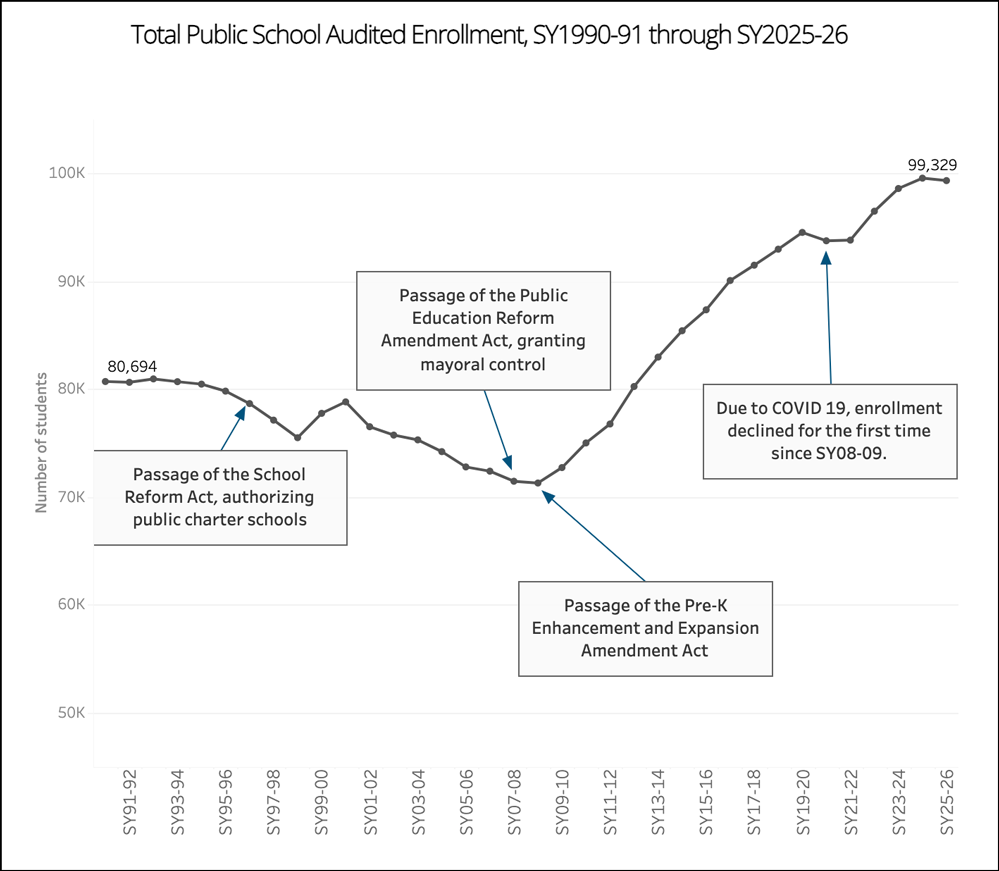
Washington D.C.'s public education system stands at a critical juncture. After years of remarkable academic gains and enrollment growth, the incoming mayor faces a complex landscape of declining student numbers, looming budget deficits, and a deep ideological divide over the future of reform. For educators across the city, this political test means navigating potential shifts in policy that could profoundly impact their classrooms and the students they serve.
A Decade of Unprecedented Growth Now Faces Headwinds
For over a decade, Washington D.C. was a beacon of educational progress. Student enrollment surged, drawing young families into the city, and academic outcomes climbed steadily. This period of sustained improvement, largely guided by a consensus-driven incumbent, saw the city's schools achieve remarkable gains.
However, the economic expansion that fueled this growth has stalled. Federal job cuts and a pandemic-induced urban exodus have led to a decline in birth rates and, consequently, a dip in student rolls for the first time in recent memory. This demographic shift coincides with a projected $1 billion deficit, creating significant financial challenges for the school system.
A 2024 survey of 1,200 K–12 educators in Washington D.C. revealed that nearly 40% are concerned about the impact of budget cuts on classroom resources and staffing levels.
Compounding these issues is a troubling decline in student attendance. Nearly 40% of children are now missing at least one-tenth of the school year, a trend that imperils even the promising recovery from post-COVID learning loss. This attendance crisis demands immediate attention and innovative solutions from school leaders and policymakers.
The Political Divide: Continuity vs. Radical Change
The upcoming mayoral race in Washington D.C. highlights a stark ideological divide, particularly concerning education policy. The two leading candidates, Kenyan McDuffie and Janeese Lewis George, represent fundamentally different visions for the city's future, and their approaches to K–12 education are no exception.
McDuffie's platform signals a commitment to continuity, emphasizing policies that have historically driven reform, such as direct mayoral control and robust accountability for teachers and schools. This approach aligns with the legacy of reform efforts that have, in many ways, been successful for the city.
Conversely, Lewis George, a city councilor, has positioned herself as a challenger to the status quo. Her proposals include granting education leaders more independence from the mayor's office and potentially dismantling established teacher evaluation frameworks. This stance has garnered significant support from the Washington Teachers Union.
The Washington Teachers Union's Shifting Allegiances
The endorsement of Janeese Lewis George by the Washington Teachers Union (WTU) underscores the growing desire among educators for a more collaborative relationship with city leadership. The union has long advocated for greater autonomy and a de-emphasis on high-stakes testing in teacher evaluations.
WTU President Laura Fuchs has been a vocal critic of top-down reforms, arguing that teachers have worked hard to mitigate their negative impacts. Under Lewis George, Fuchs believes educators will find a more receptive audience and a partner in shaping educational policy.
“What Janeese represents, in so many ways, is that she takes us seriously and believes that we are partners,” stated WTU President Laura Fuchs in a recent interview.
While the union's support for Lewis George is clear, Fuchs also acknowledges that the candidate may not fulfill every item on the union's extensive wish list. The alignment, however, signals a significant shift in the political dynamics surrounding education in the city.
Revisiting the Era of Ambitious Experimentation
The current debate in Washington D.C. echoes the broader national conversation within the Democratic Party, particularly the legacy of ambitious educational experimentation from the Obama era. The District has been a compelling case study, showcasing significant student achievement gains when national trends showed stagnation.
Thomas Toch, director of Georgetown University’s FutureEd research institute, views D.C.'s model of improvement as a national "beacon." He cautions against abandoning policies that have demonstrably benefited students over an extended period, emphasizing the importance of sustained reform efforts.
The reforms Toch refers to largely began in 2007 under Mayor Adrian Fenty. His administration transferred school governance to the mayor and implemented a new teacher evaluation system, IMPACT, spearheaded by then-Chancellor Michelle Rhee. This era was marked by bold initiatives and national attention, including a cover story in Time magazine.
The Legacy of Michelle Rhee and the IMPACT System
Michelle Rhee's tenure as D.C. schools chancellor was transformative, characterized by a strong focus on accountability and performance. The IMPACT system, introduced in 2009, ranked teachers based on student test scores, with significant implications for compensation and employment.
This system, while lauded by some for driving improvements, also generated considerable controversy. Critics pointed to its reliance on standardized testing and the perceived pressure it placed on educators. The rapid closure of underperforming schools also alienated some parents and communities.
Despite the initial turbulence and subsequent political shifts, the positive trajectory of student learning in Washington D.C. has become undeniable. Data from the National Assessment of Educational Progress (NAEP) shows substantial gains in math and reading for D.C. fourth and eighth graders between 2003 and 2019, a period when many other urban districts saw scores stagnate.
A 2021 analysis by Mathematica highlighted that Washington's ascent during the 2010s was comparable to the significant improvements seen in New Orleans post-Katrina. This sustained progress suggests that the foundational reforms, even if controversial, laid a groundwork for long-term success.
The Post-Pandemic Reality: Attendance and Recovery
While the long-term gains are encouraging, the immediate challenges posed by the pandemic cannot be ignored. Student achievement dipped during the COVID-19 crisis, but recent data indicates a strong recovery. Year-over-year academic progress since the nadir of the pandemic has actually outpaced the period preceding the public health emergency.
The Education Scorecard, a project involving scholars from Dartmouth, Harvard, and Stanford, found that D.C. Public Schools (DCPS) experienced the fastest academic recovery among cities nationwide between 2022 and 2025. This remarkable rebound is a testament to the resilience of students and educators.
Chelsea Coffin, an education policy specialist for the D.C. Policy Center, views these recent state assessment results as a "very good sign." She notes significant gains in both math and English across nearly all wards and major student subgroups, even surpassing pre-pandemic levels.
“What we saw last school year were really large gains — even compared to what D.C. had been posting pre-pandemic — in both math and English, across almost all wards and most major subgroups,” Coffin observed.
Despite this positive momentum, Coffin acknowledges that D.C. still has a long way to go to ensure all students are on grade level. The challenge now is to sustain this forward momentum amidst evolving political and financial landscapes.
Teacher Evaluations Under Scrutiny: The IMPACT Debate
The IMPACT system, a cornerstone of the reform era, remains a significant point of contention, particularly for the Washington Teachers Union. The union points to high annual teacher turnover rates, which have sometimes exceeded 20%, as evidence of the system's detrimental effects.
WTU leaders describe IMPACT as a "tool of control," arguing that it fosters an overreliance on testing and creates an environment of fear for educators. They contend that any attempts to provide teachers with more flexibility or job security are met with system adjustments that tighten control.
Refinements to IMPACT have been ongoing since its inception, addressing initial miscalculations and perceptions of bias. DCPS has commissioned reviews to combat claims of racial bias in evaluations, aiming for greater fairness and transparency.
Janeese Lewis George has pledged to end the IMPACT system if elected, asserting that it "undermines educators’ expertise and students’ joy of learning." While she supports maintaining mayoral control over schools, her suggestion of transforming the superintendent's office into an independent agency raises concerns among some about potential reduced oversight of student data and standards.
The Risk of Abandoning Proven Accountability
Despite the criticisms, proponents of accountability frameworks like IMPACT emphasize their importance in driving workforce improvements. David Grosso, a former city councilor and chair of the education committee, argues that such systems provide the "foundation" for career ladders and performance-based pay.
Grosso worries that abandoning teacher ratings would be a significant step backward. He poses critical questions about how to implement pay-for-performance or establish career pathways without the ability to differentiate between teacher effectiveness. This, he suggests, was a problem the District faced historically and continues to grapple with in much of the country.
The critiques from progressive groups and unionized workers, while valid in their concerns, can sometimes overshadow the genuine progress D.C. has made. Unlike some conservative states that have become poster children for educational turnarounds, D.C.'s consistent gains in a predominantly Democratic jurisdiction receive less national fanfare.
Navigating Budgetary Shortfalls and Structural Challenges
Beyond the ideological debates, the next mayor will face significant structural challenges, most notably mounting budgetary shortfalls. The city's ability to fund both district and charter schools at current levels is under threat, potentially impacting everything from school renovations to new academic programs.
The economic landscape has shifted, with a reduced federal presence and a post-pandemic reality that demands fiscal prudence. Funding for educational initiatives will likely depend on the District's capacity to adapt to these new economic realities.
Bisi Oydele, CEO of Education Forward D.C., acknowledges the need for retrenchment across both DCPS and charter schools. He points to CFO revenue projections that are "not great," indicating that educators and families may need to prepare for leaner times. D.C. currently spends approximately $2 billion annually on education, a figure directly tied to revenue and economic forecasts.
The city also faces the immediate task of finding a replacement for outgoing Chancellor Lewis Ferebee, who announced his resignation last month. This leadership transition adds another layer of complexity to an already challenging period.
The Path Forward: Prudent Reform and Sustained Progress
As Washington D.C. heads into its mayoral election, the future of its acclaimed public education system hangs in the balance. The incoming mayor must not only address the immediate financial and attendance crises but also navigate the deep ideological currents shaping K–12 policy.
The city's journey from a struggling district to a national model of improvement is a story worth celebrating and, more importantly, sustaining. While the debate between continuity and change is inevitable, the focus must remain on what best serves the students of Washington.
For educators, this means advocating for policies that support their professional growth, enhance student learning, and ensure equitable opportunities for all. Tools that streamline lesson planning, facilitate engaging classroom activities, and support effective student grouping can be invaluable in this endeavor. For instance, exploring Mentofy AI teaching tools for AI lesson plan creation or utilizing MentofyCove classroom games for interactive learning can empower teachers to meet these evolving demands.
The incoming mayor has a critical opportunity to build upon the hard-won gains of the past decade. By fostering collaboration, embracing evidence-based practices, and prioritizing the needs of students and teachers, Washington D.C. can continue its trajectory as a leader in American education, ensuring that the next chapter is as successful as the last.






 Explore AI Teaching Tools
Comments (0)
Please login to comment
No comments yet
Be the first to comment on this article