
Unlocking Potential: Why Learner Wallets Need a Human-Centric Design
The landscape of digital credentials and learner employment records (LERs) is rapidly evolving, with legislative support and industry partnerships gaining significant traction.
While the infrastructure for these systems is being meticulously built, the true measure of their success hinges on one critical factor: user adoption.
This article delves into the challenges of current learner wallet designs and proposes a transformative, learner-first approach that fosters genuine engagement and lasting value, ensuring that these powerful tools don't fall by the wayside.
The Crucial Gap: Building for the System vs.
Building for the Learner
Many initiatives focused on learner wallets and digital credentials are driven by the needs of the industry – the demand for standardized employment records and verifiable skills.
However, this focus often overlooks the most vital component: the learner themselves.
The process of manually populating a learner wallet, detailing every prior experience and piece of knowledge, can be an arduous and uninspiring task.
Even for individuals deeply invested in the future of work, the effort required to maintain such a record can feel like a chore.
If those who understand the system's importance struggle with its upkeep, it's a significant indicator that the current approach may not resonate with younger learners who are still exploring their identities and career paths.
The uncomfortable truth is that we are often creating tools that the industry requires rather than tools that individuals genuinely want to use.
This is akin to updating a traditional resume; it's a task performed out of necessity, not intrinsic motivation.
The goal should be to develop systems that learners engage with organically, much like how individuals passionately track their fitness goals, curate book lists on platforms like Goodreads, or find meaning in personality assessments and horoscopes.
These popular tools tap into fundamental human desires: the need to understand oneself, to craft a personal narrative, and to articulate one's identity in a controlled and meaningful way.
The Power of Identity Formation: Lessons from Everyday Digital Engagement
Consider the applications that have achieved widespread daily use.
These platforms don't typically market themselves as preparatory tools for future employment.
Instead, they succeed by tapping into deeper psychological drivers:
- Social Commitment and Loyalty (e.g., Snapchat Streaks): These features foster a sense of ongoing connection and accountability, making users invested in maintaining their engagement.
- Collection and Cataloging (e.g., Pokémon Go, Spotify): The act of gathering, organizing, and showcasing items or content provides a sense of accomplishment and personal expression.
- Continuity and Learning (e.g., Duolingo): Consistent engagement with learning modules, coupled with visible progress, builds momentum and reinforces the value of ongoing development.
- Language and Understanding (e.g., Enneagram, Myers-Briggs): These frameworks offer learners a vocabulary and structure to understand themselves and others, fostering self-awareness and articulation.
- Performance and Achievement (e.g., Strava): Tracking and sharing personal bests and progress appeals to the innate human drive for improvement and recognition.
These examples highlight a critical insight: successful tools empower users to understand, craft, and articulate who they are.
This process is inherently user-controlled, emphasizing radical control over privacy settings and data sovereignty.
The starting point for creating truly valuable learner wallets shouldn't be "this will help you get a job in the future." Instead, it should be rooted in the learner's present reality: "I am documenting this because this is who I want to become," or "I am documenting this because this is who I am right now."
Designing for the Learner: A Hypothetical Journey with Leo
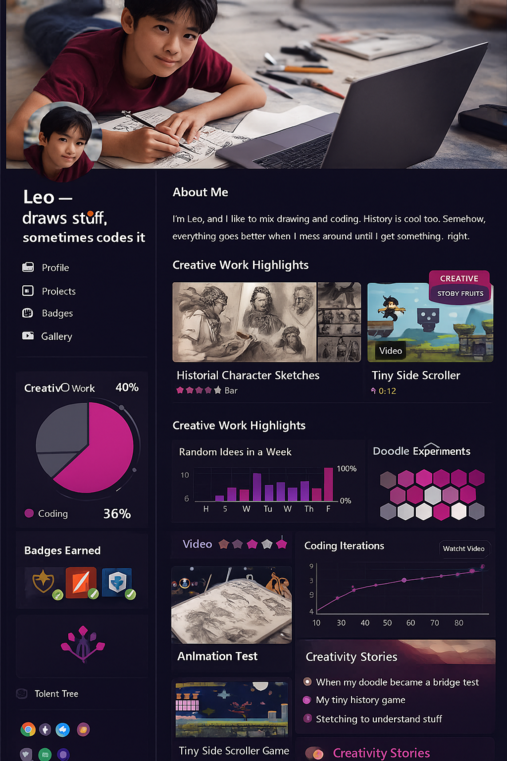
To illustrate a learner-centric approach, let's imagine Leo, a 16-year-old who feels scattered due to his diverse interests in coding, sketching, and history.
His teachers encourage him to "focus," leading him to feel guilty about his varied pursuits and perceive himself as lazy.
Leo is precisely the kind of student who would benefit immensely from a learner wallet, yet he's also the least likely to voluntarily populate one if it feels like homework or a future-oriented task.
The current design asks him to document for an imagined employer, rather than for his own immediate understanding and growth.
Now, let's explore how a learner-first design could transform Leo's experience:
The "Storm Chaser" Archetype: Embracing Variety
Upon first engaging with the app, Leo doesn't face a tedious survey.
Instead, he plays a mini-game that presents him with a problem-solving scenario.
Based on his choices, the app assigns him an archetype: "The Storm Chaser." The description reads: "You thrive in chaos.
You don't walk a straight line; you gather energy from variety.
Your superpower is Synthesis—connecting things that don't belong together." His avatar is a dynamic character with a constantly shifting cloak, visually representing his multifaceted nature.
A Week in Leo's Life: Gamified Learning and Self-Discovery
Monday: Creative Flow
Leo sketches during math class, feeling a pang of guilt but also immersed in his work.
The app passively detects his use of creative applications during school hours and rewards him with "Aether Dust," a virtual resource for creativity.
A prompt appears: "Your Creative Mana spiked during school hours.
What triggered the flow state?" Leo is presented with options, including "I was bored/avoiding work," "I had a sudden idea I couldn't lose," and "I was stressed."
This prompt is crucial because it helps Leo differentiate between avoidance and genuine inspiration – a core aspect of metacognition.
This self-knowledge is invaluable for his future, but more importantly, it helps him understand himself in the present.
He selects, "I had a sudden idea I couldn't lose."
Tuesday: Building Resilience
Leo faces a dreaded math test and activates "Dungeon Mode" for a focused 45-minute study session.
Upon completion, he receives a "Stone of Will," a resilience item.
The prompt: "Boss Battle Complete.
You defeated 'Procrastination.' What weapon was most effective?" Leo tags his response: "#LoFiBeats #PhoneInOtherRoom."
Through this, he identifies environmental conditions that aid his concentration, not for a college application, but for future study sessions.
This data is immediately actionable for his learning.
Wednesday: Processing Failure
Leo performs poorly on his math test, feeling overwhelmed and inadequate.
The app allows him to log a "Failed Quest," transforming the negative experience into a "Cracked Shield," a resilience item.
The prompt: "Damage Report: You took a hit.
Where was the breach in your armor?" Leo reflects and realizes the issue wasn't a lack of intelligence, but test anxiety.
He is building self-awareness, not just a credential.
Thursday: Emotional Processing
Still affected by the failed test, Leo isolates himself.
The app invites him to the "Campfire," a space to connect with others experiencing similar struggles.
He earns "Empathy XP," and his avatar's lantern glows.
The prompt: "Your energy feels low today.
If your avatar could speak, what would it say?" Leo records a voice note: "I just feel like everyone else gets it faster than me.
I'm tired of trying hard and still failing."
This encourages him to name his emotions, a vital step in emotional regulation.
This is organic social-emotional learning, not a mere checklist item.
Friday: The Synthesis Moment
Leo incorporates geometry concepts into an art project, achieving a successful outcome.
He shares a photo, and the app recognizes the tags #Math and #Art, awarding him a "Synergy Bonus." The prompt: "Wait... did you just use a Skill from a different class?
How did [Math] help [Art]?" Leo responds: "I used the tessellation patterns from the textbook to make the background cool."
This is the coveted transfer of learning, achieved because the app motivated him to reflect and document his journey, not because of a potential employer's interest.
This experience, and variations of it designed for diverse learning modalities, can ensure broader engagement.
Research and Design Recommendations for Lasting Impact
For learner employment records and digital credentials to truly succeed, we must shift our focus from infrastructure to the human experience.
The following research and design recommendations are crucial for building tools that learners will embrace:
1.
Mastering the Art of Self-Reflection
Humans are not inherently adept at self-reflection.
We need to draw insights from fields like counseling, neuroscience, journalism, and coaching to understand how to ask the right questions at the right time.
Ensuring that metacognition remains central to the learner's experience, rather than relying solely on AI to categorize experiences, is paramount.
This metalearning process is arguably the most important element, as it builds the confidence and articulation that, in a social capital-driven hiring landscape, can be even more impactful than the accompanying digital wallet.
2.
Identifying Truly Valuable Evidence
The field of skill extraction is rapidly advancing, with AI capable of analyzing vast amounts of data to predict success.
However, we need to determine which types of evidence and metadata hold the most significance.
Is it supervisor validation, rich multimedia documentation, or the narrative depth of an experience?
Crucially, who controls and owns this data?
More importantly, how do we empower the individual to guide their own development rather than simply checking boxes dictated by a system?
3.
Investigating the AI Companion Question
AI companions are showing immense potential for facilitating incremental growth throughout learning journeys.
However, there is significant, and justifiable, resistance from many young people who are wary of AI and the surveillance implications of these tools.
Having witnessed data misuse, they are understandably concerned about losing control.
Integrating AI into the data privacy equation may necessitate a cultural shift towards embracing self-sovereignty.
This also raises critical equity concerns, as surveillance disproportionately affects certain communities.
4.
Developing Novel Forms of Data Ownership
Currently, the data within our educational and employment systems is often owned by institutions, not individuals.
Obtaining transcripts or employer validations can be a bureaucratic maze.
We must experiment with data self-sovereignty, interoperability, and ownership to create tools where users have complete agency over what is visible.
This promotes equity by allowing individuals to selectively surface information in meaningful ways.
When individuals cannot be penalized by their data being misused by others, the inherent risks diminish.
5.
Prioritizing Student-Led Design
What would happen if we presented this design challenge directly to students?
Organizations like iThrive Games demonstrate the power of allowing learners to problem-solve through game design.
If our goal is to create a tool that teenagers use daily, can we truly believe that adults alone are best positioned to implement it?
A student-led design process would ensure that the resulting tools are not only functional but also engaging and relevant to their lived experiences.
The Path Forward: Fast, Fair, and Fun Learning Journeys
As Audrey Tang, former Minister of Digital Affairs of Taiwan, advocates for civic processes, our approach to learner wallets should be Fast, Fair, and Fun.
We need to prioritize adoption through self-attested information first, followed by data APIs.
While the data infrastructure work is ongoing and momentum is building, the fundamental product question remains: How do we make this a habit-forming and generative tool for young learners?
The answer is not to build a better resume.
It is to create something that helps young people answer the profound question: "Who am I becoming?" The employment benefits will naturally follow as a positive side effect of excellent learning design.
By solving the problem of learner engagement and self-discovery, we significantly simplify the workforce challenges.
A learner wallet, when designed with the individual at its core, is more than just a repository for credentials; it is a mirror that empowers young people to see themselves clearly – in their past, their present, and their future.
Let us commit to building tools that are not just useful, but truly worth gazing into.






 Explore AI Teaching Tools
Comments (0)
Please login to comment
No comments yet
Be the first to comment on this article