
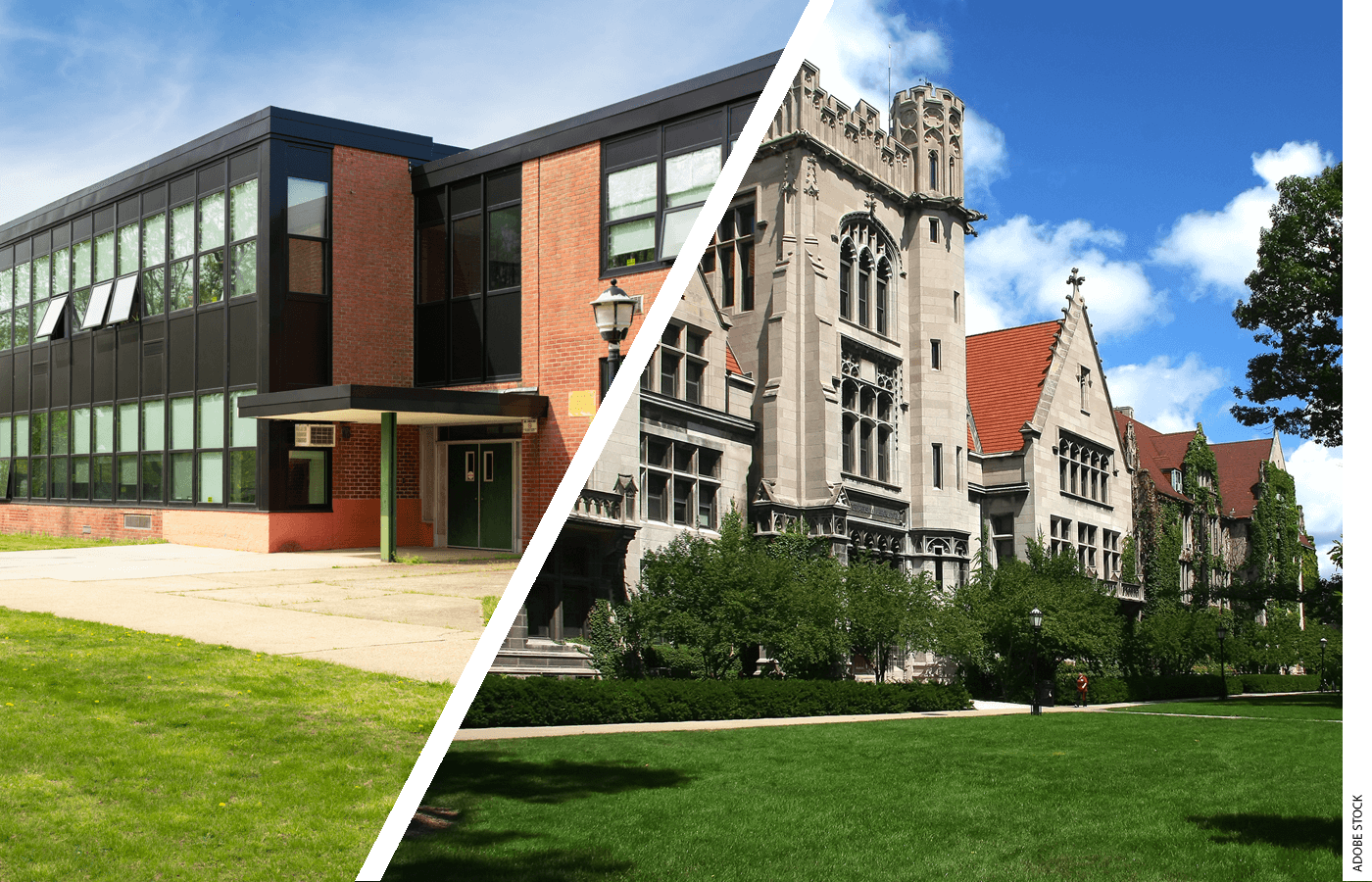
Bridging the Divide: Understanding the Stark Differences Between K–12 and Higher Education
The landscape of education is vast and multifaceted, yet often, the distinct worlds of K–12 schooling and higher education remain shrouded in mystery for those on either side.While both are dedicated to fostering learning and student development, their origins, structures, and operational philosophies diverge significantly.
This article delves into the fundamental reasons behind these differences, offering a comprehensive overview for students, educators, and policymakers alike.
Understanding these distinctions is crucial for effective leadership and informed decision-making within the broader educational ecosystem.
1.
The Genesis of Educational Systems: Pedigree and Ancestry The foundational differences between K–12 and higher education are deeply rooted in their historical origins.
Early institutions of higher learning in America, emerging as far back as the 17th century, were predominantly private and often faith-based.
They drew inspiration from centuries-old European models, establishing a distinct lineage focused on specialized scholarship and intellectual pursuits.
In contrast, the comprehensive K–12 public education system in the United States is a much younger construct, largely taking shape in the mid-19th century.
This system was born out of a uniquely American vision, influenced by thinkers like Tocqueville, emphasizing universal access and civic development.
The K–12 system was designed from its inception to be a public good, a stark contrast to the more exclusive beginnings of many universities.
This divergence in ancestry means that they evolved from fundamentally different institutional roots, shaping their subsequent trajectories.
2.
Divergent Paths: Subsequent Historical Developments Following their initial establishment, K–12 and higher education systems were shaped by distinct historical movements and policy reforms.
The K–12 sector was profoundly influenced by the "common schools" movement, which championed universal literacy and compulsory education.
Key developments included the rise of high schools, debates over religious instruction, the professionalization of teaching during the Progressive Era, school consolidation efforts, and the establishment of educator licensure standards.
These initiatives collectively aimed to create a standardized and accessible educational experience for all.
Higher education, on the other hand, navigated a different set of transformative forces.
Landmark legislation like the Morrill Act, which established land-grant colleges, and the creation of Historically Black Colleges and Universities (HBCUs) expanded access and specialized missions.
The growth of academic disciplines, the surge in federal research funding, the establishment of tenure systems, significant philanthropic contributions, and the impact of the GI Bill after World War II all played pivotal roles in shaping the modern university.
These distinct historical currents propelled K–12 and higher education in fundamentally different directions.
3.
Serving All vs.
Serving Some: The Scope of Educational Mandates A core differentiator lies in the fundamental mandate of each educational sector.
The K–12 education system is legally obligated to serve every single student within its jurisdiction.
Public schools must be accessible to all children, regardless of background or ability.
This universal service requirement dictates everything from school location and funding mechanisms to policies on special education, transportation, accessibility, and support for diverse student populations, including immigrant and homeless youth.
This "service for all" ethos permeates K–12 policy and practice.
Higher education operates under a fundamentally different paradigm.
No single institution is required to serve every individual, and the system as a whole does not bear an obligation to accommodate everyone.
This freedom influences institutional choices regarding admissions, curriculum, faculty hiring, and the range of services offered.
Students in higher education actively choose their educational path, selecting institutions and programs that best align with their specific interests and career aspirations.
This distinction profoundly impacts how each sector conceives of its mission and its clientele.
4.
The Engine of Education: Funding Models and Their Implications The financial underpinnings of K–12 and higher education reveal significant disparities.
Approximately 90 percent of K–12 students attend public schools, which are primarily funded through state and local tax revenues.
Funding formulas are a critical aspect of K–12 policy, often allocated based on student enrollment and demographic factors.
This public funding model underscores the societal investment in educating all children for the collective benefit.
While public colleges and universities receive some state operational support, the majority of their revenue, and indeed the bulk of higher education funding overall, comes directly from students in the form of tuition and fees.
Private institutions rely even more heavily on tuition, supplemented by private donations and endowments.
This student-pay model has led to a vast ecosystem of student loans and grants, making financial aid policy a central concern in higher education.
Crucially, this funding difference means that different stakeholders—the public for K–12, and students for higher education—effectively "call the tune," leading to distinct operational priorities and behaviors.
5.
Defining Success: The Varied Purposes of Education The perceived purpose of education serves as another critical point of divergence.
K–12 education is widely understood as a preparatory phase, aiming to equip young people with the foundational skills, habits, and dispositions necessary for success as family members, community contributors, workers, and citizens.
This includes mastering basic academic subjects, developing essential life skills like cooperation and perseverance, and acquiring knowledge to facilitate transitions into employment or further education.
Higher education, while also contributing to these broader goals, often pursues more specialized objectives.
Historically, universities provided a broad liberal education.
Today, they offer immense flexibility, allowing students to pursue specific majors, specializations, and even micro-credentials.
Unlike K–12, where state regulations heavily influence curriculum, higher education professors and departments typically have significant autonomy in determining course content and academic programs.
Many believe that institutional offerings increasingly reflect the preferences of faculty and the demands of the job market.
Consequently, asking a K–12 principal and a university provost about student success will likely yield very different answers, influencing resource allocation and institutional identity.
6.
Measuring Progress: Performance Metrics and Accountability The emphasis on performance measurement differs dramatically between the two sectors.
Given the substantial public investment in K–12 education and its focus on foundational skills, robust assessment systems are in place.
These include standardized tests, statewide assessments in reading and math, high school graduation exams, and civics and history evaluations.
Students also prepare for standardized college entrance exams like the SAT and ACT.
Sophisticated systems track school and teacher effectiveness, and results are often disaggregated by demographic factors to identify learning disparities.
Complex state accountability frameworks mandate interventions for underperforming schools.
Higher education, by contrast, generally lacks this level of standardized, system-wide performance measurement.
While individual courses involve papers and exams, there are typically no standardized assessments across similar courses nationwide, nor are there universal graduation examinations to gauge college-level learning.
Quantifying the direct impact of colleges on student learning can be challenging.
While some research examines the "return on investment" using graduate salaries, this often overlooks broader educational outcomes.
In essence, K–12 produces a wealth of data used for public and policymaker assessment, while higher education relies more heavily on market forces and student perceptions.
This difference in measurement shapes how success is conceived and pursued.
7.
Governance and Structure: Navigating Institutional Frameworks The institutional arrangements and governance structures of K–12 and higher education are markedly different.
Public K–12 education operates within a hierarchical system characterized by local decision-making and state-level oversight.
School districts, established by state law, are typically governed by locally elected school boards, fostering a decentralized and democratic approach.
However, state constitutions mandate the provision of primary and secondary education, granting state boards of education and superintendents significant supervisory authority.
Higher education presents a more complex governance landscape.
Over a third of four-year institutions are private, operating with private boards that may have less public transparency.
Public colleges and universities are often overseen by boards appointed by governors or state legislatures, and in many states, a single board governs multiple institutions.
Crucially, accreditation standards, tradition, and internal university policies grant campuses considerable autonomy.
Furthermore, higher education often embraces "shared governance," where faculty play a significant role in departmental and college-level decision-making.
This can complicate efforts to implement change from the top, making institutional agility a unique challenge.
8.
Local Roots vs.
Global Reach: The Role of Geography The geographical context and perceived community role of educational institutions create another key distinction.
K–12 schools are widely viewed as integral community institutions.
They are governed by local boards, serve local children, and are often funded by local taxes.
Their faculty and staff frequently hail from the same communities, fostering a strong connection to local sensibilities.
This local focus often leads to dynamic interplay between local decision-makers and state or federal authorities.
In contrast, relatively few institutions of higher education primarily identify as community institutions.
Many private universities attract students from across the globe, viewing themselves as serving an international community.
Large public flagship universities often see their mission as serving the interests of the entire state or nation.
While some regional institutions cater to local job markets, they are not typically governed at the local level, nor do they draw the majority of their students from their immediate surroundings.
Deference to local community will is a hallmark of K–12 education; this is far less common in higher education.
9.
Uniformity vs.
Diversity: The Spectrum of Educational Offerings The historical aspiration of the "common schools" movement was to create a network of similar, locally run public schools serving all students equitably.
This vision led to a degree of standardization in K–12 education, with state policies dictating aspects of curriculum, teacher qualifications, building specifications, and textbook selection.
Visiting five randomly chosen public elementary schools across America often reveals striking similarities in their operational approach and educational environment.
American higher education, from its inception, lacked this drive for uniformity.
Colleges and universities emerged with diverse missions: some focused on ministerial training, others on cultivating elite leaders, and still others on serving specific regional or vocational needs.
Institutions varied in their admissions policies (e.g., single-sex), pedagogical approaches (e.g., liberal arts vs. job-readiness), and religious affiliations.
This inherent diversity means that the concept of "school choice" is a natural assumption in higher education, whereas it can be a highly contentious issue in K–12 circles.
10.
Scale and Complexity: The Scope of Operations The sheer scale of operations presents a significant difference.
The average K–12 school serves around 500 students, with districts encompassing larger student populations but maintaining the school as the central operational unit.
However, the central actor in higher education is the campus, which can be enormous.
Universities frequently enroll tens of thousands of students, operate hundreds of buildings, house numerous colleges and departments, employ thousands of faculty and staff, and manage budgets in the billions.
This scale necessitates extensive administrative infrastructure, including large legal, financial, human resources, facilities, and public safety departments, in addition to academic support.
Decisions regarding tenure, new program development, land use, and complex financial agreements are routine.
While K–12 schools face their own unique challenges—such as navigating local tax issues, mediating parent conflicts, or addressing disciplinary matters—the operational scope and administrative complexity of higher education institutions are generally on a much larger scale.
Conclusion
The distinctions between K–12 and higher education are not merely semantic; they are deeply embedded in their historical trajectories, funding models, governance structures, and fundamental purposes.From their differing pedigrees and subsequent historical developments to their mandates of serving "all" versus "some," and their varied approaches to funding and performance measurement, these two vital sectors of education operate with distinct philosophies and priorities.
Understanding these differences is paramount for anyone seeking to navigate, lead, or contribute effectively to the educational landscape.
By appreciating the unique characteristics of each, we can foster greater collaboration and a more nuanced understanding of the diverse needs of students at every stage of their learning journey.




 Explore AI Teaching Tools
Comments (0)
Please login to comment
No comments yet
Be the first to comment on this article