
Beyond the Silos: How Reimagining Teacher Collaboration is Unlocking Student Potential
Imagine a world where the fundamental structures of education aren't etched in stone, but are instead fluid, adaptable, and designed with the student at the absolute center. For too long, the prevailing model of "one teacher, one classroom, one roster" has been treated as an immutable law of nature. But what if these deeply ingrained rules about how educators work were, in fact, just that – rules, made up once, and therefore open to being remade?
This provocative idea is at the heart of a groundbreaking initiative reshaping how teachers collaborate, moving beyond the confines of traditional classroom structures. It’s a shift that promises to unlock new levels of student support and teacher efficacy, proving that the most significant barriers are often not systemic failures, but inherited assumptions.
The Unseen Architecture of Education
Conversations about school reform often fixate on tangible elements like bell schedules, grading policies, and the concept of "seat time." While these are undeniably important, they represent only one layer of the educational edifice. Beneath the surface lies another set of rules, largely unexamined, dictating the very fabric of how teachers interact and share their expertise.
The default setting for most educators is a solitary existence within their own classroom walls. This isolation, where each teacher is solely responsible for their students and their subjects, feels like an unchangeable fixture of the educational landscape. Yet, it's a choice, a design decision that most teachers have never been explicitly invited to question or reimagine.
A Collective's Bold Experiment
At Thrive, a commitment was made to challenge this status quo. The result is the Thrive Bridge Collective, a vibrant community of practice uniting teacher teams from five diverse schools across the Bay Area. This initiative spans elementary and secondary settings, encompassing both district and charter systems, offering a rich cross-section of how collaborative work can manifest in varied environments.
These dedicated teams are not merely tinkering with existing structures; they are fundamentally redesigning what authentic collaboration looks like, building it from the ground up. Their work is a testament to the power of collective intelligence when educators are empowered to innovate.
Agency, Not Just Disruption
The Thrive Bridge Collective was not conceived as a force for radical disruption, aiming to dismantle schools. Instead, its foundation rests on a more nuanced premise: that educators, when provided with the right framework, tools, and support, possess an inherent capacity to discover greater agency in how they collaborate than they might have previously believed.
The notion of a single teacher owning a single classroom, the rigid separation of subject areas, fixed student rosters, and the idea that differentiation is an individual endeavor – these are all constructs, not immutable laws. Once teachers begin to recognize this flexibility, a profound shift in perspective occurs, opening the door to transformative practices.
Working Within, Not Against, the System
A key tenet of the Thrive Bridge Collective is its commitment to operating within existing educational systems. Each teacher team remains embedded within their familiar school environment, serving the same students, adhering to the same bell schedules, and meeting the same accountability structures. The objective is not to encourage teams to opt out of their context.
Instead, the initiative encourages teams to meticulously examine their current environment, identify areas of flexibility, and strategically redesign the organization of time, students, and expertise within those established constraints. This grounded approach ensures that innovations are practical and sustainable.
From Abstract Ideas to Concrete Solutions
In practice, this means that teams are not starting with abstract theories of innovation. Their journey begins with identifying a concrete problem that directly impacts their students. They then leverage their collective expertise to redesign their collaborative work, ensuring it more effectively addresses that specific need.
Across the Collective, this has translated into tangible shifts, such as:
- Reorganizing student groupings across classrooms to provide targeted instruction based on data-identified needs.
- Distributing specialized content expertise across a team, rather than expecting each teacher to possess and deliver it all.
- Creating shared blocks of time where multiple teachers collectively assume responsibility for all students, moving beyond individual rosters.
- Establishing consistent routines and instructional approaches to foster coherence for students as they transition between different teachers.
A Structured Year of Growth
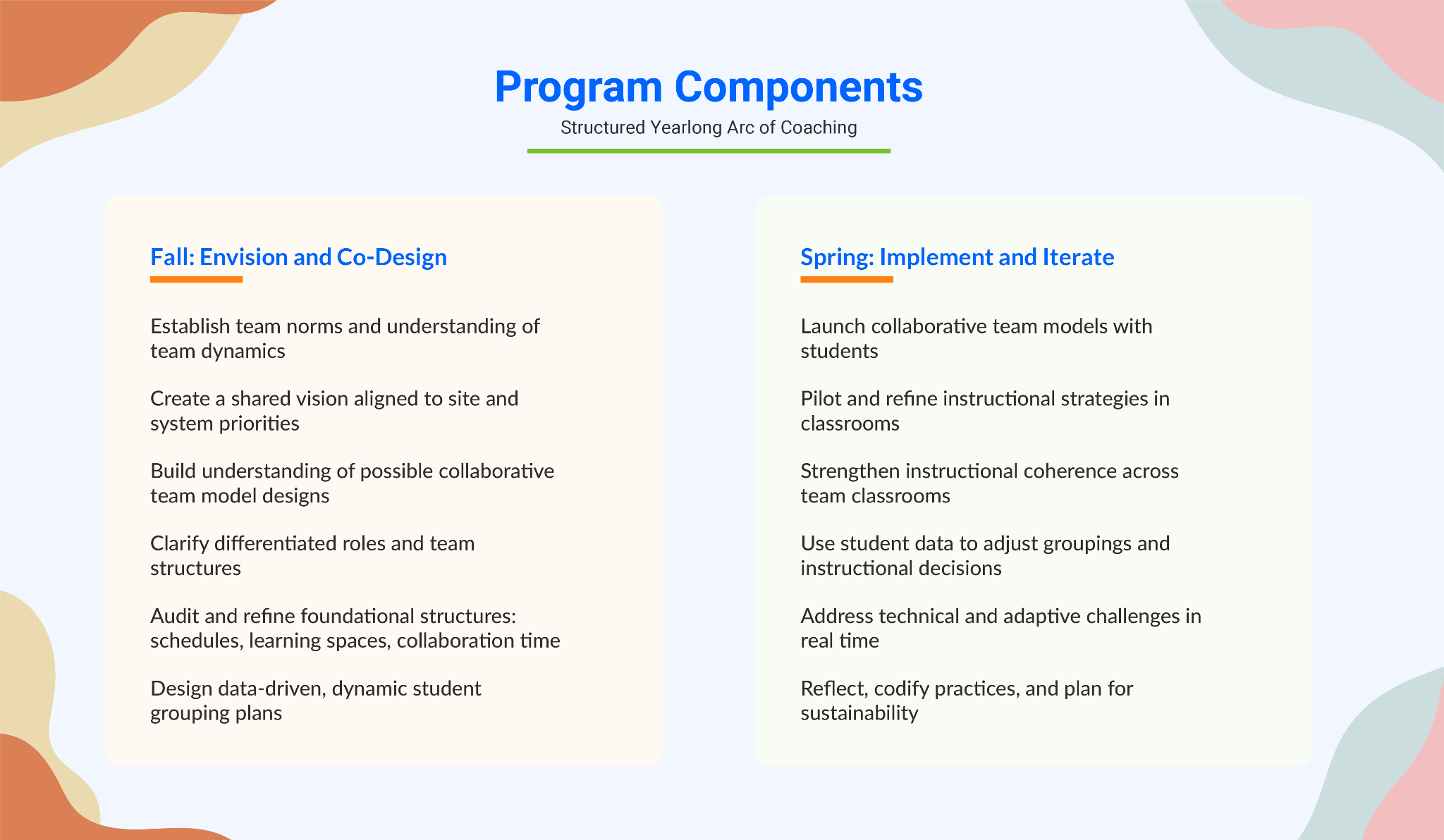
Each participating team navigates a structured, year-long arc designed for deep learning and implementation. The fall semester is dedicated to identifying a specific focus and designing a collaborative model rooted in genuine student needs. Simultaneously, teams cultivate their ability to function as cohesive units.
This includes developing a shared vision for effective instruction, clarifying roles and responsibilities, and establishing sustainable working methods that benefit both students and the educators themselves. The spring semester is then devoted to launching, testing, and refining these models in real-time with students.
Throughout the year, teams engage with their peers across different schools through open houses, dilemma consultancies, and calibration protocols. This cross-pollination of ideas fosters mutual learning and makes the innovative work of each team visible to the wider community.
Building a Theory of Change
Crucially, every team constructs a theory of change, informed by Thrive’s Strategic Staffing Assessment. This theory explicitly connects the specific shifts in their collaborative practices to the desired student and educator outcomes. Because this theory is co-created by the team, it becomes a dynamic tool for decision-making, progress reflection, and iterative design.
Five Schools, Five Unique Pathways
The true power of the Collective lies not in a prescribed framework, but in the diverse and context-specific models that five distinct teams have built and implemented. The guiding question was never about finding the "right" model, but rather about identifying what their specific model needed to solve for their students.
The answers to this question have led to five unique approaches, each deeply grounded in real-world constraints, the specific needs of their students, and the dedication of teams committed to working differently together.
Rocketship Mosaic | San Jose, CA | Grades K–5
The fifth-grade team at Rocketship Mosaic transformed their two classrooms into a shared instructional space with clearly defined roles. One teacher now leads STEM instruction for all students, while the other facilitates a Learning Lab that blends enrichment activities with targeted intervention. Both teachers share responsibility for humanities instruction, and students move fluidly between them throughout the day based on instructional purpose rather than a fixed homeroom assignment.
Student groupings are dynamic and regularly adjusted using data, enabling the team to respond swiftly to evolving needs. During independent work periods, students engage with differentiated learning playlists, which strategically create opportunities for teachers to pull small groups for focused, targeted support. These integrated structures ensure that differentiation is a shared, intentional practice across the entire team, rather than an isolated responsibility for each individual teacher.
Adelante Dual Language Academy | San Jose, CA | Grades TK–8
At Adelante Dual Language Academy, the team expanded their vision beyond a single grade level, reorganizing designated English Language Development (ELD) support across grades 3–5. Students are grouped based on their language proficiency, utilizing multiple data sources to inform these decisions. Teachers then plan and deliver instruction for their assigned language group, rather than focusing solely on their homeroom students.
These groupings are revisited regularly, ensuring that instruction remains highly responsive and personalized to the evolving needs of each student. This dynamic approach allows for more effective and targeted support for English language learners.
Michelle Obama School | Richmond, CA | Grades TK–6
The fifth-grade team at Michelle Obama School implemented a content-specialized model, where one teacher leads English Language Arts (ELA) and Social Studies, while the other focuses on Math and Science for all students across both classrooms. Instead of each teacher delivering all subjects to their own roster, students rotate between teachers for core instruction based on the subject matter. The team has meticulously aligned routines, expectations, and instructional approaches to ensure students experience a consistent and coherent learning environment across classrooms.
Later in the day, fifth and sixth graders are combined and regrouped for dedicated English Language Development based on their proficiency levels. Teachers plan for their assigned language group, and these groupings are adjusted as student needs evolve, ensuring continuous and responsive support.
New School San Francisco | San Francisco, CA | Grades K–8
The first-grade team at New School San Francisco reimagined their phonics block by grouping students across classrooms based on targeted skill needs. Ongoing progress monitoring data is used to adjust these groups over time, ensuring that support remains relevant and effective. Multiple educators share responsibility for all students, each taking on a defined instructional role, including providing enrichment and targeted small group instruction.
What makes this model particularly distinct is the seamless integration of specialized supports directly into the core phonics block. Speech and language services and resource support are embedded within this block, allowing students to receive targeted assistance within the context of grade-level learning. This approach fosters greater continuity for students and enables specialists to work collaboratively as part of a shared instructional system, rather than operating in isolation.
Summit Prep | Redwood City, CA | Grades 9–12
At Summit Prep, the AP English Language and AP U.S. History courses have been redesigned into a shared instructional model, anchored by a comprehensive research paper that all juniors are required to complete. Rather than treating these courses as separate entities, the teachers have co-designed the project as a central, unifying experience that integrates reading, writing, historical analysis, and argumentation skills.
They meticulously co-plan each phase of the project, align pacing across both classes, and utilize shared rubrics to assess student work consistently. Key lessons are co-taught, and students are encouraged to pursue topics of their own interest, fostering deeper engagement with the material. What appears as a single assignment is, in reality, a sophisticated, coordinated system across two courses, where the responsibility for student learning is intentionally shared and reinforced across content areas.
The Threads That Bind These Innovations
It is crucial to note that no two models developed within the Collective are identical, and that is precisely the point. The Collective was intentionally designed to foster learning across diverse school contexts, with the ultimate goal being not to replicate a single model, but to understand the profound possibilities that emerge when teacher teams are empowered to rethink their collaborative practices.
The insights gleaned from the Collective are now informing a broader initiative in partnership with Teach For America Bay Area and their Collaborative for Reimagining the Teaching Profession. This collaboration aims to connect and nurture these innovative efforts across the region, creating the conditions for this work to evolve from isolated instances of innovation into a shared movement to redefine teaching roles, team structures, and pedagogical approaches that can better serve both students and educators throughout the Bay Area.
Concurrently, Educators Thriving is conducting in-depth research across the participating schools to gain a deeper understanding of how these transformative shifts impact teacher well-being, engagement, and long-term sustainability. This research will provide valuable data to support the ongoing evolution of collaborative teaching models.
What unites these five distinct teams is not a shared blueprint, but a shared orientation towards problem-solving and growth. Each team began by identifying unmet student needs that the existing structures were not adequately addressing. Each team meticulously built a theory of change that explicitly linked their evolving team practices to tangible outcomes.
Furthermore, each team was actively supported to prototype, reflect, and adjust their approaches, rather than being expected to implement a predetermined design. And in this process, each team discovered a common truth: the most significant obstacle to working differently was not a lack of resources or systemic rigidity, but the deeply ingrained assumption that the current arrangements were fixed and unchangeable.
As a preceding analysis aptly put it, it is not the infrastructure that is failing educators, but rather the inherited assumptions that underpin it. And these assumptions, it turns out, are entirely redesignable when teachers are provided with the necessary support and the crucial space to undertake that redesign.




 Explore AI Teaching Tools
Comments (0)
Please login to comment
No comments yet
Be the first to comment on this article