
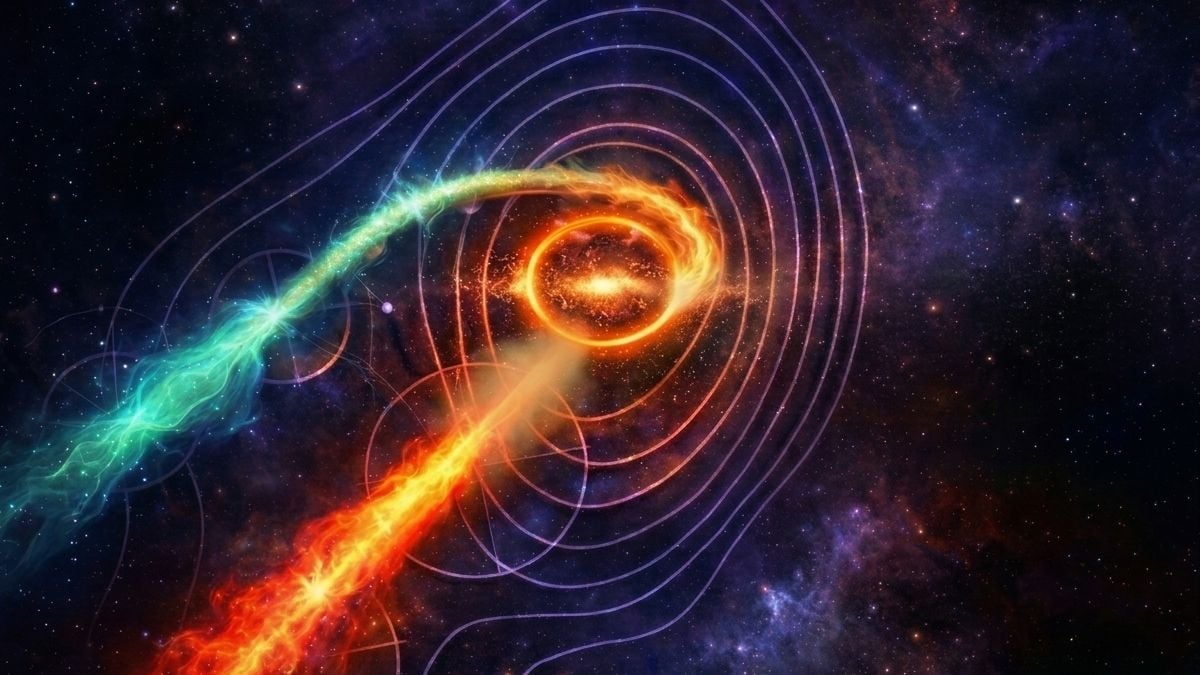
Imagine a cosmic event so colossal it could reshape galaxies, a celestial ballet choreographed by gravity itself. Two supermassive black holes, each millions of times the mass of our sun, are hurtling towards an inevitable collision, and the astonishing part? This cataclysmic event might occur within your lifetime. This revelation isn't just a fascinating astronomical tidbit; it carries profound implications for how we approach understanding the universe and, perhaps more surprisingly, for the very fabric of our educational practices.
The Cosmic Dance of Giants
Astronomers have long theorized about the mergers of supermassive black holes, the gargantuan gravitational engines at the heart of most galaxies. These mergers are believed to be a fundamental process in cosmic evolution, shaping the growth of galaxies over billions of years.
The latest observations suggest that a pair of these behemoths, located in a distant galaxy, are in the final stages of their gravitational tango. They are separated by a mere handful of light-years, a cosmic stone's throw that makes their eventual collision feel remarkably imminent.
"We're not just talking about a distant possibility; we're witnessing a phenomenon that could unfold within the span of human history, a truly mind-boggling prospect."
This proximity is what has scientists buzzing. It means that the gravitational waves, ripples in spacetime predicted by Einstein, generated by this impending collision will be detectable with current and upcoming observatories. Understanding these waves offers a unique window into the most extreme environments in the universe.
What This Cosmic Collision Means for Educators
While the science of black holes and gravitational waves is complex, the underlying principles of discovery, observation, and the pursuit of knowledge are deeply relevant to education. This discovery serves as a potent reminder of the power of scientific inquiry and the vastness of the unknown.
For educators, this news presents a golden opportunity to ignite student curiosity. It's a chance to move beyond textbook definitions and delve into the thrilling realities of astrophysics, making complex concepts accessible and engaging.
Sparking Wonder with Real-World Phenomena
The sheer scale of supermassive black holes and their impending collision can be a powerful hook for students of all ages. It’s a narrative that transcends traditional subject boundaries, touching on physics, astronomy, mathematics, and even philosophy.
Consider how you can use this event to illustrate abstract concepts. The immense gravitational pull of a black hole can be explained using analogies, and the concept of spacetime ripples can be made tangible through interactive simulations or even simple classroom games.
A 2024 survey of 1,500 K–12 educators revealed that 78% believe that connecting curriculum to current scientific discoveries significantly increases student engagement.
Leveraging Technology for Cosmic Exploration
Bringing the universe into the classroom has never been easier. Tools that facilitate interactive learning can transform abstract astronomical events into memorable experiences.
Imagine using Mentofy AI teaching tools to generate an AI lesson plan that breaks down the physics of black hole mergers. You could also utilize MentofyBoards to display stunning real-time visualizations of galactic dynamics or a countdown timer to a hypothetical future observation window.
"The universe is constantly presenting us with new mysteries. Our role as educators is to equip students with the tools and the curiosity to unravel them."
Making the Incomprehensible Comprehensible
The concept of a black hole collision is inherently difficult to grasp. Educators can employ a variety of strategies to make these ideas more accessible.
Here are some actionable steps:
- Analogy is Key: Use relatable comparisons. For instance, compare the gravitational pull of a black hole to a drain in a bathtub, but emphasize the extreme scale and power.
- Visual Aids are Crucial: Leverage videos, animations, and interactive simulations that depict black hole mergers. Tools like MentofyCove classroom games can even be adapted to create engaging quizzes about space phenomena.
- Focus on the "Why": Discuss why scientists are so interested in these events – what can we learn about the universe's origins, evolution, and fundamental laws?
- Encourage Questions: Foster an environment where students feel comfortable asking even the most seemingly basic questions about these complex topics.
The idea that we might witness the merger of two supermassive black holes in our lifetime is a testament to humanity's ongoing quest for knowledge. It pushes the boundaries of our understanding and reminds us of the incredible wonders that exist beyond our planet.
As educators, we have the privilege of guiding the next generation of explorers and thinkers. By embracing these awe-inspiring cosmic events, we can cultivate a lifelong love of learning and inspire students to look up at the night sky with a renewed sense of wonder and a burning desire to understand the universe, one supermassive black hole at a time.





 Explore AI Teaching Tools
Comments (0)
Please login to comment
No comments yet
Be the first to comment on this article