
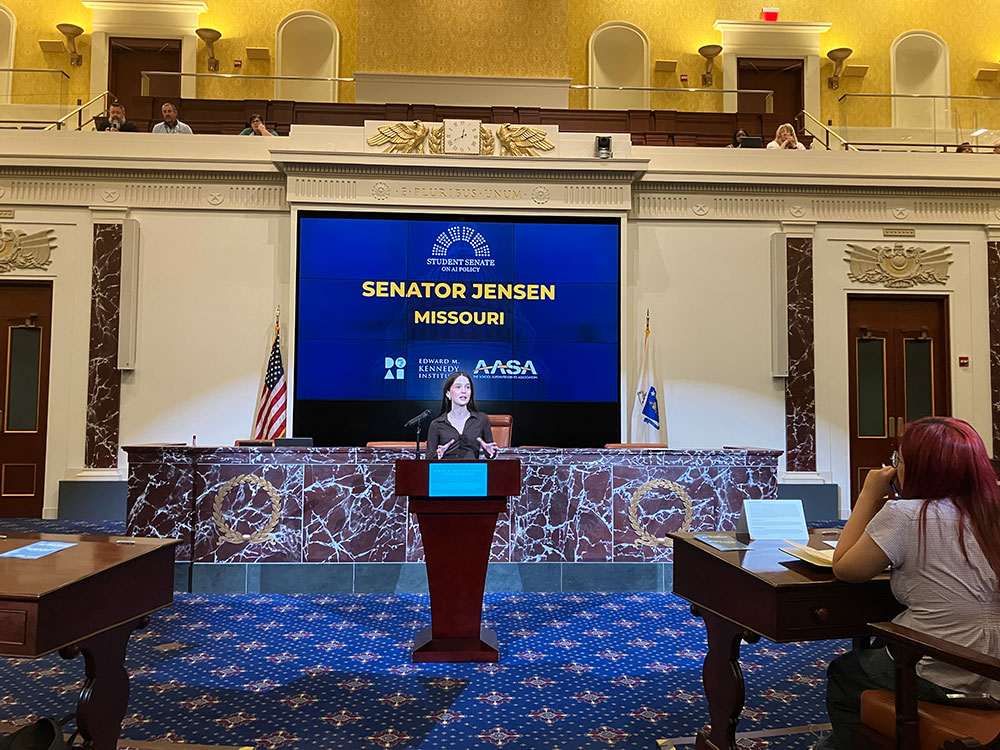
In a development that signals a seismic shift in how we approach digital citizenship and academic integrity, a group of 100 high school students from across the United States convened to draft an AI Bill of Rights for schools. This initiative, born from genuine concerns about the pervasive influence of artificial intelligence in their education, highlights an urgent need for educators to actively involve students in shaping the future of AI integration within the school environment.
Students Demand a Seat at the AI Policy Table
The recent gathering, sponsored by organizations including an MIT research initiative and a national superintendents’ association, brought together diverse student voices to articulate principles for AI use. These students, who have grown up with generative AI as a constant presence, are not just passive recipients of this technology; they are actively seeking to define its ethical boundaries and pedagogical applications within their academic lives.
This proactive stance underscores a critical realization for educators: the conversation around AI in schools cannot, and should not, be solely top-down. Students like Tatiyana Reaves, who faced an assignment penalty for using the word "whilst" — a linguistic quirk mistaken for AI output — exemplify the immediate, often frustrating, disconnect between student practice and current school policies. Her experience, and those of many others, necessitates a collaborative approach to developing guidelines that are both practical and equitable.
"We basically outline that AI, with the proper supervision, is a great tool for brainstorming and studying."
The students’ concerns span a broad spectrum, from the perennial issue of academic dishonesty to more nuanced challenges like AI hallucinations, cognitive offloading, and the mental health and environmental impacts of widespread AI adoption. These are not abstract worries; they are lived realities shaping the daily educational experiences of students nationwide.
Navigating the Ethical Minefield: Cheating, Transparency, and Trust
The specter of AI-facilitated cheating looms large, a concern echoed by educators and students alike. Many students acknowledged that AI presents an "easy way out," a temptation that bypasses the often arduous but essential process of genuine learning. This observation is particularly poignant when considering how AI tools can be used not just to find answers, but to circumvent the very effort required for understanding.
James Baxter, a 14-year-old participant, articulated this sentiment, noting that while people "like to know hard things, but learning it is a different story for most people." This highlights the fundamental challenge: how to harness AI's power to support learning without diminishing the intrinsic value of intellectual struggle and mastery.
Transparency also emerged as a key issue. Students are grappling with how to appropriately disclose their use of AI tools, especially when they serve as aids for brainstorming or understanding complex concepts. The goal, as articulated by some, is to use AI as a tool for deeper comprehension, rather than a shortcut to avoid it.
Dillian Campbell shared an anecdote about a math teacher who acknowledged AI use but placed the onus on students to pass the test, emphasizing that true understanding remains paramount. This approach, while direct, underscores the need for clearer frameworks that guide both student behavior and teacher expectations.
The Student Perspective on AI's Role
The students’ deliberations revealed a nuanced understanding of AI's potential benefits and pitfalls. They recognized AI as a powerful assistant for tasks like generating study guides or exploring different approaches to a problem. However, they drew a firm line when it came to using AI to answer test questions or generate work that should be a demonstration of personal learning.
Ethan Liu, a recent graduate, emphasized that AI should be a tool "to help kids truly understand the topic without just spoon-feeding them the answer." This perspective is crucial for educators aiming to foster genuine intellectual growth rather than superficial task completion. It also suggests that tools like Mentofy AI teaching tools, which can assist in generating practice problems or offer step-by-step explanations, can be valuable when used with this pedagogical intent.
The students’ discussions also touched upon the importance of AI literacy instruction starting early, ideally as soon as students begin using digital devices in the classroom. This literacy should encompass not only academic use but also critical evaluation of AI outputs, including identifying misinformation, understanding bias, and protecting privacy.
Beyond Cheating: Deeper Concerns About AI's Impact
The student-led discussions went far beyond the immediate concern of cheating, delving into the broader societal and psychological implications of AI. One significant worry is the potential for AI to undermine interpersonal relationships. Bihmanji Acho expressed distress over adults using AI as a therapist, highlighting a concern that technology might replace vital human connection and support systems.
This sentiment resonates with the idea that AI, while offering efficiency, can inadvertently erode essential human skills like empathy, critical thinking, and the ability to navigate complex social dynamics. The students' insights suggest a need for schools to foster environments that prioritize these human elements, even as technology advances.
Another critical point raised was the potential for AI to foster a sense of disengagement or "cognitive offloading." Tatiyana Reaves observed that many students who heavily rely on AI are "super-smart kids that are, like, just checked out." This loss of student agency, where the drive to learn and overcome challenges is outsourced, poses a significant threat to developing resilient, independent thinkers.
“It’s an easy way out,” said James Baxter, 14, from St. George, Utah. “People like to know hard things, but learning it is a different story for most people.”
Gyimah Whitaker, superintendent of the Decatur, Ga., school district, echoed this concern, noting that AI can undermine the values of project-based learning and rigorous curricula by pushing students toward task completion rather than deep mastery. This perspective underscores the importance of educators designing assignments that inherently require critical thinking, problem-solving, and creativity, tasks that are more difficult to outsource to AI.
The Call for AI Literacy for All
The students’ recommendations implicitly and explicitly call for enhanced AI literacy, not just for students but also for teachers. Cynthia Breazeal, director of MIT’s RAISE research program, stated that AI literacy is no longer optional. The rapid proliferation of generative AI necessitates a fundamental re-evaluation of pedagogical models, encouraging deeper student engagement with material.
This echoes the philosophy of Seymour Papert, who championed "hard fun" – the productive struggle involved in mastering complex concepts. The idea is to encourage students to build, explore, and embrace difficulty, rather than seeking to avoid or outsource it. This might involve incorporating more hands-on projects, debates, or presentations where students must demonstrate their understanding in ways that are less susceptible to AI shortcuts.
The PISA exam’s upcoming assessment of AI literacy in 2029 serves as a stark reminder of the global imperative to prepare students for an AI-integrated future. The potential for American students to lag behind internationally on this critical skill set highlights the urgency for schools to act decisively.
Rethinking Assessment and Instruction in the Age of AI
The students’ discussions naturally lead to questions about how schools can adapt their assessment and instructional strategies. Chase Johnson suggested that instead of assigning essays easily completed by AI, teachers should focus on assignments that require in-person presentations or collaborative problem-solving, where "You can’t cheat your way out of that."
Sarah Zahka offered a pragmatic approach, using AI for step-by-step problem-solving in math or for initial brainstorming in writing, but always ensuring the final work is her own. She acknowledged that this might mean not always achieving the highest grade if "cheaters" get them, but it guarantees she understands the material at her own level. This commitment to authentic learning is a valuable lesson for all educators.
The very act of students proposing an AI Bill of Rights is, in itself, a powerful learning experience. It fosters critical thinking, civic engagement, and a deep understanding of the ethical dimensions of technology. Educators can leverage this by creating opportunities for similar student-led discussions and policy development within their own schools.
The advent of AI also presents an opportunity for educators to explore new tools that can enhance learning while mitigating risks. For instance, using Mentofy AI teaching tools for exam creation can help generate a variety of question types that test higher-order thinking, while MentofyGroups can facilitate dynamic student grouping for collaborative projects. Similarly, MentofyCove classroom games can offer engaging ways to review material, making learning more interactive and less susceptible to passive AI consumption.
The students’ deliberations, while imperfect and still evolving, offer a compelling blueprint for how schools can navigate the complex landscape of AI. Their commitment to defining principles for responsible AI use, alongside their concerns about its broader impact, provides educators with invaluable insights. The challenge now is for schools to heed these calls for collaboration and co-creation, ensuring that the integration of AI serves to enhance, rather than diminish, the educational journey for all students.
The future of AI in education will be shaped not just by technological advancements or administrative policies, but by the thoughtful, engaged participation of students themselves. By embracing their perspectives and empowering them to be active stakeholders in this evolving digital world, educators can build a more equitable, effective, and human-centered learning environment for generations to come.





 Explore AI Teaching Tools
Comments (0)
Please login to comment
No comments yet
Be the first to comment on this article