
Beyond the Portrait: How Districts Can Actually Build Personalized Learning Systems
For years, school districts across the nation have embraced the concept of "Portraits of a Graduate." These aspirational documents, often the result of extensive community input, articulate the essential skills and competencies students need to thrive in a rapidly changing world – think collaboration, adaptability, problem-solving, and a strong sense of agency. Yet, for many, the journey stops there. The portrait adorns websites and hangs in classrooms, a beautiful declaration of values, but the fundamental learning model often remains stubbornly unchanged.
This disconnect isn't a failure of vision; it's a fundamental challenge in design. When daily schedules fragment learning into isolated blocks and grading systems prioritize compliance over genuine mastery, the very structure of our educational systems contradicts the outcomes we claim to value. As educators and leaders, we must recognize that the rules governing education today are not immutable laws of nature but rather constructs designed for a different era. The critical question is whether we possess the collective will to redesign them for the students of today.
Bridging the Vision-Practice Chasm: The Power of Disciplined Research & Development
For those who have poured their energy into crafting these graduate portraits, the gap between aspiration and reality can be disheartening. Witnessing students engage deeply in meaningful learning, only to see that engagement stifled by outdated grading policies, rigid schedule constraints, or entrenched legacy systems, is a familiar frustration. The issue isn't a lack of dedication from educators; it often lies within the very infrastructure of our educational systems.
Common obstacles include:
- Learning models that fail to integrate the desired graduate outcomes.
- Curriculum, instructional practices, and assessment methods that don't align with the portrait's vision.
- Signals such as transcripts and report cards that don't reflect the competencies outlined in the portrait.
- Learning ecosystems that are resistant to adapting to a district's core design principles.
Closing this gap requires more than just mandates; it necessitates a disciplined approach to Research and Development (R&D). While a pilot project might test a specific instructional unit, true R&D probes the deeper systemic shifts required for transformation. It asks not just "Does this unit work?" but rather, "What must change in our grading, scheduling, staffing, and policy frameworks for this to succeed at scale?"
As experts in the field observe, pilots offer a safe space to tweak existing practices, but R&D demands courage. It involves scrutinizing not only classroom instruction but also the underlying structures that govern schools: transcripts, funding models, staffing configurations, accountability systems, and the unspoken rules that subtly shape the educational experience. Most districts engage in pilots; far fewer commit to robust R&D, which is why so many ambitious transformation efforts falter.
Pilots rarely uncover the systemic barriers that prevent innovations from scaling. Disciplined R&D, conversely, involves:
- Clearly identifying a specific system constraint that needs testing.
- Creating a protected environment to test this constraint with a diverse group of students representative of the district's population.
- Meticulously documenting what works, what breaks, and what support adults require to sustain the changes.
- Leveraging these learnings to inform broader system redesign efforts.
Framing this work as R&D also mitigates political risk. It signals a commitment to disciplined experimentation and learning before widespread implementation, allowing leaders to confidently state, "We are learning before we scale."
Matching the Container to the Complexity: Scaling R&D Strategically
The scale and nature of an R&D effort should be carefully matched to the complexity of the learning challenge being addressed. Not every redesign requires the same level of structural intervention.
Here's a breakdown of how different scales of testing reveal different insights:
- 1–2 Classrooms: Best for testing shifts in grading, feedback cycles, or project-based units. This level reveals whether a practice can function within existing structures. For example, two teachers might pilot mastery-based grading and meticulously document the understanding required from students and families.
- Small Cohort (3–4 teachers, 60–100 students within an existing school): Ideal for exploring interdisciplinary collaboration, flexible grouping strategies, and shared planning models. This scale illuminates what teachers need to collaborate effectively across content areas and how students respond to sustained, integrated learning experiences. A cohort might test project-based learning that weaves together math, science, and humanities, carefully documenting the planning time and collaborative structures necessary.
- Microschool (60–150 students, often with a distinct identity or protected policy space): This environment is crucial for testing competency-based progression, policy waivers, community partnerships, and multi-system shifts. It reveals how the broader infrastructure must adapt when scheduling, grading, and staffing are simultaneously reimagined. A district microschool could test competency-based progression with flexible scheduling and performance-based assessment, providing invaluable data for system-wide changes.
The distinction between these levels goes beyond mere size; it encompasses the degree of autonomy and policy flexibility afforded to the experimental space. If the goal is to test a new rubric or a specific learning progression, a microschool is likely unnecessary. However, if the question is whether mastery can truly replace seat time, a few classrooms will not provide a comprehensive answer.
Sometimes, R&D occurs across multiple scales concurrently. For instance, a district might be investigating how to create a system that is "quality, rigid, and time flexible" through competency pathways at the secondary level. This district-wide question necessitates testing at the classroom, cohort, and dedicated microschool levels to understand the systemic changes required at each tier of the educational infrastructure.
When Microschools Unlock Systemic Innovation
Microschools, when intentionally embedded within larger district systems, are not simply boutique educational offerings. They function as powerful engines for infrastructure-level R&D, providing environments where multiple structural elements can be tested and redesigned simultaneously. Microschools prove particularly valuable when a district is testing:
- Policy flexibility related to seat time or transcript requirements.
- Competency-based progression models that fundamentally disrupt traditional pacing.
- Community-integrated, place-based, or real-world learning experiences.
- The simultaneous redesign of scheduling, grading, and staffing structures.
Crucially, equity must be a non-negotiable component of this work. If a district microschool exclusively serves self-directed, high-achieving students, it is not genuine innovation but rather a form of tracking disguised with more appealing branding. A district microschool should never serve as an escape hatch for students who are already thriving within the existing system.
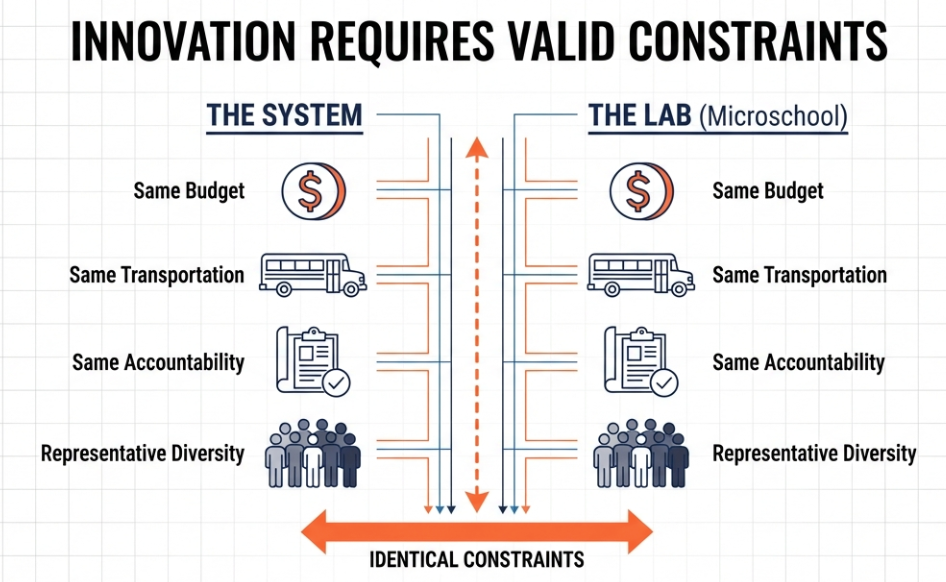
For learning to scale effectively, any district microschool must accurately reflect the district's demographic makeup and operate within the same funding, transportation, and accountability systems. The goal is the same district, the same budget, but a fundamentally different design for learning.
Real-World R&D in Action: Designing for Impact
These are not theoretical case studies; they represent intentional, disciplined testing of educational systems. By focusing on specific constraints, districts are generating actionable insights.
EDGE at Liberty Public Schools (Missouri)
Constraint Tested: Can competency-based progression operate effectively within traditional public accountability and funding structures?
Leaders at EDGE tested competency-based progression and leveraged the learnings about scheduling, facilitation, and assessment design to inform broader shifts within the comprehensive high school.
Concord Community Schools (Michigan)
Constraint Tested: Can team-based teaching foster conditions for teacher-led R&D and horizontal scaling in a smaller district?
Superintendent Rebecca Hutchinson has utilized team-based teaching as a powerful R&D structure, enhancing collective efficacy and empowering teams to prototype and scale solutions across the district.
Tacoma Public Schools (Washington)
Constraint Tested: Can Career and Technical Education (CTE) pathways function as stackable, personalized progressions within comprehensive schools, serving all students rather than operating as a separate, often exclusive, track?
The district has redesigned its CTE offerings into open-access Career & College Readiness pathways, featuring introductory, concentrator, and capstone experiences that are deeply integrated with core academic subjects.
WIN Academy, a Microschool in Cheney Public Schools (Washington)
Constraint Tested: How do schedules, community structures, and interdisciplinary design collaborate within a blended learning environment to foster both flexibility and a strong sense of belonging?
This microschool continuously iterates on its blended learning structures to understand how a cohesive student community can coexist with time-flexible learning models.
Issaquah School District (Washington)
Constraint Tested: Are the barriers to educational change primarily structural or cultural?
By ensuring students access the same buses, funding, and accountability systems, the district isolates the remaining variables: adult beliefs and practices.
Creative Minds Lab (Wichita, Kansas)
Constraint Tested: Can community-integrated, flexible-pacing models operate effectively within traditional district infrastructure?
This multi-aged model, co-located in a community-centered space, actively tests the coexistence of flexibility and public educational systems.
Readiness Over Urgency: Building the Foundation for Change
R&D is inherently more demanding than a pilot because it navigates a higher degree of uncertainty. Before embarking on such initiatives, a thorough assessment of readiness is paramount.
General Readiness Factors:
- Leadership Stability: Can the initiative be protected and supported for at least two years?
- Teacher Readiness: Are there enthusiastic educators eager to co-design and participate?
- Clarity of Problem: Can the specific system constraint being tested be clearly articulated?
- Documentation Plan: How will the learning generated be systematically captured and shared?
- Engagement: Are students and families willing and prepared to participate in the R&D process?
Additional Readiness Factors for Microschools:
- Policy Flexibility: Is there access to waiver authority or strong board support for policy experimentation?
- Budget Clarity: Is the funding model sustainable for the duration of the R&D?
- Facility Access: Can a suitable low-cost or co-located space be secured?
- Equity Design: Will the enrollment process ensure the microschool reflects the district's demographic diversity?
It is essential to balance the urgency for innovation with the existing capacity within the district. Failed experiments can create significant headwinds, making future redesign efforts more challenging to justify. If the necessary conditions for readiness are not yet in place, prioritizing their development is a strategic imperative.
The path forward for districts seeking to truly personalize learning is clear. It begins with a focused R&D strategy, tailored to the specific constraints and complexities of the system. Whether it's starting with two classrooms testing a grading shift, a cohort piloting interdisciplinary work, or a microschool designed for protected policy space and infrastructure testing, the question is not *if* to innovate, but *what* constraint to test, in *what* context, and at *what* scale. By choosing the right scale, designing rigorous tests, meticulously documenting learnings, and feeding those insights back into the broader system, districts can transform their aspirational portraits into tangible, impactful realities for all students.







 Explore AI Teaching Tools
Comments (0)
Please login to comment
No comments yet
Be the first to comment on this article