
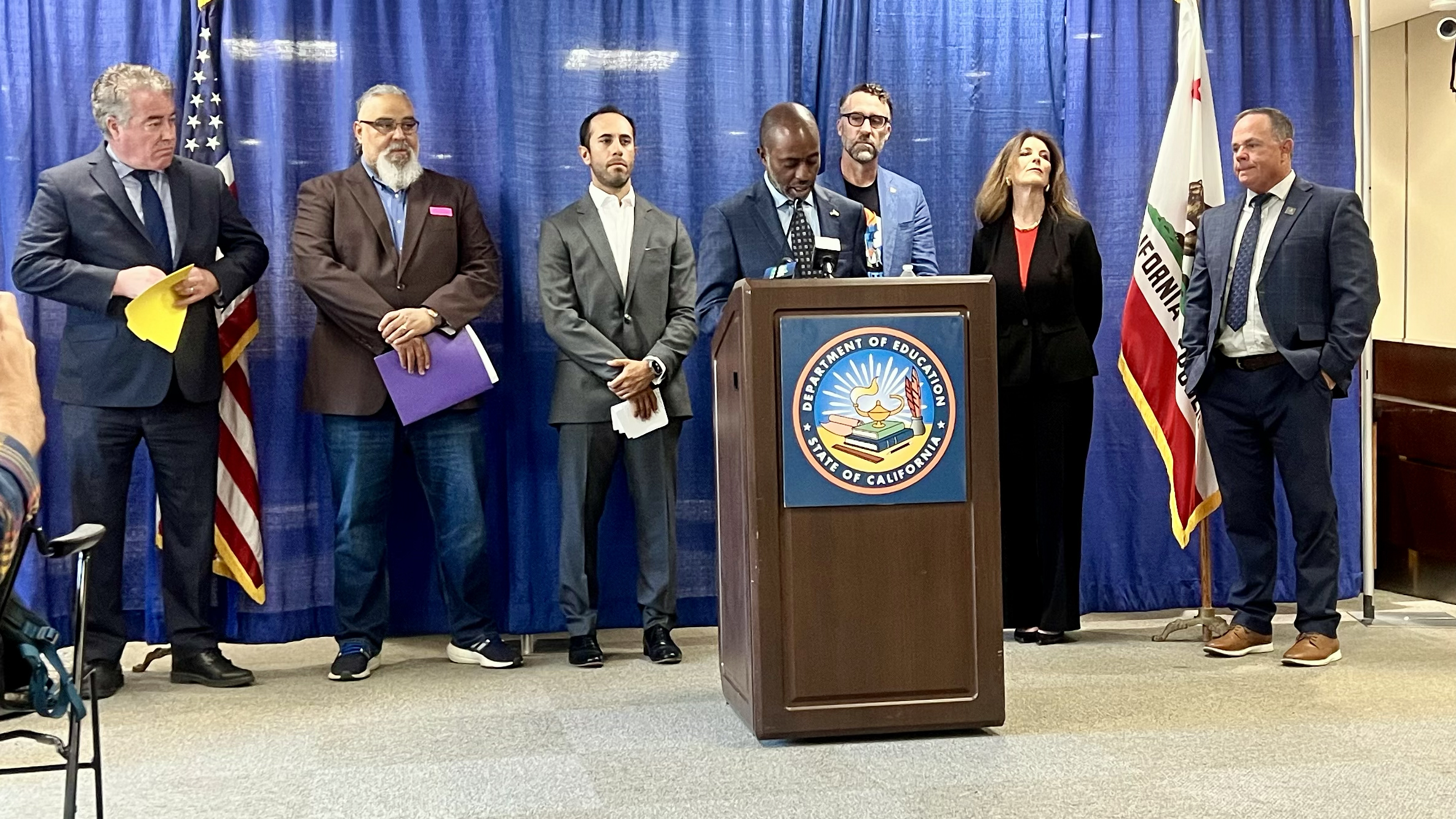
California's Top Educators Vie for State Superintendent: A Deep Dive into the Emerging Contenders
As millions of mail-in ballots continue their slow journey through California's vast electoral landscape, a clear picture is beginning to form for the state's top education post. The race for State Superintendent of Public Instruction, a position with significant influence over the Golden State's 6 million public school students, has narrowed, with two distinct voices emerging from a crowded field.
The Front-Runners Take Shape Amidst Uncounted Votes
Chino Valley Unified school board President Sonja Shaw has established a commanding lead in the primary election for State Superintendent of Public Instruction. With 24.9% of the vote counted, she is closely followed by San Diego Unified school board President Richard Barrera, who has secured 18.9%.
The remaining candidates have yet to break into double digits, indicating a clear bifurcation in voter preference. While all polling places have reported their initial counts, the final determination of who will advance to the November general election hinges on the tabulation of millions of mail-in and provisional ballots.
This meticulous counting process, overseen by the Secretary of State's Office, can extend for up to 30 days in a state with over 23 million registered voters. Historically, these late-arriving ballots tend to lean Democratic, a trend that may be amplified this election cycle as voters waited for clearer signals in other key races.
Divergent Visions for California's Public Schools
Despite a shared concern over declining student test scores and a unified opposition to the proposed restructuring of the California Department of Education, Shaw and Barrera present starkly different philosophies on how to best serve the state's educational needs.
A Clash Over Student Rights and School Policies
Sonja Shaw has garnered significant attention for her assertive stance on issues concerning student disclosure and participation in school activities. She advocates for ending policies that prohibit school staff from informing parents about a student's sexual orientation or gender identity.
Furthermore, Shaw has publicly stated her intention to prohibit transgender students from participating in girls' sports. This position directly contrasts with the existing legal framework designed to protect LGBTQ+ students.
Richard Barrera, a senior policy adviser within the state Department of Education, has voiced strong disagreement with Shaw's proposals. He emphasized the importance of current laws that safeguard LGBTQ+ students during a recent educational forum.
Prioritizing Support and Teacher Retention
Barrera's platform centers on increasing public funding for essential student support services. He also aims to address the critical challenge of recruiting and retaining high-quality educators across California's diverse school districts.
His vision emphasizes a more robust support system for students, recognizing the multifaceted needs that impact academic success. This includes a focus on mental health, counseling, and other wraparound services that contribute to a positive learning environment.
The Influence of External Funding on the Race
The State Superintendent race, initially lacking significant public engagement, saw a surge of activity in late April with the infusion of substantial funding from external organizations. This financial backing aimed to bolster the campaigns of their preferred candidates.
A Landscape Shaped by Union Investments
A voter survey conducted in early April revealed a landscape where no single candidate commanded more than 10% of support, with a considerable portion of voters undecided. This uncertainty shifted as influential education unions began to strategically invest in the race.
The California Teachers Association's independent expenditure committee made a significant commitment, allocating $5 million to support Barrera's campaign. Other key players also entered the fray, demonstrating the strategic importance of this office.
The California Federation of Teachers committee contributed $200,000, while a political action committee representing the California School Employees Association invested $175,000 in the campaign of Al Muratsuchi. The Service Employees International Union's political action committee also made a notable contribution of $250,000 to Anthony Rendon's campaign.
The Governor's Race: Education's Quiet Role
While education has not been a central theme in the current gubernatorial contest, the outcome will have profound implications for the state's school system. The next governor will inherit significant responsibilities regarding school funding and oversight.
Navigating Potential Department Restructuring
A key decision facing the incoming governor involves a potential plan to shift the oversight of the California Department of Education from the State Superintendent to a newly formed education commission. This significant structural change, if approved by the Legislature, could redefine the administrative landscape of public education in the state.
The primary election for governor has seen Republican political commentator Steve Hilton emerge as a front-runner with 27.8% of the vote. He is closely trailed by Democrat Xavier Becerra, former U.S. Secretary of Health and Human Services, who has garnered 25.4%.
Other notable contenders include Democrat Tom Steyer, a billionaire investor, with 19.6% of the vote, and Republican Chad Bianco, the Riverside County sheriff, at 11.3%. These four candidates represent the leading voices from a field of 61 individuals vying to succeed Governor Gavin Newsom.
Gubernatorial Candidates' Education Agendas
Steve Hilton has articulated a desire to alter state policies that currently prohibit parental notification regarding a student's transgender status. He also aims to address the participation of transgender athletes in girls' sports and proposes holding teachers accountable for student performance through reward and dismissal systems.
Xavier Becerra has highlighted his past efforts to expand early childhood education during his tenure as U.S. Health and Human Services secretary. He has also pledged to ensure equitable access to quality schools across all California communities and to make college more affordable.
Tom Steyer's ambitious proposal includes substantial investments in public schools and increased teacher compensation to bolster recruitment and retention. His vision extends to providing free education from universal preschool at age 3 through community college, funded by increased taxes on corporations and wealthy individuals.
Chad Bianco's educational priorities include expanding career technical education and promoting high-performing charter schools. He also advocates for a stronger emphasis on core subjects like reading, writing, math, and science, alongside increased funding for teacher training and recruitment. Bianco's platform also addresses mental health support and the placement of law enforcement officers in schools.
As the final ballots are tallied, the direction of California's public education system hangs in the balance, shaped by the distinct visions and priorities of these emerging leaders. The decisions made in the coming months will undoubtedly impact the learning experiences of millions of students across the state.




 Explore AI Teaching Tools
Comments (0)
Please login to comment
No comments yet
Be the first to comment on this article