
LAUSD's Secret Vault: Unearthing a $12 Million Treasure Trove of History and Art
Beneath the surface of Los Angeles Unified School District's sprawling educational landscape lies a hidden world, a vast collection of art and artifacts that whispers tales of centuries past. This isn't just about dusty textbooks and student projects; it's a multi-million dollar repository holding everything from ancient Mesopotamian tablets to original animation sketches.
A Legacy Forged in Time
The sheer scale of the Los Angeles Unified School District is staggering, serving nearly 400,000 students across a territory that spans over 700 square miles. But within its 700+ school sites and administrative buildings, an equally impressive collection of approximately 100,000 pieces of art and historical artifacts is quietly preserved.
This remarkable collection, known officially as the Art & Artifact Collection, began its journey not with a grand decree, but organically, tracing its roots back to the mid-1800s. It has since blossomed into an invaluable cultural asset, with a 2008 appraisal valuing it at over $12 million, according to district documents.
More Than Just School Records
While one might expect a school district's archives to primarily house administrative records, photographs, and yearbooks, the LAUSD collection shatters those expectations. It boasts items of profound historical and artistic significance, offering a unique window into both global and local history.
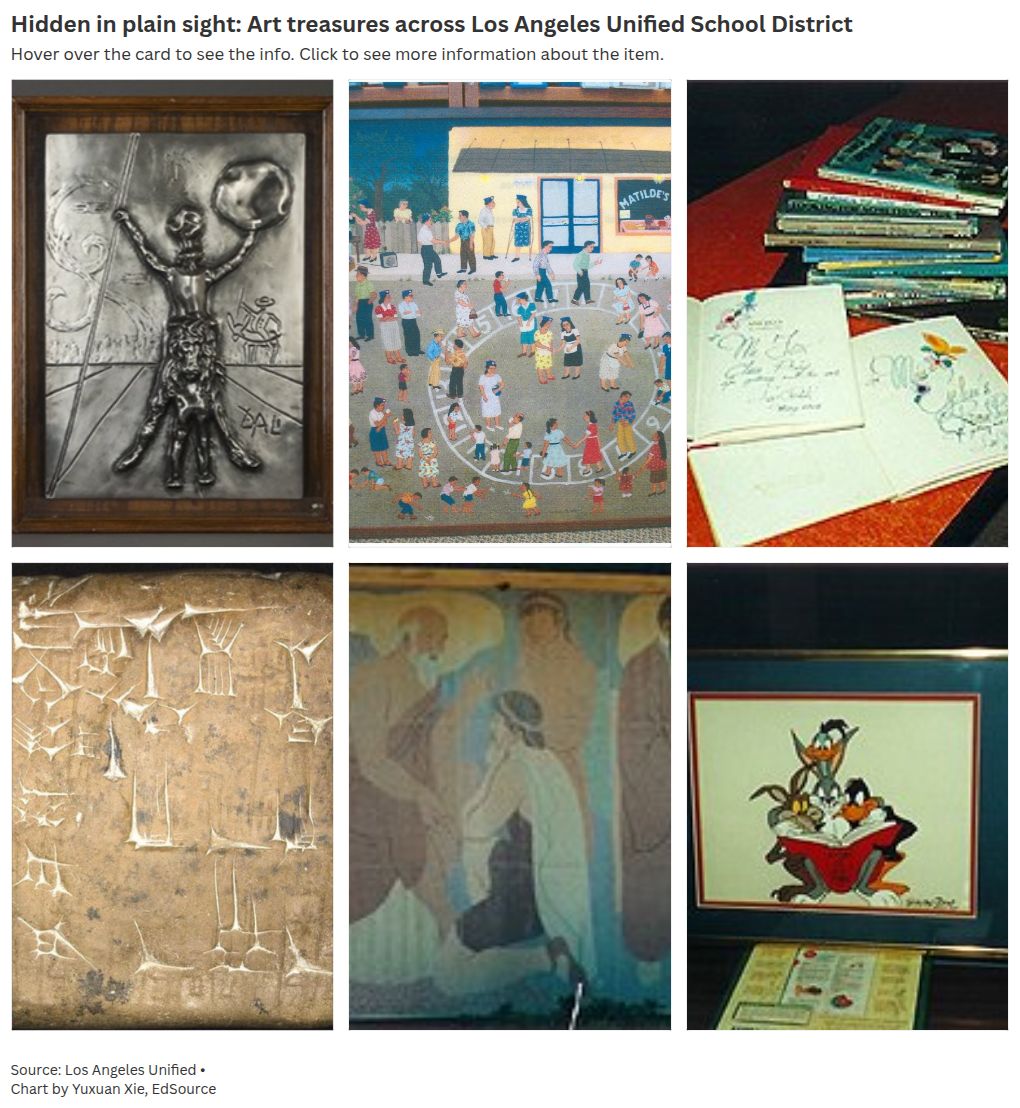
Imagine encountering ancient Mesopotamian cuneiform tablets, some dating back to 2100 BCE, nestled amongst materials that document the evolution of education in Los Angeles. The collection also features artistic marvels, such as Salvador Dalí's "Don Quixote" sculptures from 1979, a testament to the diverse artistic influences within the district's embrace.
Adding a touch of pop culture history, the collection includes a 1931 "Bugs Bunny & Friends" drawing by the legendary animator Chuck Jones. This piece is particularly poignant, depicting iconic characters engrossed in a book titled "History of the 9th St. School," subtly weaving educational history into beloved animation lore.
The Genesis of a Grand Collection
The official formation of LAUSD in 1961 was a consolidation of earlier entities, namely the Los Angeles City School District and the Los Angeles City High School District. The Art & Artifact Collection predates this formal merger, its foundations laid during a time when Los Angeles was a burgeoning city.
A significant portion of the collection's most notable pieces are not acquisitions made by the district itself, but rather generous donations. Alumni, former administrators, and engaged members of the broader Los Angeles community have all contributed to its richness, ensuring that their contributions to the city's narrative are preserved.
A Curator's Perspective: "LAUSD History is Los Angeles History"
Cintia Romero, the dedicated curator and archivist for the collection, emphasizes the profound connection between the district's holdings and the city's identity. "LAUSD history is Los Angeles history," Romero states, highlighting the interwoven tapestry of people, architecture, and cultures represented within the archives.
She elaborates on the unique character of the collection, noting that it encompasses "all the people here; we have all kinds of buildings; we have all kinds of architecture; we have all kinds of cultures." This multifaceted perspective underscores the collection's value as a comprehensive chronicle of the region's development.
Rarity in Preservation: An Archivist's Insight
Brenda Gunn, the president-elect of the Society of American Archivists, offers a critical perspective on the rarity of such extensive collections within school districts. "I don't think it's very common at all," Gunn remarks, pointing out the typical challenges districts face in preserving their historical assets.
Gunn explains that many school districts often lack the dedicated investment in preservation, and the role of an archivist is seldom filled by a professional. "It's not often that a school district has an archivist, and if they do have any preservation efforts, it's usually by a nonprofessional," she observes, underscoring the exceptional nature of LAUSD's commitment.
Treasures Unearthed at School Sites
Beyond the curated donations, the collection also grows organically from the very ground of LAUSD's campuses. School officials often unearth historical items during renovations, such as old fire alarms, which are then incorporated into the district's historical record.
Yearbooks and photographs that meticulously document LAUSD's history are also actively collected. The district maintains a commitment to "professional standards for archival care," aiming to safeguard these crucial pieces of history for future generations of students and researchers.
A Public Diary of Societal Shifts
Gunn views school district records as a "continuous public diary," offering invaluable insights into societal evolution. These documents chronicle shifts in neighborhoods, the district's pedagogical approaches, its management of desegregation, and its response to significant social and cultural events.
For individuals, these records can also offer a deeply personal connection, providing a means to explore family genealogy and understand their own historical roots within the Los Angeles community.
The Educational Imperative: Criteria for Inclusion
Romero explains that the LAUSD archive is remarkably inclusive, with a primary criterion for accepting new items: their potential to serve an educational capacity or act as a teaching aid. This philosophy ensures that the collection remains a dynamic resource for learning.
While LAUSD occasionally loans pieces to other institutions, the district is not engaged in the buying or selling of artwork. This stance aligns with the spirit of the donors, many of whom were the original artists or had a deep personal connection to the items they gifted.
"It doesn't necessarily have to be valuable to be accepted. It can be a teaching aid," Romero reiterates. "So, everything kind of has value, really. Everything can be somewhere." This inclusive approach maximizes the educational potential of every artifact.
The Central Repository: A Warehouse of Wonders
The physical heart of the LAUSD Art & Artifact Collection resides in a warehouse located at the district's police headquarters. Here, amidst rows of boxes, a significant portion of the collection is meticulously stored, awaiting discovery and study.
This central repository houses items from the district's antiquity collection, notably including materials from Venice High School's historic Latin Museum, which operated from 1932 to 1997 before its closure. The presence of such diverse historical artifacts underscores the breadth of the collection.
A Glimpse into the Past: The 19th-Century Classroom
Within the LAUSD headquarters on S. Boundary Avenue, a small museum space offers a tangible connection to a bygone era. A meticulously recreated late 19th-century classroom provides an immersive experience, showcasing the tools and expectations of early education.
Visitors can observe wooden phonics teaching tools, antique maps, and silver-colored vessels once used in home economics classes. A prominent display features a list of "Rules for Teachers 1872," offering a stark and often humorous contrast to modern educational practices.
These rules, such as bringing "a bucket of water and a scuttle of coal for the day's session" and dedicating "one evening each week for courting purposes, or two evenings a week if they attend church regularly," provide a fascinating glimpse into the social and professional lives of educators in the 19th century.
The Perils of "Benign Neglect"
While the LAUSD collection benefits from dedicated curation, Gunn highlights a pervasive issue in many school districts: "benign neglect." This refers to the passive storage of archival materials, where items are kept but not actively preserved or utilized, leading to their gradual deterioration.
"There are all kinds of places that this archival material will end up," Gunn explains. "And staff are like, ‘Oh, I don’t want to throw this away, but it can’t be in my office, so I’m going to store it somewhere,’ and then it stays there until the next person." This cycle often leads to valuable historical items being lost or forgotten.
Hope for Preservation: A Call to Action
Gunn expresses a fervent hope that school officials will move beyond mere storage and actively engage in the preservation of art, documents, and history. Simply placing items in a closet or a box is insufficient, she argues.
"You’re not hurting anything. You’re certainly not throwing things away, but you’re not helping this; you’re not improving the situation of the records," Gunn states. Her aspiration is that future individuals will discover these hidden treasures and recognize their value, potentially finding them a new home in another archive if they cannot be maintained on-site.
Security and the Case of the Stolen Painting
The LAUSD archive has not been immune to challenges, including instances of theft. A notable case involved a painting stolen from Dorsey High School. Romero recounted that while details of the painting were scarce, the president of the school's alumni association successfully recovered it.
The recovery involved a creative exchange, with the alumni association trading $25,000 worth of posters to ensure the painting's return to LAUSD. This incident underscores the value placed on these artifacts, even when their provenance is initially unclear.
Currently, the district asserts that robust school security procedures, including key access controls, are in place to safeguard the collection's pieces, aiming to prevent future losses.
Public Access: A Digital Bridge to the Past
While LAUSD students may encounter delightful historical pieces displayed within their schools, public access to the broader collection presents a more complex challenge. The district has, however, made significant strides in bridging this gap.
A formal inventory of the art collection was undertaken in the 1980s, and a crucial step was taken in 2004 when the collection was digitized. This digital transformation has been a cornerstone of making the archives more accessible.
Since 2018, Romero and her dedicated, albeit small, team—comprising a volunteer and interns from Cal State Northridge and LAUSD’s Downtown Business Magnet school—have been diligently digitizing items and populating a public database. This online resource allows for free viewing of a substantial portion of the collection.
Funding the Future of History
The ongoing digitization efforts are largely sustained through a combination of donations and grants, reflecting a community-wide appreciation for the collection's importance. While Romero's position as curator is funded through LAUSD's general fund, external support is vital for the expansion and maintenance of the digital archive.
Beyond Nostalgia: A Vision for Tomorrow
The work of curating LAUSD's Art & Artifact Collection extends far beyond mere historical preservation; it is intrinsically linked to the future. Romero and her team actively monitor ongoing renovation projects at school sites, recognizing that these endeavors can often lead to the discovery of new historical additions.
"We have so many schools, and each school has something," Romero emphasizes. "Every school has some kind of history." This ongoing discovery process ensures that the collection remains a living, breathing testament to the enduring legacy of education and community in Los Angeles.






 Explore AI Teaching Tools
Comments (0)
Please login to comment
No comments yet
Be the first to comment on this article