
Classroom Freedom vs. Classroom Consistency: The Tightrope Walk for Educators
In the complex world of education, a persistent tension exists: how do we empower teachers with the freedom to innovate and adapt, while ensuring a consistent, high-quality learning experience for every student? This delicate balance is at the heart of how education systems function, impacting everything from teacher morale to student achievement.
The Autonomy Divide: Where Do Teachers Stand?
Data from the expansive Teaching and Learning International Survey (TALIS) reveals a striking disparity in the level of professional autonomy granted to teachers across the globe. This isn't just a minor difference; it's a chasm that significantly shapes the daily realities of educators.
Choosing the Tools of the Trade
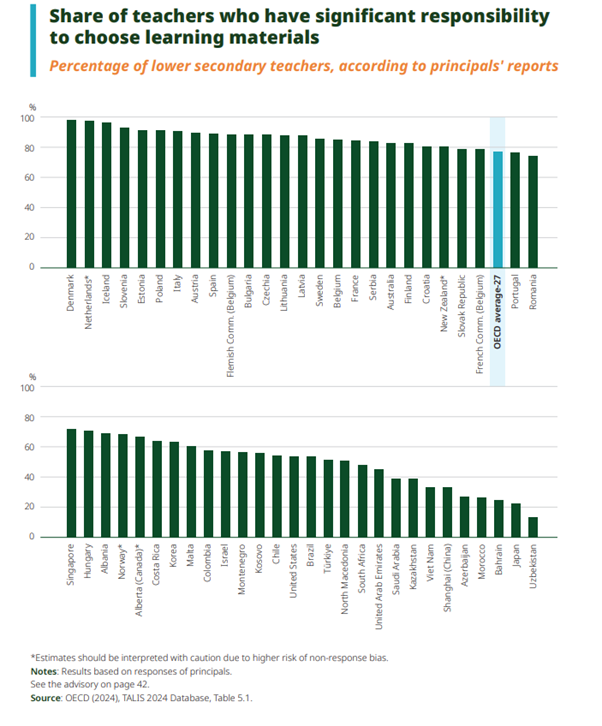
Consider the selection of learning materials. In countries like Azerbaijan, Bahrain, Japan, Morocco, and Uzbekistan, fewer than 30% of lower secondary teachers report having substantial say in the resources they use. This suggests a top-down approach to curriculum delivery.
Conversely, in nations such as Denmark, Estonia, Iceland, Italy, the Netherlands, Poland, and Slovenia, over 90% of teachers, according to their principals, have the freedom to choose their teaching materials. This highlights a more decentralized, teacher-centric model.
The Promise and Peril of Teacher Freedom
The question of how much freedom teachers should have in their classrooms is deceptively simple. Most would instinctively argue for the right of professionals to exercise their judgment, rather than merely follow directives. However, the practicalities of pedagogy and system-wide coherence introduce significant complexities.
Autonomy's Impact on Teacher Well-being and Efficacy
The TALIS findings offer compelling correlations: teachers who experience greater autonomy in designing lessons and employing teaching methods often report higher confidence in managing their classrooms and delivering instruction. This increased freedom is also linked to greater job satisfaction, reduced stress levels, and a stronger ability to adapt teaching to individual student needs.
However, it's crucial to acknowledge that correlation does not equal causation. While autonomy appears beneficial, the underlying drivers might be more nuanced. For instance, a teacher's inherent confidence could be the very reason they seek and utilize more autonomy, leading to lower stress levels as a consequence, rather than autonomy being the sole cause of reduced stress.
Experience Matters: A Differentiated Approach to Autonomy
The data also points to a significant difference based on experience. The link between autonomy and self-efficacy is notably stronger among seasoned educators. Teachers with a decade or more of experience often thrive when given the latitude to tailor their pedagogical approaches.
Conversely, for novice teachers, who may lack established support structures and a deep understanding of pedagogical best practices, excessive autonomy without adequate guidance could prove detrimental. This suggests that the implementation of autonomy needs to be carefully considered in relation to a teacher's professional journey.
Navigating the Policy Landscape: Balancing Freedom and Frameworks
For policymakers, the challenge lies in fostering an environment where teacher autonomy flourishes without sacrificing essential coherence across classrooms and the broader education system. Unfettered, idiosyncratic, or unscientific teaching methods risk undermining student outcomes and eroding the public's trust in the teaching profession.
Cultivating a Shared Professional Culture
A cornerstone of effective policy is the promotion of a shared professional culture, firmly rooted in evidence-based practices. This ensures that students receive a consistent and high-quality educational experience, regardless of the specific teacher or classroom they encounter.
Education systems must thoughtfully consider which teachers are granted greater freedom and under what specific circumstances. A teacher's individual profile—their experience, confidence levels, and demonstrated competence—should be a key factor in decisions regarding autonomy.
Mentorship and Collaboration: Pillars of Effective Autonomy
For instance, a teacher new to the profession might require a structured environment with robust mentorship before being expected to exercise significant autonomy. Even for experienced educators, autonomy can only truly be effective when it is embedded within a collaborative professional culture.
Autonomous teachers must actively engage in defining shared standards of good practice, aligning their expectations, and collectively building instructional coherence throughout the entire system. This collaborative spirit is vital for ensuring that individual freedoms contribute to collective success.
Models of Success: Countries Paving the Way
Several countries offer compelling examples of how to navigate this complex terrain, demonstrating innovative approaches to balancing teacher autonomy with systemic coherence.
Slovenia: Gradual Empowerment and Strategic Alignment
In Slovenia, a decade-long reform of upper secondary education saw teachers progressively assume greater responsibility for whole-school planning and implementation. This shift granted teachers considerable autonomy to shape their classroom practices.
Crucially, accountability was woven into the fabric of the system through shared strategic goals and the provision of national resources to guide teachers' work. This approach fostered collaboration among teachers, ensuring that increased autonomy did not come at the expense of system-wide coherence.
Colombia: Embedded Participation and Dedicated Development Time
Colombia has actively embedded teacher involvement by including educators in educational governing bodies, giving them a direct voice in curriculum development and policy decisions. This empowers teachers and ensures their perspectives are considered at the highest levels.
The country has also bolstered teacher autonomy through the establishment of five dedicated weeks annually for institutional development. During these periods, teachers can focus on refining their teaching practices, as well as contributing to their school's strategic planning and community partnerships.
Structured Freedom for Collective Growth
These examples highlight structured programs that successfully balance individual freedom with shared responsibility. They intentionally create space for teacher-led initiatives to operate in synergy with broader educational objectives.
By deliberately fostering environments where teachers can learn from one another and align their work, these systems demonstrate a powerful truth: professional autonomy thrives when it is a collective endeavor, not an isolated pursuit.
The Oversight Imperative: Ensuring Accountability Without Stifling Innovation
While granting freedom in the classroom is essential, it must not come at the cost of adequate oversight. Currently, in some countries with high levels of teacher autonomy, this oversight is insufficient, leaving educators' practices largely unexamined.
The Blind Spots in Oversight
For instance, in Italy and Norway, where a significant number of teachers report substantial instructional autonomy, approximately one in four teachers have never undergone a formal appraisal. In Finland, this figure rises to over one-third. This raises concerns that educational leaders may not have a clear understanding of what is happening in their classrooms.
Such a lack of insight can have serious implications for maintaining standards and ensuring effective teaching across the board. Successful accountability systems should empower teachers to innovate while simultaneously establishing clear benchmarks for success.
Cultivating Professional Communities for Coherence
More importantly, effective systems cultivate vibrant professional communities where teachers can observe each other, exchange constructive feedback, and develop shared understandings of what constitutes effective teaching practice. This collaborative culture is the bedrock upon which professional autonomy can be viable and coherent at scale.
Policymakers have a critical role in nurturing environments that encourage teachers to work collaboratively to define and refine good practices. This can be achieved through mechanisms like structured classroom observations and the establishment of professional learning communities.
The Double-Edged Sword of Accountability
Such collaborative efforts ensure that autonomy is exercised responsibly and collectively, thereby strengthening overall quality and standards within the education system. However, it is equally important to recognize that accountability systems, if implemented too rigidly or punitively, can have a detrimental effect.
When systems become overly focused on punishment or are disconnected from the realities of daily classroom work, they can inadvertently limit and undermine teacher autonomy. This can foster an atmosphere of mere compliance rather than encouraging creativity and innovation, ultimately harming the quality of teaching and learning.
The Path Forward: Anchoring Autonomy in Collaboration
The ultimate goal is not to restrict the professional freedom of teachers, but rather to anchor it within a robust, collaborative professional culture. This approach empowers educators to exercise their individual judgment while simultaneously contributing to shared educational goals, moving away from isolated practice.
This exploration is part of a series examining findings from the OECD’s Teaching and Learning International Survey (TALIS). TALIS stands as the world's most extensive international survey focused on teachers and school leaders, providing invaluable insights into the state of teaching globally.






 Explore AI Teaching Tools
Comments (0)
Please login to comment
No comments yet
Be the first to comment on this article