
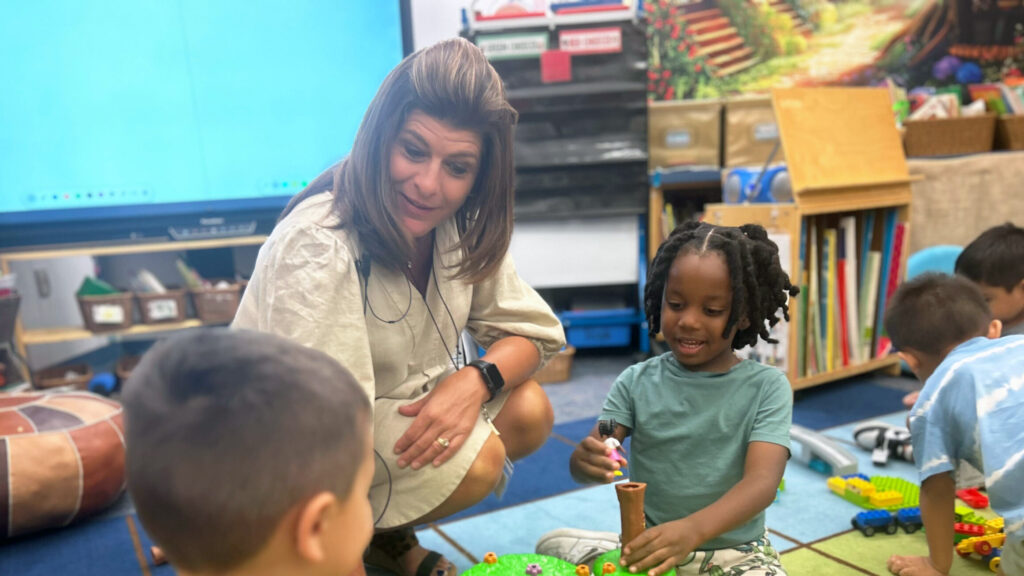
California's Quest for Early English Language Identification: A New Era for Young Learners
Identifying young children who may need additional support in acquiring English is a complex but crucial task for educational systems.
In California, a significant shift is underway as the state re-evaluates its approach to pinpointing four-year-olds who could benefit from early English language intervention.
This initiative aims to ensure that every child, regardless of their linguistic background, receives the tailored support necessary for academic success, setting a new standard for early childhood education and language acquisition.
The Evolving Landscape of English Language Learner Identification
California is embarking on a vital mission to refine how it identifies four-year-old students who require extra assistance with English.
This process is particularly delicate, as children at this age are in the foundational stages of language development and are not accustomed to formal testing environments.
Historically, assessments designed for older students have sometimes proven overwhelming for these youngest learners, leading to anxiety and inaccurate results.
The state is committed to finding screening tools that are sensitive to the developmental needs of preschoolers, ensuring that identification is accurate and supportive.
The state superintendent of public instruction faces a critical deadline: March 31.
By this date, a selection of screening tools must be approved for mandatory implementation starting in the 2027-28 academic year.
This timeline underscores the urgency and importance of this reform.
Previously, the English Language Proficiency assessment for California (ELPAC) was the standard.
However, a significant change occurred in 2024 when students in transitional kindergarten (TK) were exempted from this assessment.
This exemption followed reports from educators and advocacy groups highlighting that many four-year-olds were being misidentified as English learners simply due to their age and unfamiliarity with test formats, rather than a genuine need for language support.
Research consistently indicates that for this age group, screening tools should prioritize the assessment of speaking and listening skills over reading and writing.
This focus aligns with the natural progression of language acquisition in young children.
The goal is to move away from assessments that might induce stress and instead embrace methods that accurately reflect a child's emerging language abilities in a supportive context.
Navigating the Challenges of Early Childhood Assessment
The journey to identify young English learners is fraught with unique challenges.
Four-year-olds are naturally in a phase of rapid language acquisition, making it difficult to distinguish between typical developmental progress and a need for specialized intervention.
Traditional testing methods, often designed for older students, can be intimidating for this age group.
Studies indicate that children can become distressed during such assessments, sometimes withdrawing or exhibiting behaviors that do not reflect their true capabilities.
When children first enroll in California’s K-12 system, families are typically asked to complete a survey about the languages spoken at home.
If a language other than English is indicated, the school has historically been required to administer the ELPAC to gauge the student's English proficiency.
However, this practice has been re-evaluated, particularly for the youngest learners.
The Transitional Kindergarten (TK) Exemption: A Turning Point
Up until the previous school year, students in transitional kindergarten were also subject to the ELPAC.
This requirement was eventually lifted after educators voiced concerns that the assessment was overwhelming for four-year-olds.
Advocates further argued that many young children were being incorrectly identified as English learners because the test was not designed for their developmental stage.
An analysis conducted by the California Department of Education revealed that transitional kindergartners were disproportionately scoring at the lowest levels of English proficiency on the ELPAC.
In the 2023-24 school year, the last year the ELPAC was mandated for TK, a striking 81% of TK students assessed fell into the lowest proficiency category, compared to 67% of kindergartners.
The decision to exempt transitional kindergartners from the ELPAC was met with relief by many TK teachers.
Currently, California lacks a formal mechanism to assess the English proficiency of these youngest students.
This gap means that schools may miss out on crucial federal and state funding allocated for English learners.
Without formal identification, schools are not legally obligated to provide language services or report the academic and language progress of these students on the California School Dashboard.
To address this, the state Legislature has allocated $10 million to select a new screening tool for identifying TK students needing English language support.
The state superintendent is expected to finalize a list of approved screeners by March 31, with pilot testing in select districts during 2026-27, leading to mandatory implementation in 2027-28.
Debates Surrounding Early Screening Tools
The necessity of a new screening instrument for such young children has sparked debate among educators.
Some teachers, like Jacquilla Burris, a TK teacher in Fresno Unified School District, express skepticism.
She stated, "Technically, they’re all learning English at this age.
There’s not a lot of difference for a child who is a non-English speaker." Many teachers, relieved by the exemption from the ELPAC, question the need for another assessment.
Paula Merrigan, a TK teacher in Castro Valley, voiced her opinion, saying, "I think it’s a waste of taxpayers’ money.
For TK?
Really?"
These teachers emphasize that all children in their classrooms are actively developing vocabulary and language skills, irrespective of their native tongue.
They often pause to clarify word meanings during story time, noting that even native English speakers benefit from vocabulary expansion.
For example, explaining the word "grin" as a "smile" helps build comprehension for all students.
The Case for Targeted Language Support
Despite these reservations, many researchers and educators advocate for robust methods to identify students who require additional language support.
Bernadette Zermeño, a professor and multilingual specialist, highlights the importance of supporting "multilingual geniuses," stating, "That’s true, and our multilingual geniuses, as I like to call them, need extra support." Effective screening can also empower schools to tailor materials and professional development for teachers, ensuring they have the resources to support both English language acquisition and the maintenance of home languages.
Carolyne Crolotte, director of policy at Early Edge California, a nonprofit that championed the exemption for TK students, believes that "We need to ensure that we’re providing those tools and resources to schools to help support not just English but also the home language." This perspective underscores the dual goals of supporting English learners while also valuing and nurturing their home languages.
Designing Effective Screening Tools for Young Learners
Experts agree that any new screening instrument for this age group must prioritize oral language skills—speaking and understanding—over literacy-based skills like reading and writing, as most four-year-olds have not yet acquired these foundational literacy abilities.
The vocabulary used in assessments should be age-appropriate and accessible, and the overall experience should be engaging, perhaps incorporating elements of play, storytelling, and natural conversation.
Researchers also emphasize that the most accurate assessment of a child's language proficiency often comes from observing their interactions in natural settings.
Teachers stress the importance of conducting these observations or assessments in environments where children feel secure and comfortable, ideally with a familiar adult.
This approach helps mitigate shyness or anxiety that could otherwise lead to inaccurate evaluations.
Insights from Other States and Research
A 2024 study by the American Institutes for Research (AIR) and New America found that fifteen states currently require screening of preschoolers to identify English learners.
These states often utilize one of five common screeners, such as the Pre-IPT, preLAS, preLAS Observational Assessment, Oklahoma Pre-Kindergarten Screening Tool (PKST), and Woodcock-Muñoz Language Survey (WMLS).
It is important to note that many of these tools were not specifically developed for students who speak languages other than English.
Rebecca Bergey, a principal researcher at AIR, notes the variability in these approaches, stating, "It’s all over the place." Some states, like Texas and Illinois, mandate preschool screening for English learners partly due to laws requiring bilingual programs and prioritizing funding allocation for these students.
Other states opt to identify English learners only upon entry into kindergarten, acknowledging that bilingual children are simultaneously developing two languages at this age.
Bergey cautions that "Language in this time frame is developing so rapidly and changing and dynamic.
So I think there's some caution.
Even the best-designed assessment is going to be limited in what it tells us.
And there's a risk of inappropriately identifying students." This highlights the delicate balance between identifying needs and avoiding mislabeling, especially given the fluid nature of early language development.
California's Existing Preschool Language Survey
California already employs a family language survey, often followed by an interview, in state-subsidized preschool programs.
This existing system serves children in the same age group as TK and is used to identify dual language learners—children who are simultaneously acquiring English and their home language.
This existing infrastructure presents an opportunity for alignment.
Zermeño points out a persistent challenge: "There’s this continuous missed opportunity of alignment with our preschools, that’s not addressed enough.
We shouldn’t be a whole separate entity." She and others suggest that the survey and interview process should be augmented by observations from teachers and parents to gain a comprehensive understanding of where students might need additional support.
Zermeño recommends that TK teachers be provided with paid time to conduct home visits, allowing them to observe how children use English and other languages within their family context.
These observations, combined with classroom interactions with peers and teachers, can offer a richer picture of a child's language development.
Addressing Parental Concerns and Misidentification Risks
Several TK teachers have expressed concerns that relying solely on the home language survey might not yield accurate results.
They note that some parents may hesitate to disclose all home languages spoken, fearing their children might be labeled as English learners, which they sometimes perceive as a disadvantage.
Conversely, other parents might report speaking a different language at home, but the children themselves may primarily speak English.
This can lead to misidentification.
Teachers also worry about students who, despite speaking only English, might struggle with proficiency tests due to other underlying issues.
Marcella Gutierrez, a TK teacher in Mountain View, shared her perspective: "Maybe they’re special ed, maybe they’re absent all the time, maybe they’re in foster care, maybe they’re homeless, maybe they have a certain home life, and because of that they’re lacking so many skills.
We don’t want kids labeled English learners when they’re just behind academically." This sentiment underscores the critical need for screening tools that are sensitive to a child's overall developmental and environmental context, ensuring that students are accurately identified and appropriately supported, rather than being mislabeled.
Conclusion
California's commitment to refining its approach to identifying four-year-olds who need extra help learning English marks a significant step forward in early childhood education.
By moving away from potentially stressful, age-inappropriate assessments and focusing on observational, play-based, and oral language-centered screening, the state aims to ensure more accurate identification and provide timely, effective support.
This initiative, driven by research and the experiences of educators, promises to create a more equitable and supportive learning environment for all young children, empowering them to thrive in their academic journeys and beyond.
The successful implementation of new screening tools by 2027-28 will be a testament to California's dedication to its youngest learners.







 Explore AI Teaching Tools
Comments (0)
Please login to comment
No comments yet
Be the first to comment on this article