
Navigating the Storm: How Rehumaning Can Save Our Schools
Imagine a classroom where a student slumps over their desk, lost to sleep during third period. Picture a teacher, their lunch break consumed by a mountain of emails. Envision a school leader, their calendar a relentless cascade of meetings with no breathing room. We’ve come to accept this as the norm, labeling it as dedication, commitment, or simply the price of doing business. But Stephanie Malia Krauss offers a different perspective: it’s a storm we were never designed to weather.
In her latest book, How We Thrive: Caring for Kids and Ourselves in a Changing World, Krauss expands upon the holistic vision she first presented in Whole Child, Whole Life. This new work extends its gaze beyond the students in our care to encompass the adults who guide them. The central question isn't about maximizing output or optimizing performance. Instead, it probes how we can preserve our humanity within systems that relentlessly erode our capacity for feeling, rest, connection, and belonging.
The Shifting Tides of Modern Life
Drawing inspiration from her Native Hawaiian heritage and the legacy of Polynesian wayfinders, Krauss employs a powerful navigation metaphor. We are all, she suggests, adrift on a changing sea, many without a safe harbor in sight. She identifies four pervasive conditions that define our contemporary existence: being overtapped, overworked, overstimulated, and overwrought. These are not individual failings, Krauss argues, but rather environmental realities that demand our attention.
She posits that the crucial first step in navigating these turbulent waters is simply to name the storm. Understanding the forces at play is essential for charting a course toward calmer seas. This act of recognition is the foundation upon which all subsequent efforts to rehumanize our educational systems must be built.
Rehumaning: A Systems Imperative for Survival
At the core of Krauss’s argument lies the concept of “rehumaning.” This is a deliberate return to the fundamental human needs that sustained us long before industrialized schedules and institutional demands reshaped our daily lives. She meticulously outlines these essential elements across four interconnected domains:
- Body: Emphasizing the critical importance of eating, sleeping, moving, and regulating our physical selves.
- Mind: Highlighting the necessity of play, wonder, flow states, and creative expression.
- Heart: Underscoring the profound human need for connection, love, and a sense of belonging.
- Spirit: Recognizing the value of celebration, contribution, and the cultivation of belief.
As I delved into these chapters, I found myself frequently pausing, not due to the complexity of the research, but because of its profound resonance. Krauss’s prose illuminated my own experiences and offered a clear lens through which to view the systems we operate within. Her narrative is deeply grounded, weaving together rigorous research, expert insights, and her own hard-won lived experiences, including periods of homelessness and recovery.
Krauss does not romanticize resilience; instead, she challenges the very premise of why so much resilience is required in the first place. Her work compels us to question the structures that necessitate such extraordinary fortitude from both students and adults.
Schooling, Exhaustion, and the Quest for Authentic Learning
The implications of Krauss’s framework for educators are profound. Much of what we currently define as “schooling” is characterized by rigid time constraints, constant management, and a distinct lack of authenticity. These environments often prioritize compliance over genuine contribution, fragmenting students’ days into short bursts of cognitive activity with minimal space for regulation or reflection.
Krauss poses a critical question: Is it truly surprising that students disengage when their environments restrict movement and compress natural curiosity into static, prescribed blocks? She avoids shaming educational institutions, instead posing incisive questions about the daily realities within schools. What does a typical school day truly allow for? What does it inadvertently restrict? And what are we asking children to endure in the name of academic achievement?
Her framework advocates for an expansion of learning beyond the artificial confines of traditional schooling. This includes embracing opportunities like internships, community-based projects, and genuine conversations with adults engaged in meaningful work. These are experiences that engage the body, mind, heart, and spirit simultaneously.
The principle that authenticity is energizing, while artificiality is exhausting, is a powerful one. If our stated aim is to prepare students for purpose-driven lives, we must critically examine how well our current systems honor the fundamental human conditions that make such a life possible. This requires a deliberate shift in how we structure learning experiences for students.
Wayfinding, Agency, and Transparent Competencies
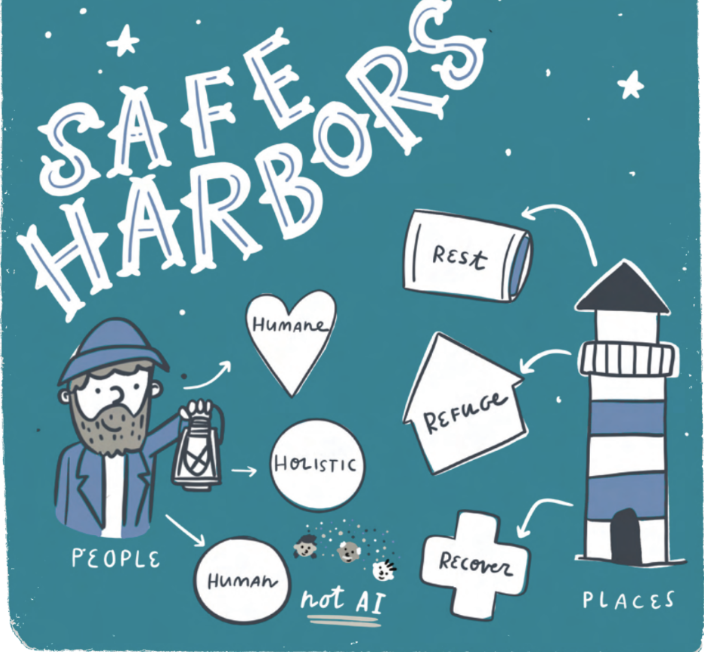
The navigation metaphor extends to the development of agency in students. True wayfinding, Krauss explains, demands both a clear sense of direction and a deep understanding of oneself. Crucially, it requires a safe harbor – a sense of belonging – before embarking on any significant journey. Without this foundational sense of belonging, the willingness to take risks is diminished.
Similarly, without adequate regulation, the capacity for reflection is stunted. And without reflection, genuine agency cannot flourish. This is where Krauss’s work significantly deepens our ongoing conversations about personalized and competency-based learning models. While transparent competencies can make growth visible, true agency extends far beyond mere clarity of outcomes.
Agency necessitates self-awareness – the space to understand one’s strengths, interests, limitations, and motivations. In systems that offer little room for wonder or rest, this crucial aspect of agency is often squandered. Rehumaning reminds us that purpose-driven work is not solely the product of acceleration; it is fundamentally built upon identity formation, a strong sense of belonging, and meaningful opportunities for contribution.
This requires a conscious effort to design learning environments that foster these essential human elements, allowing students to develop a robust sense of self and purpose. The work of developing agency is intrinsically linked to the work of rehumaning.
Rehumaning Adults for Sustainable Change
Krauss makes a compelling case that we cannot hope to design human-centered systems while the adults within them are operating in a constant state of survival. Rehumaning, therefore, is not merely a wellness initiative; it is a fundamental systems strategy. Sustainable transformation is an impossibility if the adults leading the charge are depleted and exhausted.
In our own work exploring the qualities of successful graduates, we often emphasize the critical alignment between a clear vision and daily practice. If we aspire to cultivate graduates who are resilient, reflective, collaborative, and courageous, then the adults modeling these traits must embody them. This modeling, however, requires psychological safety, appropriate pacing, and leaders who view rest not as a weakness, but as a vital form of stewardship.
We cannot realistically expect students to thrive in systems where the adults are barely surviving. While storms are an undeniable reality, so too are safe harbors. Educational institutions have the power to be either one or the other. When adults are overtapped and overwrought, innovation often devolves into mere compliance, risk-taking evaporates, and the grand vision shrinks to the mundane task of maintenance.
Rehumaning, in this context, becomes a powerful act of leadership. It is a conscious choice to design schedules, grading practices, and professional cultures that actively sustain human capacity rather than relentlessly drain it. This requires a fundamental reevaluation of our priorities and practices.
Questions for Leaders and Designers of Educational Systems
Krauss’s insightful work serves not only as a call for reflection but also as a powerful impetus for action. If rehumaning is truly essential, rather than an optional add-on, we must ask ourselves critical questions:
- What are we willing to stop doing to create space for rehumaning?
- Where does our daily schedule genuinely promote regulation, and where does it actively undermine it?
- Are our grading systems aligned with fostering genuine growth, or are they primarily focused on speed and compliance?
- In what ways does our current model of schooling energize learners, and in what ways does it contribute to their exhaustion?
- How are we actively cultivating a sense of belonging for adults within our educational communities, not just for students?
- If purpose is our ultimate aim, where are students currently practicing contribution in meaningful ways?
- What would it look like to intentionally treat rest as a strategic leadership imperative?
These are not easy questions, but they are vital for anyone committed to creating more humane and effective educational environments. The work of rehumaning requires a deep commitment to understanding and addressing the systemic factors that contribute to burnout and disengagement.
A Final Reflection on Navigating the Storm
We are undeniably living through stormy conditions, and both our students and our educators feel the impact acutely. Rehumaning is not a “soft” approach; it is disciplined, intentional work. It requires us to redesign schedules, rethink grading policies, re-evaluate our expectations, and critically examine our own pace of work.
Rehumaning is essential, not optional, for the health and sustainability of our educational systems. The crucial question remains: What are we willing to stop doing to make it a reality? The path forward requires courage, a willingness to challenge the status quo, and a deep commitment to prioritizing human well-being alongside academic achievement.




 Explore AI Teaching Tools
Comments (0)
Please login to comment
No comments yet
Be the first to comment on this article