
Texas' Bilingual Education Surge: A Blueprint California Could Follow
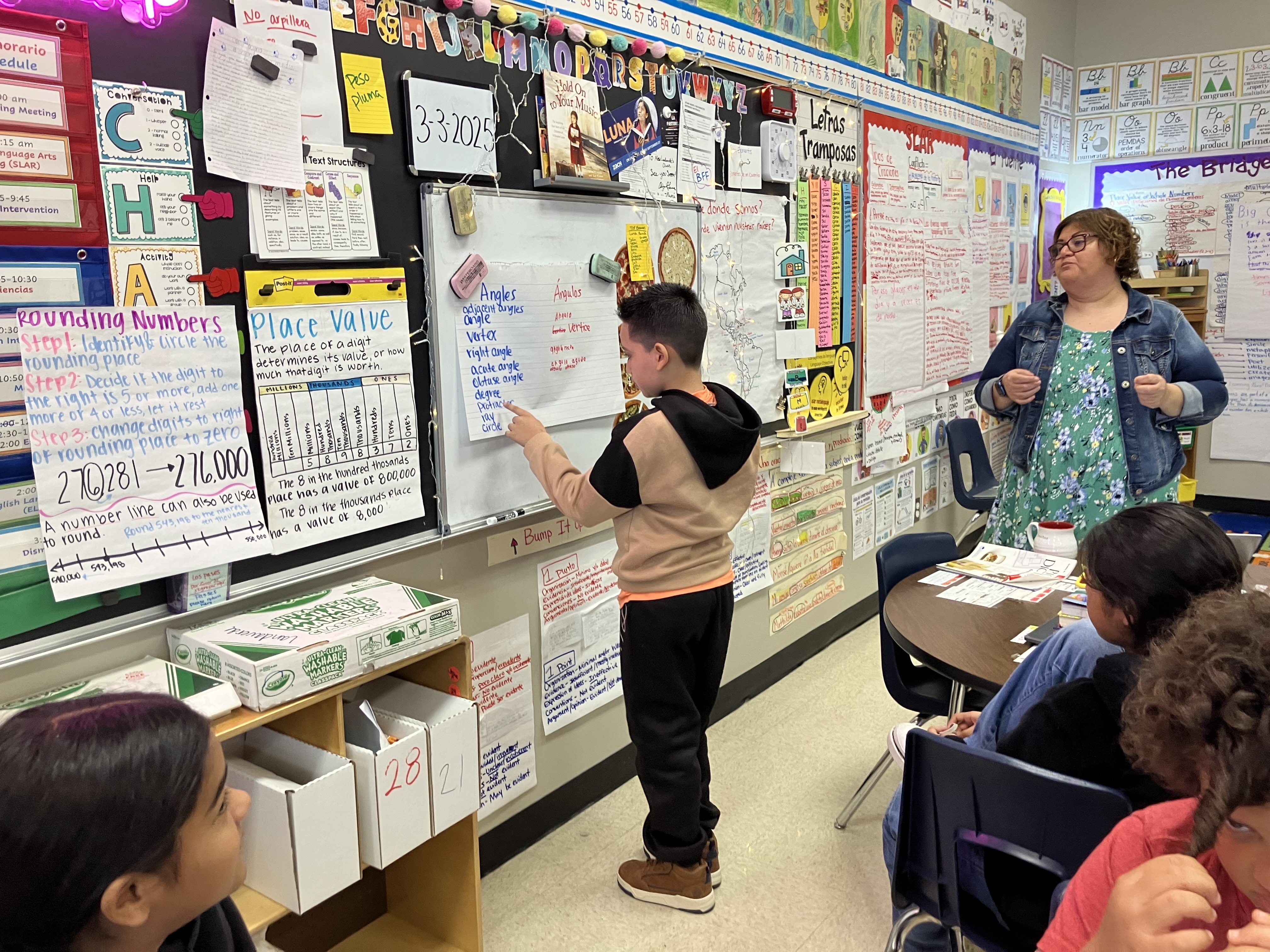
In a seventh-grade classroom in Austin, Texas, students aren't just learning Spanish; they're dissecting literary genres and preparing for advanced placement exams before high school. This sophisticated academic environment, where students engage with complex literature in a second language, is a testament to a robust bilingual education system that is increasingly setting Texas apart from its West Coast counterpart.
From Preschool to AP: A Deep Dive into Texas' Bilingual Success
Wendell Norris Marquez's seventh graders are not your typical language learners. They're already fully bilingual by the time they reach his classroom, thanks to years of immersion in dual-language programs. This allows for a curriculum that delves into literary analysis, metaphor, and essay writing, pushing students beyond basic conversational skills.
“When I describe this class, I tell people it's not really what you think in the back of your head as a language course,” Norris Marquez explained. “By the time they get to us, they're already fully bilingual. So it is about taking them to the next level.”
The foundation for this advanced learning is laid in the early years. Most of Norris Marquez's students have been participating in dual-language programs, receiving instruction in both Spanish and English, since preschool or kindergarten. This consistent, early exposure is a key differentiator, enabling students to achieve a level of fluency that supports advanced academic pursuits later on.
The Data Doesn't Lie: Texas Outpaces California
The reality of bilingual education's prevalence is stark when comparing Texas and California. A comprehensive analysis reveals that Texas enrolls a significantly higher percentage of its English learners in bilingual education programs – 38% compared to California's 18%. This substantial difference has tangible outcomes.
Data from the National Assessment of Educational Progress consistently shows that English learners in Texas outperform their counterparts in California in both reading and math. This trend holds true across multiple administrations of the test, suggesting a systemic advantage for Texas students.
While multiple factors influence academic scores, research strongly supports the efficacy of bilingual education. Studies indicate that English learners in bilingual programs may initially score slightly lower in English acquisition and academics, but by approximately fourth grade, they tend to surpass those in English-only environments. This gap widens by eighth grade, aligning with the observed performance differences between Texas and California.
Policy and Mandates: The Driving Forces Behind Texas' Lead
The divergence in bilingual education approaches is rooted in historical policy decisions. Texas has had a legislative mandate since 1973 requiring school districts to offer bilingual education if at least 20 children in the same grade speak a non-English language at home. This long-standing commitment has fostered a rich environment for multilingual learning.
In contrast, California's educational landscape was significantly shaped by Proposition 227, passed in 1998. This law mandated English-only instruction for English learners unless parents specifically opted out through a waiver. This policy remained in effect for 18 years, creating a substantial setback for bilingual education initiatives.
The lingering effects of Proposition 227 are still felt today. “The passage of Proposition 227 deeply impacted bilingual teacher education programs, resulting in fewer teachers earning bilingual certification over the past two and a half decades,” wrote Alesha Moreno-Ramirez, director of multilingual support at the California Department of Education. “Bilingual teacher education programs are still recovering.”
Investing in the Future: Funding and Support Structures
Beyond mandates, financial incentives play a crucial role. In 2019, Texas enacted a law that provides additional funding for all students enrolled in dual-language immersion programs, with even greater support for English learners. This translates to an estimated $924 more per year for every English learner in a dual-language immersion setting.
This financial commitment is coupled with a history of bipartisan support for bilingual education in Texas. The state's top education official reportedly even sends his own children to a bilingual school, signaling a deep-seated belief in its value.
Austin alone boasts 57 elementary schools offering dual-language programs in Spanish, Mandarin, and Vietnamese. Over half of the district's emergent bilingual students are enrolled in these programs, underscoring the widespread availability and adoption of bilingual education.
Classroom Realities: Stories from the Front Lines
At Perez Elementary School in Austin, the sounds of Spanish and English fill the classrooms, hallways, and playground. The school library features a dedicated section for student-written books in both languages, showcasing the tangible outcomes of immersion.
Fourth-grade teacher Yadi Landaverde emphasizes the importance of explicitly teaching linguistic differences and similarities, especially for recent immigrants. Her classroom, which includes eight recent immigrants this year, benefits from her own experience growing up in South Texas with English-only instruction.
“As long as the first language is strong, students do tend to score higher on state tests,” Landaverde observed. “I've seen that.”
Students themselves articulate the profound impact of bilingual education. Ten-year-old Emil describes it as a “superpower,” while his classmate Luis, who emigrated from Venezuela, found solace and belonging in a dual-language program after struggling to communicate in an English-only school in New York. “Now in class, I can speak Spanish normally without nobody saying that they don’t understand me,” Luis shared. “And when I don’t know… something in English, I can just ask my friend that speaks more English than me and say, ‘What does this word mean?’”
Mathilda, a student in the dual-language program since pre-kindergarten, highlights how it has helped her maintain her Spanish proficiency, contrasting her experience with cousins in California who lack similar opportunities.
Beyond Elementary: Sustaining Bilingualism Through Middle and High School
The commitment to bilingual education extends into secondary schools. In Austin, 13 middle schools and five high schools offer programs where students take at least two classes per semester in Spanish, including language arts and content subjects like science or math. Electives such as film history and web design are also available in Spanish.
Antonia Vincent, who teaches AP Spanish to eighth graders at Lively Middle School, witnesses the transformative power of these advanced courses. “At the beginning, they don’t even believe that they can do an AP class,” Vincent noted. “But at the end, we have good results, and they are very proud of themselves.”
These advanced Spanish classes not only benefit students who have been in bilingual programs since elementary school but also empower recent immigrant students. Vincent shared a letter from one student who wrote, “Thanks to your class, I know that I can express myself, and that is empowering me to continue and to take this opportunity in my other classes.”
The advantages are not limited to English learners. Caroline Sweet, a dual-language instructional coach, enrolled both her children in dual immersion programs. Her son, now in 10th grade, found his advanced Spanish courses in high school challenging yet intellectually stimulating, fostering a keen awareness of language and cognitive flexibility.
California's Patchy Progress: A Call for Deeper Investment
While dual-language immersion programs do exist in California, including over 230 in Los Angeles Unified, advocates argue that the state's investment has been inconsistent. Access to these programs varies significantly by district, community, and available resources.
A primary obstacle identified by both advocates and state officials is the shortage of teachers with bilingual credentials. The California Department of Education has made recent investments, including $10 million in grants for dual-language immersion expansion in 2021 and another $10 million in 2022 for teacher training in language acquisition programs. Most recently, $20 million was allocated to a program aimed at increasing the number of teachers with bilingual credentials.
However, these efforts, while helpful, are considered insufficient by many. Anya Hurwitz, executive director of SEAL, a nonprofit promoting bilingual education, stated, “If we want to see multilingual education scaled in California, it’s got to be invested in.” She emphasized that while money isn't the sole solution, it's an indispensable component.
Conor P. Williams, a senior fellow at The Century Foundation, echoed this sentiment, noting that while the impact of Proposition 227 is undeniable, a decade has passed since its repeal. He suggests that for California to be a progressive leader in this area, it's time to move beyond past challenges and implement more substantial, systemic changes.





 Explore AI Teaching Tools
Comments (0)
Please login to comment
No comments yet
Be the first to comment on this article