
The Hugs Are Real, But The Recognition Isn't: Early Childhood Educators Feel Unseen by Society
Every morning, early childhood education and care (ECEC) professionals are met with a symphony of giggles, enthusiastic greetings, and the occasional tearful embrace. Children, in their unfiltered honesty, shower them with affection, and parents often express deep gratitude for their dedication. Yet, beneath this daily affirmation of their crucial role, a stark reality emerges: many of these vital staff members feel profoundly undervalued by the very society they serve.
A Tale of Two Audiences: Children and Parents vs. The Wider World
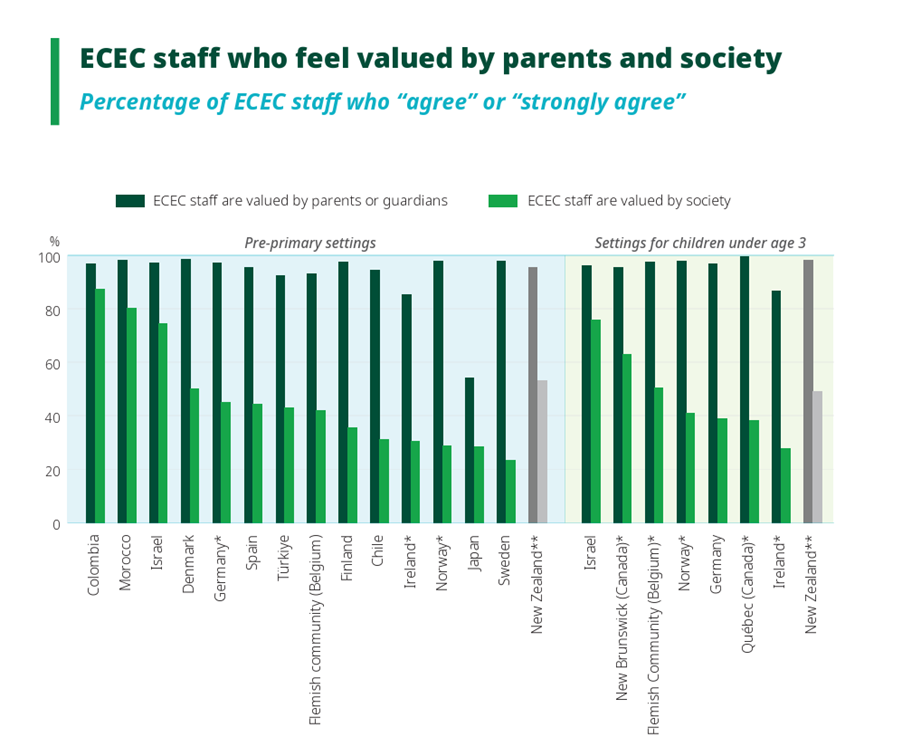
Data from the OECD's TALIS Starting Strong report paints a clear, albeit concerning, picture. In virtually all participating countries, a staggering majority of ECEC staff—over 80%—report feeling appreciated by parents and guardians. This sentiment holds true for both settings catering to children under three and those for pre-primary age groups. The connection with the children themselves is even more profound, with nearly universal acknowledgment of their value from the little ones they nurture.
However, this warmth and recognition evaporate when the focus shifts to societal perception. The share of ECEC staff who feel valued by the broader community plummets dramatically. While some countries, like Colombia, Morocco, and Israel, see at least seven out of ten professionals feeling societal appreciation in pre-primary settings, the numbers drop precipitously elsewhere.
In places like Chile, Japan, Norway, and Sweden, and in Ireland across both age groups, fewer than one in three ECEC staff feel recognized by society. This stark contrast highlights a disconnect between the intimate, impactful work performed daily and the public's broader understanding and appreciation of the profession.
The Invisible Wall: Why Societal Recognition Fades
The nature of daily interactions offers a key insight into this disparity. ECEC staff build deep, personal bonds with children and their families through consistent, direct engagement. The immediate, visible impact of their work—a child learning to share, a new word mastered, a moment of comfort provided—fosters a strong sense of appreciation from those directly involved.
But once these interactions move beyond the immediate circle of the ECEC setting, the recognition often fades. In many societies, the perception of ECEC professionals leans more towards that of a caregiver than a highly skilled educator. This perception is often reinforced by factors such as comparatively low pay and limited public visibility, leaving many staff feeling overlooked by the wider community.
Interestingly, despite this societal deficit, ECEC staff often report feeling more valued by society than their counterparts in lower secondary education. In countries like the Flemish Community of Belgium, Israel, Spain, and Türkiye, ECEC professionals are twice as likely as secondary school teachers to feel society values their work. This suggests a systemic issue in how ECEC is perceived, rather than a universal lack of appreciation for educators across the board.
The Ripple Effect: Underappreciation's Impact on Quality and Retention
The consequences of this lack of societal recognition are far-reaching and threaten the very foundation of the ECEC sector. When professionals do not feel valued, the motivation to attract and retain skilled individuals dwindles. This problem is exacerbated when low societal prestige is coupled with widespread dissatisfaction regarding compensation.
These factors contribute directly to critical issues such as staffing shortages, high turnover rates, and diminished morale. Ultimately, these challenges impact the consistency and quality of the education and care that children receive, hindering their crucial early development.
The underappreciation of ECEC staff perpetuates a harmful myth: that working with young children is a low-skill endeavor. This is in direct opposition to the reality of the profession's critical importance for lifelong learning and well-being. Data reveals a paradox: ECEC staff who feel less valued by society often possess more years of experience and higher educational qualifications.
This suggests that the sector may be losing some of its most dedicated and qualified professionals due to dissatisfaction. When individuals feel unsupported, regardless of their field, their inclination to innovate, pursue further training, or remain in their roles can significantly decrease.
The Staffing Crisis: A Growing Concern for ECEC Leaders
ECEC leaders consistently identify staffing shortages as the primary driver of lower-quality education and care environments. The problem is particularly acute in certain regions and countries. For instance, in Germany and Norway (across both ECEC levels), and in Ireland and New Brunswick, Canada (for under-3 settings), more than half of centers struggle to maintain adequate quality due to a lack of staff relative to the number of children enrolled or frequent staff absences.
This situation creates immense pressure on existing staff, often leading to burnout and further exacerbating the cycle of underappreciation and turnover. The impact on children is undeniable, as consistent, high-quality interactions are vital for their cognitive, social, and emotional development.
Charting a New Course: Strategies for Elevating the ECEC Profession
Addressing the complex challenges facing the ECEC sector requires a multi-faceted approach that goes beyond simply increasing funding, although that remains a critical component. While raising salaries is a clear solution, it presents significant hurdles for countries operating under tight budget constraints.
Policymakers have long acknowledged the profound impact of early years experiences on lifelong outcomes, yet investment in the ECEC workforce has often lagged behind this rhetoric. Elevating the status and compensation of ECEC professionals must be viewed as a strategic imperative for building a stronger society.
Building Career Pathways and Professional Growth
One effective strategy involves implementing a more diversified and structured career framework. By defining a broader spectrum of roles—such as lead educators, curriculum specialists, or family engagement coordinators—governments can establish clear pathways for professional advancement.
Each role could be associated with progressively higher levels of pay, autonomy, and responsibility, accurately reflecting the complexity and impact of the work. This tiered system not only incentivizes continuous professional development but also serves to elevate the overall status and standards of the ECEC sector.
Countries and subnational entities like Colombia, the Flemish Community of Belgium, Morocco, and Spain have demonstrated success in pre-primary education by implementing such frameworks. In these regions, staff are less likely to consider leaving the sector entirely, often aspiring to leadership or primary teaching roles. Notably, these professionals also report higher levels of societal appreciation and greater job satisfaction, including with their salaries.
Addressing Workforce Dynamics and Promoting Inclusivity
Given that the ECEC workforce is predominantly female, absences due to maternity leave and family caregiving responsibilities are more frequent than in many other sectors. To mitigate the impact of these absences, ECEC systems can invest in pools of qualified replacement staff, ensuring continuity of care and education.
Simultaneously, concerted efforts are needed to encourage greater male participation in the profession. Balancing gender representation can enrich the learning environment and challenge traditional stereotypes associated with caregiving roles.
Shifting Public Perception Through Narrative and Policy
Public awareness campaigns and policy narratives play a crucial role in reinforcing the societal importance of ECEC professionals. By highlighting the expertise, dedication, and profound impact of these individuals, societies can begin to shift their perceptions.
Furthermore, broader policy measures, such as designing more flexible parental leave policies for both mothers and fathers, can foster a more equitable sharing of parental caregiving responsibilities. These initiatives, taken collectively, can contribute to building a more resilient, respected, and valued ECEC workforce, ultimately benefiting children and society as a whole.






 Explore AI Teaching Tools
Comments (0)
Please login to comment
No comments yet
Be the first to comment on this article