
Beyond Textbooks: How Career Tech Programs Ignite Student Potential and Forge Future Leaders
In a landscape where traditional academic paths often dominate the conversation, a powerful movement is quietly reshaping the high school experience. Across Los Angeles Unified, career technical education (CTE) programs are not just offering vocational training; they are cultivating essential life skills, fostering leadership, and providing a tangible head start for thousands of students on their journey toward meaningful careers.
Igniting Passion Through Hands-On Experience
The air crackled with energy and purpose at a recent showcase, a vibrant testament to the transformative power of hands-on learning. Under the relentless Southern California sun, students from across the district converged to demonstrate the skills and knowledge they've acquired through immersive, industry-aligned programs. This wasn't just a display of academic achievement; it was a preview of the next generation of innovators, problem-solvers, and community leaders.
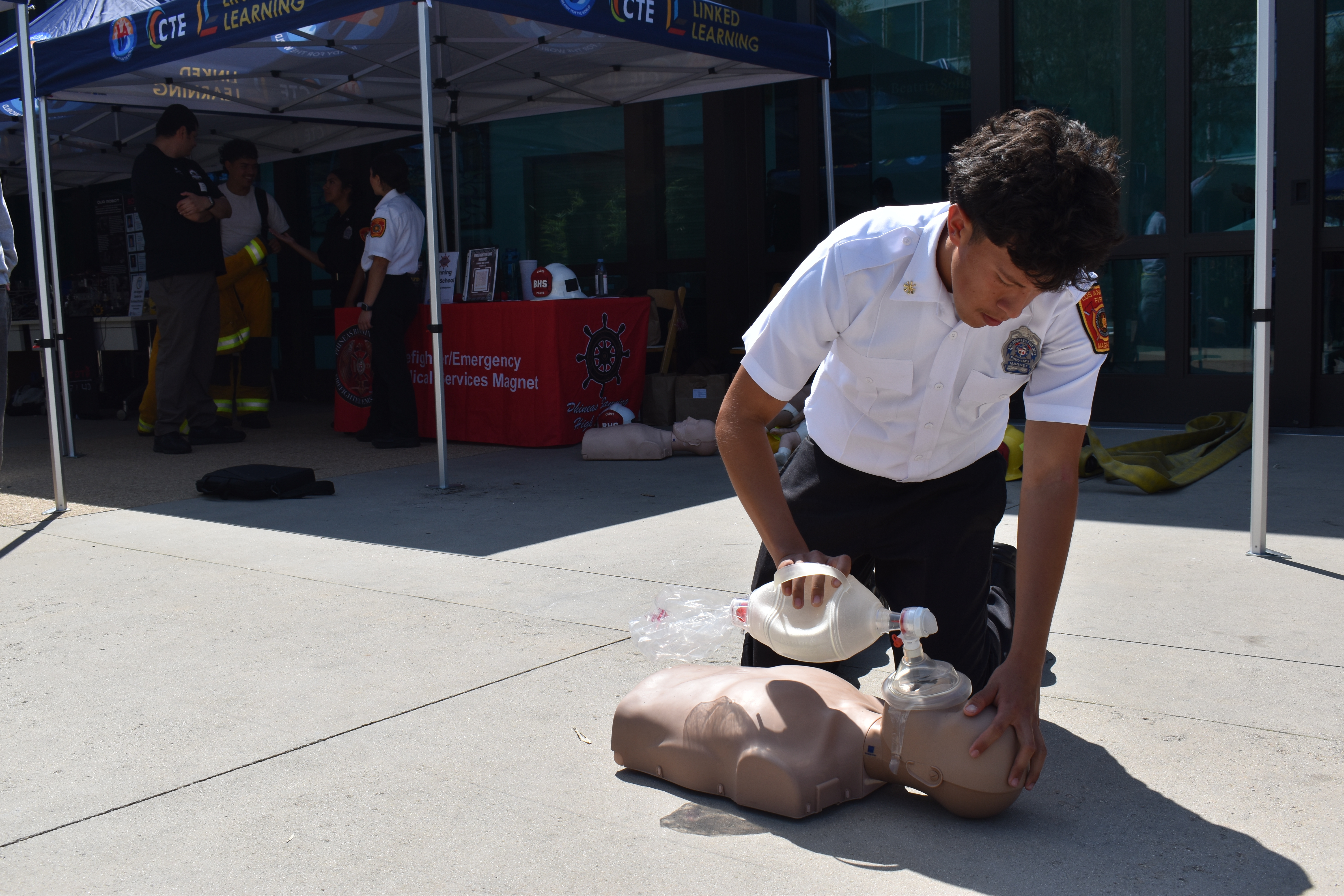
Sergio Garcia, a senior deeply immersed in the fire academy at Banning High School, embodied this spirit of dedication. With practiced urgency, he donned a firefighter's jacket, secured an oxygen mask, and began chest compressions on a training dummy. His demonstration of CPR, performed with precision and focus, drew the attention of fellow students, many of whom were exploring their own career aspirations.
Sergio's commitment extends beyond the immediate demonstration. He is on track to earn a fire science degree at a technical college, driven by a profound desire to serve. "With my degree, I'd rather know I'm going to help people," Sergio shared, his voice resonating with conviction. "Although it is very physically demanding, the fact that you're doing good in this world is a bigger gift than anyone could ever ask for."
His participation in the fire academy, a comprehensive three-year program, exemplifies the district's commitment to providing students with real-world experience. These programs are designed to bridge the gap between the classroom and the professional world, equipping students with both technical proficiency and the critical thinking skills necessary to thrive.
Engineering Dreams and Building Futures
Elsewhere at the showcase, the hum of innovation was palpable. Students cheered on a robotic battle, their creations vying for the ultimate prize: a custom-designed 3D-printed bot. Amidst the excitement, Madelynne Arevalo, a senior from Fremont High School, meticulously set up a mini flight simulator, a testament to her passion for aerospace engineering.
Madelynne is a key player in her school's robotics program, currently focused on designing a rocket launch for her aerospace engineering project. The competitive nature of these programs, she explained, adds an exhilarating dimension to her learning. "We also compete with other high schools, and the competitions are really fun," Madelynne said, a bright smile illuminating her face.
She recalled a past competition where her team had to design an elevator system within a robot. While they ultimately opted for a more time-efficient design for the event, the experience proved invaluable. "It was a lot of our own ideas and a lot of collaboration," Madelynne reflected. "And I thought that even if it doesn't work, at least the process was nice." This sentiment highlights a crucial aspect of CTE: the emphasis on process, resilience, and collaborative problem-solving, even when faced with setbacks.
These programs are not isolated initiatives. Los Angeles Unified has significantly expanded its career technical education offerings, now encompassing approximately 435 distinct pathways. These span a wide array of fields, from cutting-edge engineering and technology to essential trades like construction and vital sectors like business. This expansive network now serves nearly 40,000 students, demonstrating a substantial investment in their future success.
The impact of these programs is measurable. In the 2024-2025 school year alone, approximately 1,000 students secured valuable internships, gaining firsthand experience in their chosen fields. Furthermore, CTE programs boast an impressive graduation rate of around 97%, underscoring their effectiveness in keeping students engaged and on track to complete their education.
Cultivating Curiosity and Sharpening Perspectives
The value of CTE extends beyond technical skills, fostering a deeper engagement with the world. Israel Urbina, a junior at Washington Preparatory High School, showcased his mastery of photojournalism, a field that has allowed him to explore the artistic potential of light itself. His display featured striking images where he manipulated light to create intricate designs and spell out his name, a technique known as light painting.
"Right now, my thing in photography is light painting," Israel explained, his enthusiasm evident. "I did a video about it in my photography class, and it's about all my light paintings and the different ones I've done and the different people I've done it with." His dedication has not gone unnoticed; his photojournalism teacher described Israel as nearly an "expert" in the field.
Through years of honing techniques related to perspective, reflections, texture, light, and shadow, Israel's teacher noted that most students leave the program with a heightened sense of curiosity about their surroundings and a more discerning eye for detail. "What that says to me is that teaching them the basics is to be sensitive and have a different sensibility about their environment," the teacher remarked. "That's what makes me come to school in the morning."
Blessed Thomas-Hill, a senior at Washington Prep, collaborated with Israel on a film project exploring light painting, contributing her poetic narrative to the visual storytelling. She initially chose the photojournalism program because of her teacher's ability to foster self-expression. "I'm an introvert, and talking with people, I really struggle with that a lot," Blessed admitted.
However, the program provided a supportive environment for growth. "I got to know a lot of great friends this year. I've got to get closer to more people. It's made me more sociable," she shared, highlighting the unexpected social benefits of pursuing a creative technical field.
Finding Confidence and Purpose
The journey through CTE programs often involves overcoming personal challenges and discovering hidden strengths. Madelynne, who plans to pursue a college degree in biomedical engineering, initially felt a sense of being behind her peers in the robotics program. Having committed to robotics in her senior year, she worried about the coding experience many students had gained since middle school.
"At first, I didn't believe in myself. I didn't think I was smart enough to do something as complicated as engineering," Madelynne confessed. Her involvement in the robotics program, however, led her to "Girls Build," a club dedicated to empowering girls in coding and machine building. "Spreading the positivity around has helped me believe more in myself," she added, a testament to the supportive communities that often form within these programs.
Sergio, the dedicated student at the fire academy, also faced his own hurdles. The physical demands of the training were initially challenging, but through simulated fire alarm drills, he developed both speed and strength. More importantly, he discovered a profound sense of capability and leadership within himself.
"I've also learned that when it comes to rising to an occasion, I rise to that occasion. Whether it be someone's in trouble, I help protect people," Sergio stated with quiet confidence. "This academy has brought out leadership in me, the discipline, the social skills that I wouldn't have learned any other way." This internal transformation is a powerful outcome of programs that push students beyond their perceived limits.
Sergio's future plans further illustrate the integrated nature of modern CTE. He intends to become a certified diesel mechanic, a path directly influenced by his experience with the firefighting program. This allows him to combine his passion for working on vehicles with a desire to contribute to a greater good. "I love the whole firefighting part, but I've also always loved working on cars," Sergio explained. "I figured if I'm going to be a mechanic, I might as well do it for a better cause. Working on fire engines, so when those firefighters go out and save those lives, I can say I helped with that."
A Glimpse into the Future of Education
The success stories of students like Sergio and Madelynne are not isolated incidents but rather indicators of a broader shift in educational priorities. Career technical education is proving to be a vital pathway for students seeking not only immediate job readiness but also the development of critical thinking, teamwork, and personal resilience.
As these programs continue to expand and evolve, they offer a compelling model for how education can better serve the diverse needs and aspirations of all students. By providing tangible skills, fostering a sense of purpose, and igniting a passion for lifelong learning, career technical education is undoubtedly shaping a brighter future for individuals and communities alike.





 Explore AI Teaching Tools
Comments (0)
Please login to comment
No comments yet
Be the first to comment on this article