
Navigating California's Educational Landscape: Student Well-being and School Funding Concerns
A recent comprehensive survey has illuminated the evolving priorities and anxieties of Californians regarding their public school system.While concerns about student mental health remain a significant focus, public sentiment towards a statewide school bond initiative appears to be less enthusiastic.
This analysis delves into the survey's findings, offering insights into public opinion and its potential implications for educational policy and investment.
Understanding these trends is crucial for educators, policymakers, and the broader community invested in the future of learning.
The Persistent Shadow of Student Mental Health
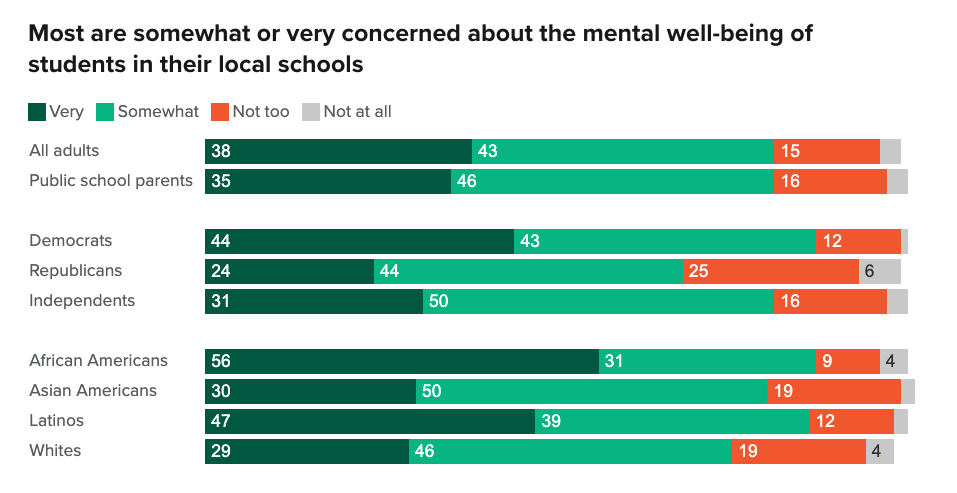
Four years after the widespread disruption caused by school closures, a significant majority of Californians express deep concern about the mental well-being of students in public schools.This sentiment cuts across diverse demographics, including various racial backgrounds, political affiliations, and income levels, underscoring a shared understanding of the lasting impact of recent global events on young minds.
The survey data suggests that this worry persists even as students have returned to traditional classroom settings, indicating a recognition of the long-term effects of the pandemic on student health and development.
The data reveals that a substantial 81% of all adults and public school parents reported being either strongly or somewhat concerned about students' mental health and overall well-being.
This finding is particularly noteworthy as it reflects a continuing societal awareness of the challenges students have faced, extending beyond academic concerns to encompass their emotional and psychological states.
The persistent worry highlights a collective acknowledgment that the return to normalcy in schools does not automatically erase the anxieties and stresses experienced by students during periods of uncertainty and isolation.
This ongoing concern about student mental health is a critical indicator for educational institutions and policymakers.
It suggests a need for sustained investment in mental health resources, counseling services, and programs designed to foster resilience and emotional support within school environments.
The survey's findings serve as a powerful reminder that a holistic approach to education, one that prioritizes the well-being of every student, is paramount.
Public Opinion on Statewide School Bonds: A Lukewarm Reception
While the importance of student well-being is widely acknowledged, the prospect of a statewide school bond initiative to fund facility improvements and construction appears to be met with a more divided and less enthusiastic response from voters.The survey indicates that a significant portion of likely voters are undecided or inclined to vote against such a measure, presenting a potential challenge for proponents aiming to secure the necessary support for passage.
Specifically, the survey data shows that only 53% of likely voters indicated they would vote in favor of a state bond, while a substantial 44% expressed an intention to vote no, with a mere 3% remaining undecided.
This level of support falls below the commonly accepted benchmark of 60% favorability that typically provides comfort to initiative backers as they prepare for a campaign.
The findings suggest that voters may be hesitant to commit to new financial obligations, potentially due to broader economic concerns or a lack of clear understanding about the necessity and impact of such a bond.
The lukewarm reception to the bond proposal underscores the importance of clear communication and robust public engagement.
For any educational funding initiative to succeed, it is essential to articulate a compelling case for its necessity, detail the specific benefits it will bring to students and communities, and address any potential concerns voters may have about fiscal responsibility and the allocation of funds.
The survey's results serve as a crucial data point for strategizing future public outreach and campaign efforts related to school infrastructure funding.
Assessing Leadership in Education: Mixed Reviews for State Officials
The survey also probed public perceptions of how state leadership, including the Governor and the Legislature, is managing the state's education system.The results reveal a mixed sentiment, with a slight majority expressing approval, but with notable shifts compared to previous assessments.
This indicates a complex public evaluation of current educational governance.
According to the survey, 51% of all Californians and a more substantial 60% of public school parents indicated satisfaction with the Governor's handling of education.
While this represents a majority, it is important to note that this figure marks the lowest approval rating since the Governor's election in 2018.
This trend aligns with broader assessments of the Governor's overall job performance, suggesting a potential shift in public perception regarding his leadership in various sectors, including education.
The timing of these assessments is also significant.
The Governor's highest approval ratings in this area were observed in April 2020, during the initial stages of the pandemic.
This surge in support was attributed to decisive action taken in response to the unprecedented crisis, including the decision to close schools.
The current, more moderate approval ratings suggest that the initial "bump" in public confidence may have subsided, and voters are now evaluating performance based on ongoing educational challenges and policy outcomes.
Navigating Contentious Issues: Book Bans and Classroom Discussions
Beyond funding and leadership, the survey delved into public opinions on several contentious social and political issues that have surfaced within educational discourse.These findings offer insight into the community's stance on curriculum control, book accessibility, and the scope of classroom discussions.
Community Stance on Book Bans and Removal
A significant majority of Californians expressed opposition to individual school boards enacting policies that ban or remove certain books from classrooms and school libraries.This sentiment was echoed by a considerable portion of public school parents, indicating a broad community value placed on intellectual freedom and access to diverse literature.
The survey revealed that 69% of all adults strongly or somewhat opposed the idea of school boards passing laws to ban and remove specific books.
A similar, though slightly smaller, majority of public school parents, with 30% strongly and 25% somewhat opposing such measures, shared this view.
This widespread opposition suggests a public inclination towards allowing a broader range of materials in educational settings, even on topics that may be considered sensitive or controversial.
This finding is particularly relevant in light of recent debates and policy decisions in various school districts.
The data implies that the public, in general, favors a more inclusive approach to library collections and curriculum content, trusting educators and established review processes to curate appropriate materials.
The survey's results can inform discussions about the role of local school boards in content selection and the importance of upholding principles of academic freedom.
Restrictions on Classroom Discussions
Complementing the views on book bans, the survey also explored public sentiment regarding restrictions on topics that teachers and students can discuss in the classroom.The findings indicate a strong preference for open dialogue and a cautious approach to limiting academic discourse.
A notable 58% of all adults and 55% of public school parents opposed the creation of policies by individual school boards that would restrict what subjects teachers and students can discuss.
This suggests a general belief that classrooms should be environments where a wide range of topics can be explored, fostering critical thinking and comprehensive understanding.
The opposition to such restrictions implies a trust in educators to guide discussions appropriately and a recognition that open dialogue is essential for a robust educational experience.
Support for Teaching Sensitive Historical Topics
The survey also highlighted strong public support for incorporating discussions about sensitive historical topics, such as slavery, racism, and segregation, into the public school curriculum.This indicates a community consensus on the importance of comprehensive historical education.
More than 80% of adults and public school parents expressed strong or somewhat favorability towards teaching about the history of slavery, racism, and segregation in public schools.
Furthermore, over 50% of all respondents held this view strongly.
This overwhelming support underscores a societal understanding that a complete and accurate portrayal of history, including its difficult and often painful aspects, is crucial for educating future generations and fostering a more informed and equitable society.
Preparing Students for the Future: College Readiness vs.
Workforce Skills The survey also examined public perceptions of how well local schools are preparing students for their post-graduation pathways, distinguishing between readiness for higher education and preparedness for the workforce.
The results reveal a notable difference in these assessments.
A significant majority of respondents believe that local schools are doing a good job preparing students for college.
Specifically, 60% of all adults and a higher 72% of public school parents rated their schools favorably in this regard.
This suggests a general confidence in the academic rigor and college preparatory programs offered by many public schools.
However, when it comes to preparing students for the workforce, the ratings are less impressive.
Only 51% of all adults and 65% of public school parents felt that schools were doing a good job preparing students for jobs and the workforce.
This disparity indicates a potential area for improvement, suggesting that while academic foundations are being laid, there may be a need for greater emphasis on vocational training, career exploration, and the development of practical skills that are directly applicable to employment opportunities.
Disparities in College Preparedness by Race
The survey also brought to light significant disparities in how different racial groups perceive their schools' effectiveness in preparing students for college.These findings highlight the need for targeted interventions to ensure equitable educational outcomes.
For instance, only 45% of African American respondents reported that their schools did a good job preparing students for college.
This contrasts with higher percentages among other racial groups: 64% of Asian Americans, 61% of Latinos, and 61% of Whites expressed similar positive assessments.
These figures underscore the importance of addressing systemic inequities and ensuring that all students, regardless of their background, have access to the resources and support necessary to succeed in higher education.
Partisan Divides on Social Issues in Schools
As is often the case with complex social issues, the survey revealed sharp partisan divisions in public opinion, particularly concerning topics related to gender identity and inclusivity in schools.These divisions highlight the challenges in finding consensus on sensitive cultural matters within the educational sphere.
When it comes to allowing books with stories about transgender youth in public schools, California adults were nearly evenly split, with 50% supporting the idea and 49% opposing it.
However, this overall balance masks significant partisan differences.
A strong majority of Democrats, three in four, supported this inclusion, while a similarly strong majority of Republicans, eight in ten, opposed it.
Independents were also divided, with 51% supporting and 48% opposing.
These divisions extended to views on including lessons on transgender issues.
Public school parents, in particular, showed opposition, with only 42% supporting the idea and 57% opposing it.
This suggests that while the broader adult population may be more evenly split on some aspects of LGBTQ+ inclusion in schools, parents of public school students exhibit a clearer trend of opposition to these specific educational components.
Support for Universal Transitional Kindergarten
In contrast to the divisions on social issues, there appears to be broad consensus and strong support for the state's initiative to expand transitional kindergarten (TK) for all 4-year-olds.This initiative has garnered widespread approval across various demographic groups.
The survey indicates that two-thirds of all adults, including a substantial 77% of public school parents, view the expansion of TK as a positive development.
This support is further amplified among specific political and racial groups: 80% of Democrats, 84% of Black respondents, and 57% of White respondents expressed approval.
While Republicans showed less enthusiastic support at 41%, the overall sentiment remains overwhelmingly positive, highlighting a shared belief in the benefits of early childhood education.
The Uncertain Path of School Construction Bonds
The prospect of a statewide school construction bond, intended to address the pressing need for facility upgrades and new construction, faces an uncertain future.While the Governor has expressed support for placing such a measure on the ballot, the specifics remain under negotiation, and public sentiment, as indicated by the survey, suggests a challenging road ahead.
The state has not passed a statewide bond for school construction since 2016, and a significant funding gap exists for districts' capital improvement projects.
The survey's findings, particularly the lukewarm support for a bond, could influence the size and scope of any proposed measure.
It is possible that legislative leaders may opt for a smaller bond amount than initially discussed, or one that is more narrowly focused on TK-12 and community colleges, rather than including funding for the University of California and California State University systems, which polls less favorably.
Experts suggest that the current economic climate, including concerns about inflation and state budget deficits, may be contributing to voter hesitancy regarding new debt.
The recent narrow passage of Proposition 1, which addresses housing and mental health funding, serves as a reminder of the public's sensitivity to taking on additional financial commitments.
However, some believe that voter attitudes could shift as the economic outlook improves and a balanced state budget is adopted later in the year.
Historically, state bond initiatives have faced greater success in November elections, which typically see higher voter turnout, compared to primary elections.
While a bond was rejected in the March 2020 primary, past trends suggest that November elections offer a more favorable environment for passage.
Nevertheless, the current level of voter anxiety about the economy and debt suggests that proponents of a school bond will need to mount a compelling campaign to secure the necessary support.
Conclusion: Balancing Priorities in California Education
The recent survey provides a nuanced snapshot of Californian public opinion on critical educational issues.It clearly signals that while the mental health and well-being of students are paramount concerns, the path forward for funding essential school infrastructure through a statewide bond is fraught with challenges.
The mixed reviews for state leadership in education, coupled with deep partisan divides on social and curriculum-related topics, underscore the complex landscape policymakers must navigate.
The strong support for universal transitional kindergarten stands out as a unifying issue, indicating a shared commitment to early childhood education.
Conversely, the disparities in college preparedness by race and the differing perceptions of workforce readiness highlight areas where targeted interventions and policy adjustments are urgently needed.
As California moves forward, understanding these public sentiments, addressing economic anxieties, and fostering clear communication will be crucial for building consensus and ensuring a robust and equitable future for its public school system.





 Explore AI Teaching Tools
Comments (0)
Please login to comment
No comments yet
Be the first to comment on this article