
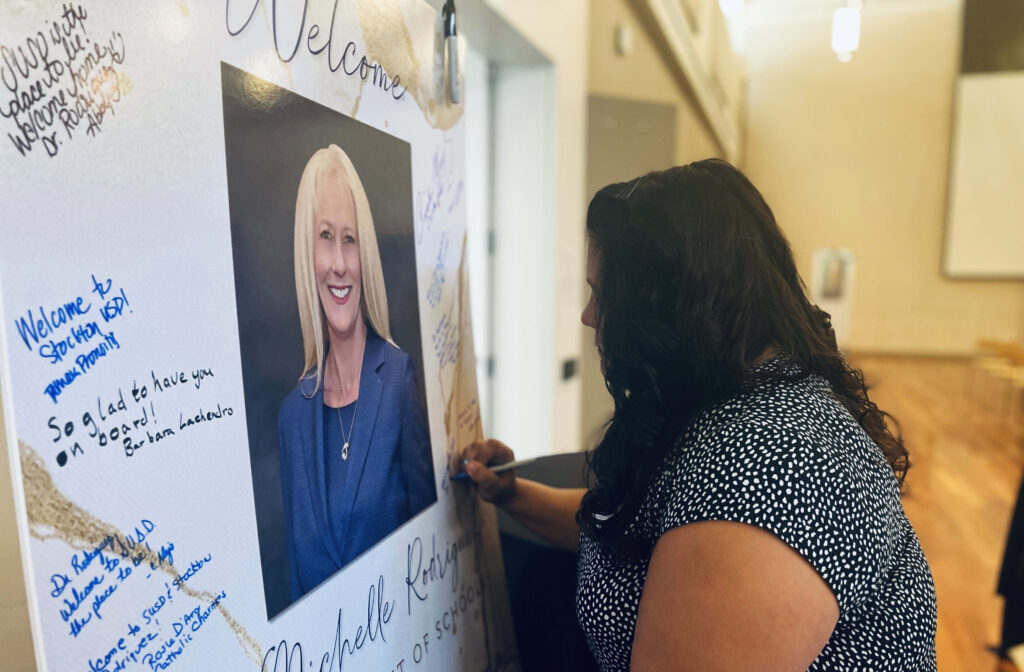
Stockton Unified's Transformation: A Year of Progress Under Superintendent Rodriguez
For years, the Stockton Unified school district has grappled with significant challenges, from financial instability and leadership turnover to persistent issues with student achievement.
However, a new era of focused leadership and community engagement has begun.
This article explores the impactful changes implemented in Stockton Unified over the past year under Superintendent Michelle Rodriguez, detailing her strategic approach to revitalizing the district and enhancing the educational experience for all students.
1.
A New Vision for Stockton Unified: Addressing Systemic Challenges
Upon her arrival in July 2023, Superintendent Michelle Rodriguez inherited a district facing considerable headwinds.
Stockton Unified, serving nearly 40,000 students, had a reputation marred by legal entanglements and a high rate of underperformance, with a majority of students not meeting state standards in English and mathematics.
Rodriguez, the fourteenth superintendent in less than two decades, recognized the urgent need for stability and a fundamental shift in focus.
Her stated mission was to pivot away from the district's troubled past by prioritizing students, fostering a stable environment, rebuilding public trust, and actively involving the community.
This commitment was encapsulated in her philosophy of driving change "one interaction, one decision, one day at a time."
Rodriguez's initial approach was characterized by a refusal to make assumptions.
Instead of immediately diagnosing the root causes of the district's struggles, she emphasized the importance of direct observation and engagement. "Until I get in the classroom, I probably won’t be able to answer the question about lack of student achievement here," she stated, underscoring her belief that true understanding comes from firsthand experience.
This grounded perspective informed her strategic framework, which identified four critical pillars for effective educational systems: quality assurance, high expectations, continuous improvement, and community trust.
These foundational elements became the guiding principles for her ambitious agenda.
2.
Building a Foundation of Accountability and Community Input
A cornerstone of Rodriguez's strategy was the establishment of a robust public accountability system.
This began with extensive outreach efforts, including meet-and-greets and listening sessions conducted in both English and Spanish.
These sessions were designed to solicit direct feedback from parents, students, and community members, ensuring that the district's priorities were deeply rooted in the needs and concerns of those it served.
The feedback gathered was instrumental in shaping "priority recommendations," a set of actionable goals that bore the "fingerprints" of community involvement.
This collaborative process led to the development of 44 priority recommendations, a comprehensive roadmap for the district's future.
Among these was a critical goal to create tailored student success plans for various student demographics, ensuring that support was targeted and effective.
To make this progress transparent and accessible, Stockton Unified launched the "It Takes All of US" public accountability dashboard.
This innovative tool, available in English and Spanish, provides a clear overview of each goal, its complexity, the responsible department, the actions being taken, completion status, and the measurable outcomes and impact.
This initiative was a direct response to the community's desire for tangible evidence of progress, ensuring that the extensive engagement efforts translated into meaningful action and that the Stockton Unified community felt heard and valued.
3.
Early Wins and Strategic Goal Achievement
Almost immediately after setting the 44 priority recommendations, Rodriguez and the district team focused on achieving "easy wins"—quick, impactful actions that demonstrated immediate progress and built momentum.
One such early success involved equipping special education classrooms with radios.
This seemingly small intervention addressed a significant safety concern reported by teachers and staff regarding students, particularly those with special needs, leaving classrooms unsupervised.
The radios provided a crucial tool for staff to quickly request assistance, enhancing student safety and providing teachers with greater peace of mind.
Rodriguez highlighted that these seemingly minor improvements had a substantial positive impact on the system, empowering educators and improving the learning environment.
In parallel, Rodriguez established the Superintendent's Student Advisory group, comprising 90 students from across the district's high schools.
This groundbreaking initiative provided a direct channel for students to voice their concerns and advocate for their peers, as exemplified by Emily Gomez Valle, a junior at Chavez High School.
The district also tackled short-term goals within the first three months, including implementing thorough exit interviews to understand staff attrition patterns.
These intentional early successes were designed to build confidence and demonstrate the superintendent's commitment to getting things done.
By the 2023-24 school year, these efforts began to yield significant results.
The district's graduation rate climbed to an all-time high of 83.9%, a testament to the renewed focus on student success.
Long-term goals also saw substantial progress, including increased participation in "Educators Thriving," a program offering vital social-emotional support and training for school staff.
Furthermore, specific student success plans were developed for vulnerable populations, including Black students, English learners, homeless youth, and students with special needs, underscoring the district's commitment to equitable support.
4.
Navigating Financial and Legal Landscapes
Beyond academic and operational improvements, Rodriguez's tenure has also involved addressing the district's complex financial and legal challenges.
Stockton Unified had been under scrutiny due to a state audit that uncovered potential financial irregularities between 2019 and 2022, leading to investigations by local and federal authorities.
A significant portion of this scrutiny involved millions of dollars in federal Elementary and Secondary School Emergency Relief (ESSER) funding.
Under Rodriguez's leadership, the district successfully navigated these issues, notably avoiding the repayment of $6.6 million in improperly awarded ESSER funds.
A major challenge was ensuring the timely and effective expenditure of ESSER funds before their deadline.
As of March 2023, only a small fraction of the allocated funds had been utilized.
However, by the time of this review, the district had reportedly utilized all ESSER funding, completing over 40 projects.
The allegations of ESSER fund misuse also prompted a grand jury investigation into the district's broader spending practices.
The grand jury report identified a reliance on consultants as a contributing factor to staff lacking the necessary expertise for complex tasks.
In response, Stockton Unified undertook a thorough evaluation of its consultant engagements and has bolstered internal staff expertise, leading to a significant reduction in consultant costs.
From $886,561 in the previous school year, estimated costs dropped to $275,000.
By June, 32 of the 44 priority recommendations had been finalized, encompassing both immediate wins and longer-term strategic objectives, demonstrating substantial progress in resolving systemic and structural issues.
5.
Addressing Remaining Priorities and Future Directions
Despite the significant progress achieved in the first year, Rodriguez acknowledges that substantial work remains.
The challenges faced by many students in Stockton Unified are deeply rooted in socioeconomic disadvantages.
An encounter with a homeless student who had not attended school for a week, struggling with basic needs like hygiene, underscored the critical importance of expanding family and community partnerships, raising expectations, and developing equitable action plans.
These remain key priorities aimed at enhancing the student experience.
Rodriguez's philosophy emphasizes reframing experiences to change beliefs and ultimately elevate expectations for students.
The district is committed to conducting a comprehensive equity audit to identify and dismantle policies and practices that create barriers for students.
This audit will inform a three-year action plan, developed by teams of employees from each school, to foster a more equitable educational environment.
These remaining priorities will be integrated into the district's Local Control Accountability Plan (LCAP), a key state requirement.
The LCAP goals for 2024-2027 include enhancing student academic achievement, supporting the whole child, offering innovative programs aligned with student interests, fostering meaningful partnerships, ensuring access for students with disabilities, and creating positive learning conditions for Black students to thrive.
Additional district priorities include significant investments in facilities, allocating $50 million of ESSER funding for upgrades such as science labs.
There is also a concerted effort to provide equitable access to arts programs across all 55 schools, with a particular focus on students who are Black, English learners, homeless, have special needs, or are foster youth, ensuring they benefit from differentiated instruction.
The district is also implementing administrator classroom visits to provide feedback to staff and enhance administrative understanding of the curriculum.
Furthermore, Stockton Unified is actively working to resolve outstanding findings from various state and county reports, including those from the California Department of Education, the San Joaquin County Office of Education, and the grand jury.
6.
Data-Driven Decision-Making and Adapting to Change
Stockton Unified is increasingly leveraging data to inform its strategies and adapt its approach.
While the district has seen improvements in areas like chronic absenteeism—decreasing by 3.1 percentage points from 2022-23 to 2023-24—Rodriguez emphasizes the need for continuous evaluation.
The question remains: "Is it working fast enough?
Are there any shifts that we could continue to do?" This data-driven mindset extends to academic performance.
The district has observed that while interventions are in place, student academic growth is not yet at the desired level.
To address this, Stockton Unified is utilizing iReady data, a tool that provides adaptive lessons and tracks student progress.
Fall 2023 data revealed significant gaps in English and math proficiency among fourth graders, with a substantial percentage performing multiple grade levels behind.
However, by the spring 2024 semester, the district saw encouraging improvements: the percentage of fourth graders on grade level in English increased by 11.7 percentage points, and in math, it grew by an impressive 20.6 percentage points.
This rapid improvement demonstrates the district's ability to pivot and adjust its strategies based on real-time data, a crucial element for sustained progress.
Rodriguez stated, "Every quarter we're looking at the data because we want to be able to pivot and shift quicker than just yearly."
Conclusion
Superintendent Michelle Rodriguez's first year at the helm of Stockton Unified has been marked by a profound commitment to systemic change, driven by community engagement, data-informed decision-making, and a clear vision for student success.
The district has moved from a period of instability and underperformance to one of focused action and measurable progress.
From establishing a transparent accountability system and achieving early wins to tackling complex financial issues and setting ambitious future goals, Stockton Unified is on a transformative path.
While challenges persist, the dedication to equity, continuous improvement, and unwavering focus on the needs of every student, as championed by Rodriguez and her team, positions the district for a brighter educational future.
The ongoing work, guided by the established priorities and a responsive approach to data, signifies a sustained effort to ensure that all students in Stockton Unified have the opportunity to thrive.







 Explore AI Teaching Tools
Comments (0)
Please login to comment
No comments yet
Be the first to comment on this article