
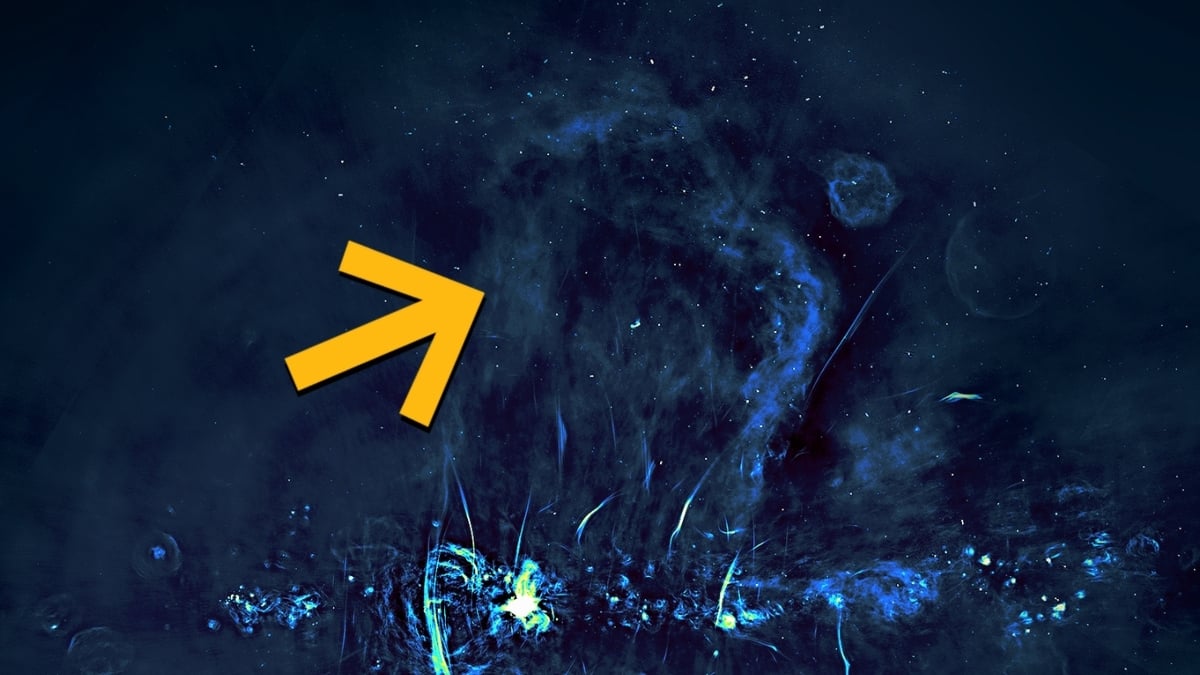
For forty years, astronomers have been perplexed by a colossal, enigmatic structure lurking at the heart of our galaxy. This towering anomaly, invisible to the naked eye and even challenging for powerful telescopes, has been a cosmic mystery, a giant question mark against the backdrop of the Milky Way. Now, thanks to groundbreaking research, scientists believe they have finally begun to solve this enduring puzzle, a development that has profound implications for how we understand galactic evolution and could even inspire new approaches to problem-solving in our own classrooms.
Unveiling the Galactic Enigma: A 40-Year Quest
Imagine a structure so vast it dwarfs anything we can comprehend on Earth, yet so subtle it has evaded definitive identification for decades. This is the challenge faced by astrophysicists studying the galactic center. For generations, observations hinted at something unusual, a complex arrangement of gas and magnetic fields that didn't fit existing models of stellar nurseries or black hole activity.
The mystery deepened with each new telescope and survey. Was it a unique formation of dark matter? A remnant of an ancient galactic collision? The scientific community was rife with speculation, piecing together fragmented data like detectives on a cosmic crime scene. The sheer scale of the Milky Way makes pinpointing such elusive features an immense undertaking.
"This structure isn't just large; it's a fundamental piece of the galactic puzzle we've been missing."
The breakthrough came from a convergence of advanced observational techniques and sophisticated computational analysis. By combining data from multiple radio telescopes and employing cutting-edge algorithms, scientists were able to map the region with unprecedented clarity. This allowed them to discern the true shape and extent of the anomaly, moving beyond mere hints to concrete evidence.
The Towering Revelation: What Scientists Discovered
The answer, it turns out, is as elegant as it is immense. The giant structure is not a singular object, but rather a vast network of filamentary, magnetized gas. These filaments, stretching for hundreds of light-years, appear to be organized in a way that suggests a powerful, underlying magnetic field guiding their formation and orientation.
This discovery offers a crucial insight into the dynamics of the galactic center, a region known for its extreme conditions and intense magnetic activity. It helps explain some of the puzzling radio emissions and energetic particle distributions that have long baffled researchers. The structure acts as a sort of cosmic scaffolding, influencing the flow of matter and energy.
The implications extend beyond simply cataloging galactic features. Understanding how such massive, organized structures form and persist in the chaotic environment of the galactic core can provide models for how complexity arises from seemingly random processes. This is a powerful lesson for educators seeking to foster critical thinking and problem-solving skills.
From Cosmic Threads to Classroom Strategies
The process of solving this 40-year mystery offers a compelling narrative for engaging students. It’s a story of observation, hypothesis, rigorous testing, and ultimately, revelation. How can we translate this scientific journey into tangible learning experiences?
Consider the tools used by the scientists: advanced technology, collaborative data analysis, and a willingness to question established assumptions. These are precisely the skills we aim to cultivate in our students. The sheer scale of the problem – a giant structure in our Milky Way – can be a springboard for discussions about scale, perspective, and the vastness of the universe.
Here are a few ways educators can leverage this discovery:
- Spark Curiosity: Use the story as an introduction to astronomy, astrophysics, or even the scientific method. Ask students what they imagine such a structure might be and why it took so long to find.
- Visualize the Invisible: Discuss the challenges of observing faint or distant objects and how scientists overcome these limitations using different wavelengths of light and advanced technology.
- Model Complex Systems: Explore how magnetic fields can organize matter on a grand scale. This could lead to simple experiments demonstrating magnetic forces or discussions about how patterns emerge in nature.
- Embrace the Unknown: Highlight the iterative nature of scientific discovery. The 40-year mystery wasn't solved overnight; it involved many scientists contributing pieces to the puzzle.
The methods employed by these scientists underscore the importance of interdisciplinary approaches and the power of computational tools. For instance, the ability to process and analyze vast datasets is crucial. This mirrors the growing need for students to develop data literacy and an understanding of how technology can help us solve complex problems.
"The universe is full of wonders, and the more we learn, the more we realize how much more there is to discover."
The journey to understand this galactic anomaly is a testament to human ingenuity and perseverance. It reminds us that even the most enduring questions can be answered with dedicated research and innovative thinking. This spirit of exploration is something every educator strives to instill in their students.
Leveraging Technology for Galactic-Scale Learning
Just as scientists use advanced tools to probe the cosmos, educators can harness technology to bring complex concepts into the classroom. Tools designed for interactive learning can transform abstract ideas into engaging experiences. For example, visualizing the structure of the Milky Way or the forces at play in the galactic center can be made more accessible.
Imagine using an AI lesson plan generator to create a unit on galactic structures, complete with interactive elements. Tools that facilitate collaborative learning and real-time assessment can also mirror the scientific process. The idea is to make learning as dynamic and investigative as the scientific endeavor itself.
Platforms offering live quiz and classroom games can be particularly effective in reinforcing concepts about space and science. A well-designed trivia game on astronomy, for instance, can solidify understanding of galactic components and phenomena. Similarly, using an exam creator to generate quizzes on astrophysics can test comprehension in a format that feels less like traditional assessment and more like a knowledge challenge.
The discovery of this giant, towering structure in our Milky Way is more than just a scientific triumph; it’s an inspiration. It’s a reminder that the universe holds incredible secrets, and that with the right tools and a persistent spirit, we can unravel even the most complex mysteries. This pursuit of knowledge, from the farthest reaches of space to the everyday classroom, is what drives progress and ignites the minds of future generations.






 Explore AI Teaching Tools
Comments (0)
Please login to comment
No comments yet
Be the first to comment on this article