
Florida's 15-Year Education Gamble: Did Choice Outshine Spending for Public Schools?
For nearly 15 years, Florida has been a real-world laboratory for a bold education experiment. While many focused on the students directly benefiting from expanded school choice, a crucial question lingered: what about the students remaining in the public school system? New research suggests the answer might be surprisingly positive, challenging long-held assumptions about how best to improve academic outcomes for all students.
The Cost of More: Examining Traditional Spending Increases
The idea that more money directly translates to better student performance is a deeply ingrained belief in education. This was powerfully illustrated by the massive influx of federal funding during the pandemic. Billions were poured into public schools, with the intention of mitigating learning loss and supporting academic recovery.
However, the results, while showing some positive movement, were far from transformative. Studies evaluating this substantial spending found that each additional $1,000 per student yielded only a handful of extra learning days in math and reading. The gains, while present, were modest when weighed against the immense financial investment.
This pattern isn't new. Decades of research have consistently shown that simply increasing school spending, without a clear strategy for how those funds are utilized, often yields diminishing returns. The consensus among many education researchers is that the *efficiency* of spending, not just the amount, is the critical factor for meaningful improvement.
Consider the scale: to merely return students to pre-pandemic academic levels through increased spending alone would require hundreds of billions of dollars nationwide. This stark reality underscores a fundamental challenge: how can we achieve significant academic gains without an exorbitant price tag?
The Competition Effect: How Choice Can Spur Public School Gains
While the impact of increased spending is often debated, a growing body of research has turned its attention to the effects of school choice programs on public schools. The theory is that when families have the option to choose private schools, public schools face a competitive pressure that can incentivize them to improve.
For years, studies on this "competition effect" have yielded mixed results, often showing small or negligible impacts. This was partly due to the relative newness of many choice programs and limitations in available data, making it difficult to track long-term consequences.
However, a landmark study examining the first 15 years of Florida's Tax Credit Scholarship Program offers a compelling counter-narrative. This program, which provides scholarships to lower-income students to attend private schools, has grown significantly, serving over 100,000 students at its peak during the study period.
Researchers meticulously analyzed public school students in areas with varying levels of private school competition. They developed a sophisticated index to measure this pressure, considering factors like the proximity, density, and enrollment of nearby private schools before the scholarship program's widespread adoption.
Growing Benefits for Public School Students
The findings were striking. Public school students in areas with higher competition consistently demonstrated improved academic performance. This wasn't just a minor uptick; test scores in reading and math rose, and rates of suspension and absenteeism decreased.
After 15 years, students in these more competitive environments were learning significantly more than their peers in less competitive areas. The impact was even more pronounced for students from low-income families, suggesting that competition can disproportionately benefit those who need the most support.
Perhaps most remarkably, these positive competitive effects actually *grew* as the scholarship program scaled. This is a rare phenomenon in education interventions, where gains often plateau or even decline as programs expand. This suggests that the competitive dynamic in Florida's public schools became more robust and effective over time.
A Cost-Effective Comparison: Choice vs. Direct Spending
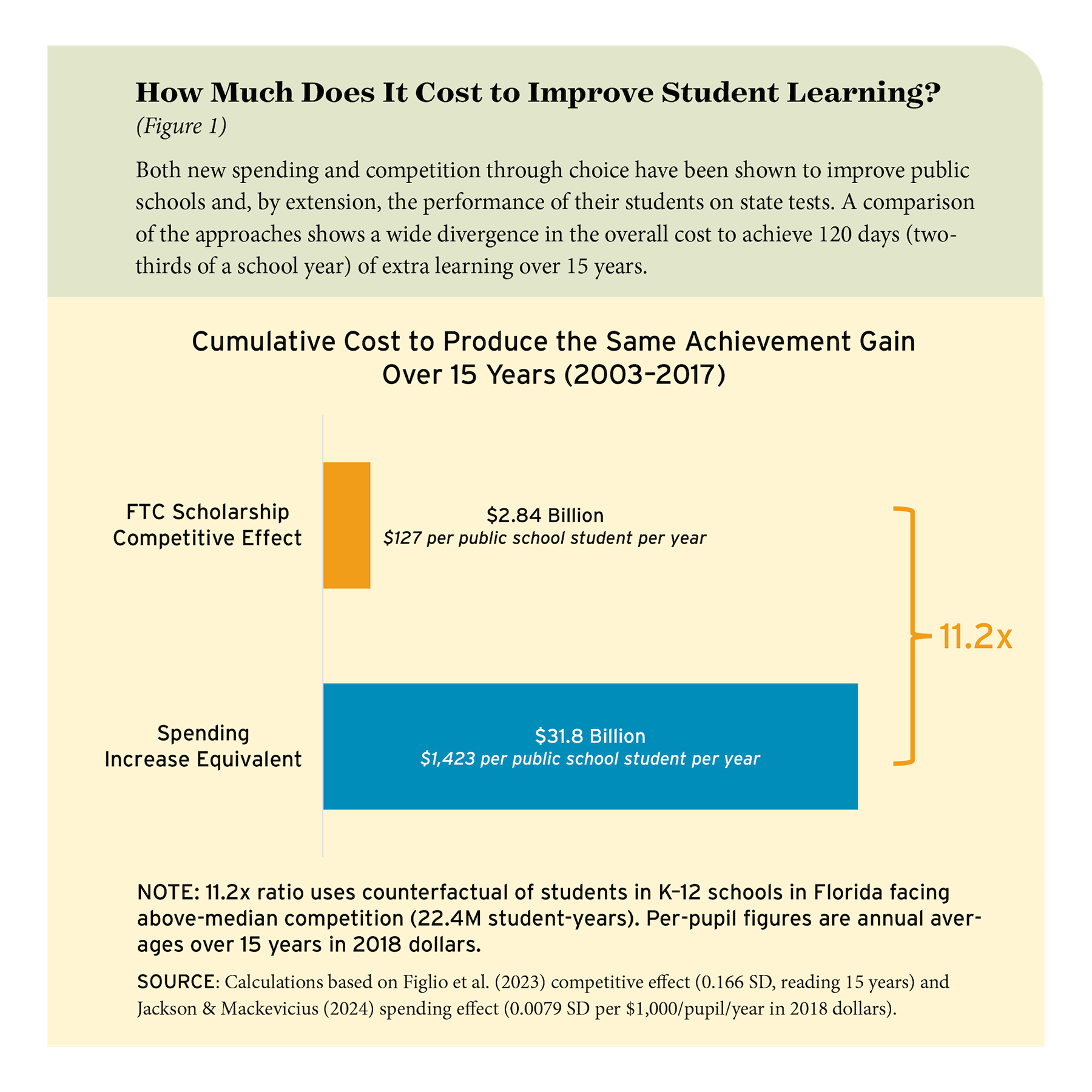
The critical question then becomes: how does the academic return for public school students from this competition compare to the return from direct increases in school spending? The research synthesis directly tackles this by comparing the costs and benefits of Florida's scholarship program with the projected costs of achieving similar gains through increased public school spending.
The results are eye-opening. To achieve the same 120-day learning advantage observed in public school students exposed to higher competition, Florida would have needed to spend an astronomical $31.8 billion over the 15-year period. This figure is more than ten times the actual cost of the scholarship program.
In essence, the competition generated by school choice provided academic benefits to the majority of Florida's public school students at a fraction of the cost compared to solely relying on increased direct spending. The research indicates that the academic gains for public school students in schools facing higher competition were approximately 11 times greater than what the best research on school spending would predict.
It's important to note that these findings are based on conservative assumptions. The analysis doesn't account for all potential positive spillover effects or cost savings that might arise from increased choice. If anything, the true return on investment for competition might be even higher.
Ensuring Gains Aren't Just About Decline Elsewhere
A common concern is whether these positive effects are simply a result of public schools in low-competition areas performing worse, rather than genuine improvement in high-competition areas. To address this, the research also examined national data, specifically looking at trends in rural public schools.
The analysis found that students in Florida's rural public schools also made substantial progress during this period. This indicates that the gains observed in competitive areas were not at the expense of other public school students, but rather an additional benefit stemming from the competitive dynamic.
School Choice Funding: A Win-Win, Not a Zero-Sum Game
For those concerned about responsible education spending, Florida's experience offers a compelling case study. It demonstrates that funding school choice can be a powerful engine for improvement, benefiting students, families, and taxpayers alike.
This isn't an "either/or" proposition. Florida's education landscape has continued to evolve, incorporating programs like the Personalized Education Program and supporting microschools, further expanding options and fostering competition even in less populated regions.
As of today, with hundreds of thousands of students participating in various private-school choice programs, Florida's public school students continue to outperform those in states with limited or no choice options. Crucially, they achieve this while spending significantly less per student.
States that actively resist measures to introduce competition into their education systems, often due to strong traditional institutional interests, may be missing out on a highly cost-effective strategy for boosting academic achievement for all students. The research suggests these states could be leaving significant gains on the table.
The fundamental lesson from Florida is that how education funding is utilized and the incentives within the system are paramount. Investing in private-school choice, as demonstrated by the state's long-running experiment, need not be a zero-sum game. It can lead to greater options, increased competition, and tangible improvements for public school students, all at a remarkably efficient cost.





 Explore AI Teaching Tools
Comments (0)
Please login to comment
No comments yet
Be the first to comment on this article