
Beyond 'If-Then': The Probabilistic Revolution Demands a New Kind of Learner
For decades, our digital world operated on predictable logic: input A and output B. But a seismic shift is underway. We've moved from deterministic systems, where answers were absolute, to a new era of probabilistic computing, where outcomes are nuanced, likely, and ever-evolving. This fundamental change in how machines "think" isn't just a technological upgrade; it's a profound psychological recalibration that demands a new approach to learning and work.
The Dawn of Probabilistic Intelligence
The Information Age, spanning roughly forty years, was defined by deterministic computing. Think of rule-based systems powering everything from financial markets to intricate supply chains. These were the digital filing cabinets, meticulously organized and predictably responsive.
Now, the landscape has transformed. Generative AI, exemplified by tools that complete sentences based on vast internet training data, has brought probabilistic intelligence to the forefront. This isn't just about turning filing cabinets into databases; it's about those databases actively performing tasks, often with greater speed and efficiency than human experts.
At its core, probabilistic computing moves beyond the rigid "yes or no" of traditional computation. Instead, it embraces uncertainty, calculating the likelihood of various outcomes. This mirrors human intuition, allowing systems to make "best guess" judgments in complex scenarios.
Consider autonomous vehicles: a probabilistic system analyzes a blurry shape, assessing the probability of it being a pedestrian versus a static object. In healthcare, AI can weigh multiple potential diagnoses simultaneously, offering a confidence score rather than a single, definitive answer.
These systems navigate vast datasets with remarkable speed, trading absolute precision for immense processing power. The result is a landscape of weighted probabilities, a more dynamic and adaptable form of intelligence.
The Entrepreneurial Imperative in an AI-Dominated World
Navigating this new probabilistic landscape requires more than just technical proficiency. It demands an entrepreneurial mindset – the ability to embrace uncertainty, manage risk, and discover opportunities hidden within complexity.
The rapid pace of AI model updates necessitates constant adaptability and resilience. The capacity to unlearn and relearn is no longer a bonus; it's a prerequisite for thriving.
As one prominent educator put it, "The world is going to go to the people who take agency for themselves." This doesn't necessarily mean launching a startup. It means cultivating the ability to assemble resources, engage in self-directed learning, experiment, and ultimately, create tangible value.
Cultivating Curiosity and Value Creation
The concept of opportunity recognition, a cornerstone of the entrepreneurial mindset, is becoming increasingly critical. It suggests a shift in focus, beginning with identifying meaningful work and then seeing it through to its valuable conclusion.
Traditionally, education has prioritized knowledge transmission. However, in an era where knowledge is abundant and readily accessible, the true value lies upstream: in curiosity, in the ability to curate information, and in the discernment to make sound judgments.
Research indicates a fundamental shift in what defines human worth. We are moving from an era where our value was measured by our capacity to build and discover, to one where our survival depends on our ability to steer, understand, and imbue meaning into created outputs.
While concerns about academic integrity in the face of AI are valid, the professional world is rapidly refocusing on the foundational elements of work: curiosity, opportunity identification, problem-finding, contextual understanding, and the orchestration of intelligent agents. Downstream, the emphasis is on curation, validation, judgment, and the effective delivery of impact.
The Necessity of Real-World Learning
The rise of AI presents a unique challenge: how do we leverage its power without diminishing our own cognitive capacities? The argument is not whether to adopt new technologies, but how to rebalance learning to preserve attention, understanding, judgment, and autonomy.
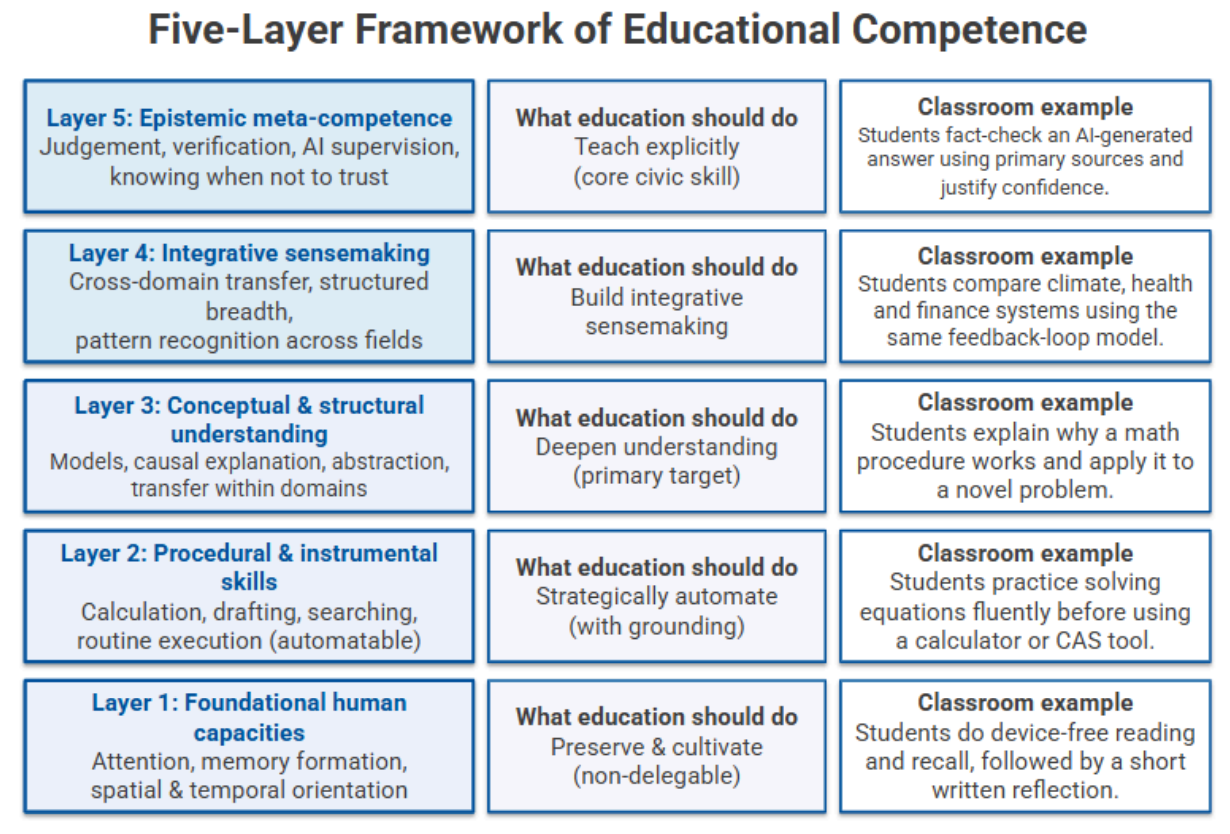
The key lies in shifting educational emphasis upward, towards conceptual and structural understanding. Learners need to grasp the underlying principles and systems that power automated outputs, rather than simply consuming the results.
In this new era, a core capability is epistemic meta-competence – the ability to judge, discern, and adapt. The critical divide is no longer between those who use advanced tools and those who don't, but between those who can critically orchestrate them and those who are merely deferred to by them.
It's crucial to distinguish between cognitive offloading, where a tool supports thinking, and outsourcing, where a system performs the thinking for us. While offloading enhances cognition, outsourcing can replace it, potentially weakening the embodied, contextual, and internally sustained capacities that education has traditionally cultivated.
This trade-off between abstract knowledge and embodied experience is significant. Tacit knowledge – understanding gained through practice, immersion, and interaction – is vital for innovation and entrepreneurship. Therefore, educational approaches must deliberately balance digital instruction with rich opportunities for hands-on engagement, iterative creation, and authentic real-world participation.
Embracing Human Agency in an Age of Autonomous Systems
The concept of human agency, or the agentic mindset, is fundamental to navigating complex and uncertain systems. It's the internal belief that one has the power to influence and change their environment.
As AI systems become increasingly agentic – capable of taking actions rather than just responding to prompts – a corresponding human agentic mindset becomes essential. This is the human counterpart to autonomous tools, enabling us to effectively collaborate with and direct them.
The explosion of agentic AI has reignited interest in this concept. For humans, an agentic mindset fosters the ability to identify opportunities and create value, aligning with the core tenets of entrepreneurial thinking.
Riding the Exponential Curve of Possibility
For years, experts have cautioned about underestimating the speed of technological progress, particularly in artificial intelligence. Our intuitive tendency to predict the future based on linear trends fails to account for the exponential nature of innovation.
We are entering an era where AI agents can perform hours of human work in mere minutes. This shifts the focus from working *with* AI to effectively *managing* AI. This new paradigm is a direct result of rapid, exponential improvements in AI capabilities.
Understanding this exponential trajectory is crucial for grasping where we are and where we are headed. As AI capabilities cross critical thresholds, entirely new use cases emerge, rapidly reshaping perceptions of what's possible.
Organizations that proactively experiment with AI will discover new strategies and redefine the value of different employee roles. Despite occasional discussions of slowing progress, recent advancements demonstrate that the exponential curve remains steep, with the potential for recursive self-improvement only accelerating this trend.
To truly thrive in this environment, an "innovation growth mindset" is paramount. This involves challenging ourselves to think bigger about our potential and recognizing the exponential sense of possibility that AI now affords us.
Opportunity recognition, in this context, requires an expansive view of what we can achieve as augmented learners and value creators. The invitation to engage in meaningful, value-creating work is more compelling than ever, amplified by the accelerating pace of AI-driven innovation.
Ultimately, the Age of AI demands an entrepreneurial mindset coupled with an exponential sense of possibility. This potent combination is best cultivated and demonstrated through real-world learning experiences – opportunities to connect with communities and actively participate in creating value.







 Explore AI Teaching Tools
Comments (0)
Please login to comment
No comments yet
Be the first to comment on this article