
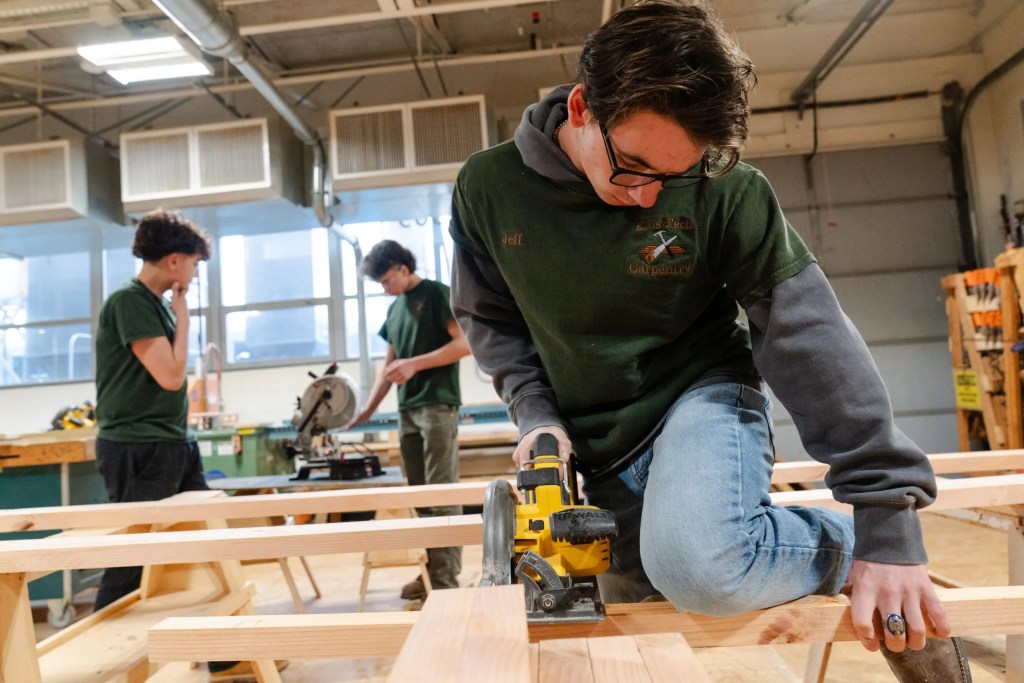
Beyond the Diploma: Unpacking the Real Impact of High School Career Pathways
For years, the debate has raged: do high school career pathways truly equip students for success after graduation? While billions have been invested in connecting secondary education to postsecondary opportunities and the workforce, a critical question lingers: are these programs delivering on their promise, or are we merely measuring participation instead of genuine student achievement?
A Glimmer of Clarity in the Data
New, in-depth research offers a compelling, albeit incomplete, picture of how students fare after completing these specialized programs. The findings suggest that well-structured pathways can indeed be a powerful launchpad, but they also highlight the urgent need for more nuanced data to truly understand their effectiveness.
A significant study, examining over 5,000 students across Delaware's diverse school districts, tracked three graduating cohorts. This comprehensive analysis, encompassing rural, suburban, and urban communities, provides one of the most detailed looks yet at the post-high school trajectories of students who engaged with career pathways.
The Delaware Snapshot: Promising Trends Emerge
The data from Delaware paints an encouraging scene. Among students who successfully completed a career pathway, a remarkable 74 percent pursued postsecondary education within six months of earning their high school diploma. This figure significantly outpaces the national average, which hovers around 62 percent.
Even more striking, approximately 45 percent of these students enrolled in a college major directly aligned with their high school pathway. Simultaneously, 55 percent secured employment within the same six-month window, with many successfully juggling both work and academic pursuits.
By the 18-month mark, the picture becomes even more dynamic. Overall employment rates climbed to 69 percent, and the proportion of students successfully balancing work and postsecondary education surged from 35 percent to an impressive 48 percent.
Perhaps the most telling statistic is the minimal number of students left behind: only about 6 percent of pathway graduates were neither employed nor enrolled in further education within six months, a figure that dwindled to a mere 2 percent by 18 months.
Challenging Traditional Metrics: The "Placement" Conundrum
These findings underscore a crucial reality that many educational and workforce systems are still struggling to acknowledge: today's students are increasingly navigating a blended landscape of work and study. Our current accountability frameworks, however, often fall short of capturing this complex reality.
Federal legislation, designed to bolster career and technical education and workforce development, typically relies on broad "placement" metrics. This approach often lumps together diverse outcomes—employment, postsecondary enrollment, military service, and training—into a single, undifferentiated statistic.
This means a student pursuing a rigorous nursing degree is counted the same as someone working a part-time retail job. Similarly, an individual entering a formal apprenticeship program might appear indistinguishable from a student taking unrelated courses with no clear connection to their long-term career aspirations.
These are fundamentally different paths, yet our data systems often treat them as equivalent. This lack of granularity obscures the true impact of specific programs and interventions.
The Call for Deeper Data and Meaningful Distinctions
While legislation has recognized the need for more detailed data collection on student outcomes, a significant hurdle remains: the availability of such information. The phrase "to the extent such data are available" often reveals the stark reality that, in many states, this nuanced data simply does not exist.
The Delaware study, however, offers a compelling model by not only capturing more detailed outcomes but also by beginning to highlight meaningful distinctions between different pathway areas. For instance, pathways in health care, education, and the skilled trades demonstrated particularly strong alignment with postsecondary academic pursuits.
Within 18 months of graduation, a notable 58 percent of health care pathway students enrolled in majors directly related to their high school focus. This compared to 44 percent of education pathway students and 48 percent of those who completed architecture and construction pathways.
While these figures are not perfect, they represent a crucial step forward. They begin to answer a question that many states have yet to adequately pose: are students actively pursuing futures that are genuinely connected to the pathways we have intentionally created for them?
Connecting the Dots: From K-12 to Lifelong Opportunity
This level of detailed data is invaluable. It allows us to move beyond simply tracking participation and begin identifying specific barriers and developing targeted solutions. By understanding how postsecondary and workforce systems, in addition to K-12 institutions, shape student outcomes, we can foster more effective connections to opportunities.
Consider the example of Delaware's registered apprenticeship system, which currently faces a waitlist for enrollment. While this may not impact every student interested in the skilled trades, it undoubtedly influences the timing and manner in which some young individuals can transition into aligned careers.
The economic landscape students are entering is undergoing a profound transformation. Young people are navigating a labor market where education and employment are increasingly intertwined, where demonstrated skills often hold as much weight as formal credentials, and where career progression is rarely a linear ascent.
Employers consistently voice a demand for workers possessing both practical skills and relevant experience. In this evolving environment, the success of career pathways cannot be solely defined by whether students are simply "placed" somewhere after high school.
Rethinking the Future: Asking Better Questions, Driving Real Progress
If we are to achieve genuine alignment between education and workforce systems, we must commit to asking more insightful questions and holding ourselves accountable for the answers we uncover. This commitment is essential to ensure that students are not just moving through a system, but are actively navigating toward pathways that offer genuine opportunity, upward mobility, and lasting economic value.
The focus must shift from broad metrics to granular understanding, from mere participation to demonstrable, meaningful outcomes that empower students to build fulfilling and prosperous futures.




 Explore AI Teaching Tools
Comments (0)
Please login to comment
No comments yet
Be the first to comment on this article