
Beyond the Single Skill: Forging Durable Learning Pathways for Today's Students
In an educational landscape increasingly focused on real-world readiness, Career and Technical Education (CTE) has emerged as a powerful force. With an astonishing 98% of school districts offering CTE programs and over 11.2 million students nationwide engaging in these hands-on learning experiences, the reach of CTE is undeniable. Students are actively seeking opportunities to build practical skills, connect with potential careers, and explore new possibilities. Yet, a critical question lingers: how do these valuable experiences translate into sustained momentum and clearly defined futures?
The CTE Success Story: Exposure and the Unmet Call for Continuity
The widespread adoption of CTE programs represents a significant educational achievement. These initiatives are successfully exposing millions of students to diverse career fields and equipping them with tangible skills. States are recognizing the value and increasing investment, while student enrollment numbers reflect a strong demand for this type of learning. The foundation is undeniably robust.
However, students themselves are articulating a clear desire for more. They relish the hands-on nature of CTE, the direct connection to authentic work, and the skills they are actively building. What they are seeking, with increasing urgency, is a clear understanding of what comes next. How does this current experience seamlessly lead to the next? How can they continue to build upon the knowledge and abilities they have already acquired?
Too often, without intentional design and integration into a broader educational vision, CTE can function as a standalone step rather than a foundational element of a larger staircase. This disconnect can leave even the most engaged students feeling adrift, unsure of how to leverage their newfound expertise. The impressive participation numbers, while a testament to CTE's appeal, are often not mirrored by a proportionally high number of students completing these programs and transitioning to further opportunities.
This is not a critique of CTE itself, but rather an invitation to reimagine its implementation. It's about exploring how individual learning experiences can coalesce into cohesive pathways that generate sustained momentum over time. When students can clearly see the progression from one experience to the next, their learning compounds, their skills deepen, and their confidence grows. What begins as initial exposure can then blossom into genuine expertise.
When CTE Operates in Isolation: Lost Opportunities and Disconnected Skills
When CTE courses exist in a vacuum, disconnected from a district's overarching learning design or its commitment to a clear "Graduate Portrait," even the most motivated students can falter. Consider a hypothetical sophomore who discovers a passion for mechanics and problem-solving in an introductory automotive technology course. She thrives on diagnosing issues, working with her hands, and understanding complex systems.
Yet, upon completion of the class, her schedule shifts to a chemistry course. There's no explicit connection drawn between her burgeoning interest in automotive systems and the principles of physics governing motion or the chemistry of combustion explored in her other classes. Fast forward to her senior year, and she might recall her enjoyment of that automotive class but lack any clear direction on how to pursue it further. Was it merely an elective, a fleeting experience? She moves on, uncertain of the potential avenues that were left unexplored.
When CTE is siloed from the broader educational journey, students may acquire valuable skills but struggle to articulate how those skills transfer, stack, or connect to their future aspirations. The course provides valuable exposure, but without intentional bridges to other learning experiences, internships, or deeper exploration, that exposure can remain an isolated event rather than a springboard for future growth.
While a significant number of states, at least 43, offer CTE dual or concurrent enrollment, allowing these courses to count towards college credit, this alone is insufficient to constitute an intentional pathway. True pathway development requires a more deliberate and integrated approach.
Unlocking Potential: The Power of Intentional Connection and Community Partnerships
The true power of CTE is unleashed when it's intentionally woven into the fabric of a student's educational journey, fostering connections that build momentum and open doors. This requires a proactive approach to identifying local needs and aligning them with student learning opportunities.
Personalizing Learning Through Local Partnerships
A crucial step in building durable pathways is forging strong relationships with local businesses and industries that have demonstrable workforce demands. By actively engaging with these entities, and often working through intermediaries, schools can develop CTE programs that directly align with in-demand careers. This collaboration can then extend to creating embedded internship and cooperative education program (CCP) opportunities within these programs.
A Real-World Example: Addressing Community Needs Through Student Learning
In Porterville, California, a unique challenge presented itself. The school district had invested in an electric bus fleet to meet state electrification mandates, but persistent malfunctions plagued the vehicles. The students enrolled in the district's automotive program possessed strong mechanical skills, yet lacked experience with electric vehicle technology – a gap mirrored in the local workforce.
This dual demand, stemming from state electrification goals and local workforce development needs, spurred the district to forge vital connections. They partnered with a local community college and an electric vehicle manufacturer. This collaboration allowed the automotive program to evolve, integrating electric vehicle technology into its curriculum. Students now gain high school and college credit while acquiring skills directly relevant to the local economy.
These students aren't just learning about electric vehicles in theory; they are actively diagnosing and resolving real problems with the district's actual buses. This provides them with invaluable real-world experience while contributing to work that directly benefits their community. This initiative didn't necessitate abandoning the existing automotive program but rather a strategic question: What are our community's pressing needs, and how can student learning be leveraged to address these challenges? The answers created a powerful pathway that serves both students and the community simultaneously.
Building Stackable Pathways: A Trajectory of Growth and Specialization
The concept of "stackable pathways" is fundamental to ensuring that CTE experiences are not isolated events but rather interconnected steps in a student's development. If a student completes a healthcare-focused CTE course, the pathway can extend through opportunities like shadowing professionals at a local clinic, volunteering with a community health organization, or undertaking a capstone project investigating health equity within their community.
Through initiatives like the Kauffman Foundation’s Real World Learning efforts in Kansas City, it has become evident how a variety of experiences can naturally lead into one another, reinforcing learning for young people. These interconnected experiences foster confidence, build capacity, and provide clarity regarding students' future aspirations.
The most effective pathway programs often follow a clear trajectory, allowing for increasing specialization over time while offering both entry and exit points for learners. This structure ensures that students can tailor their educational journey to their evolving interests and goals.
The Foundation of Experience: Building Awareness and Core Skills
These foundational experiences are crucial, beginning in middle school and continuing through the freshman year. Their primary focus is on developing essential skills and fostering broad awareness. This includes cultivating abilities such as ideation, design thinking, and leadership, which are transferable across a multitude of disciplines and career fields.
Connecting Learning to the Real World: Bridging the Gap
Connection experiences are designed to directly link classroom learning to real-world applications. While these types of experiences should be available throughout a student's academic career, they are particularly impactful during freshman and sophomore years through client-connected projects, and during junior and senior years via internship opportunities.
Empowering Agency: Entrepreneurship and Learner-Driven Projects
Agentic experiences empower students through entrepreneurship and capstone projects, often co-designed or fully conceptualized by the learners themselves. The Advance CTE Career Clusters Framework highlights Entrepreneurship and Management as cross-cutting clusters that should be integrated across all CTE sectors. Simultaneously, research underscores the critical importance of building and maintaining social capital, enabling students to navigate future opportunities effectively.
By establishing stackable pathways and credentials that progress from foundational skill-building to immersive experiences and ultimately to full learner agency, educational institutions can significantly enhance the likelihood that graduates will be well-prepared for their next steps.
A Model of Intentional Progression: Tacoma Public Schools
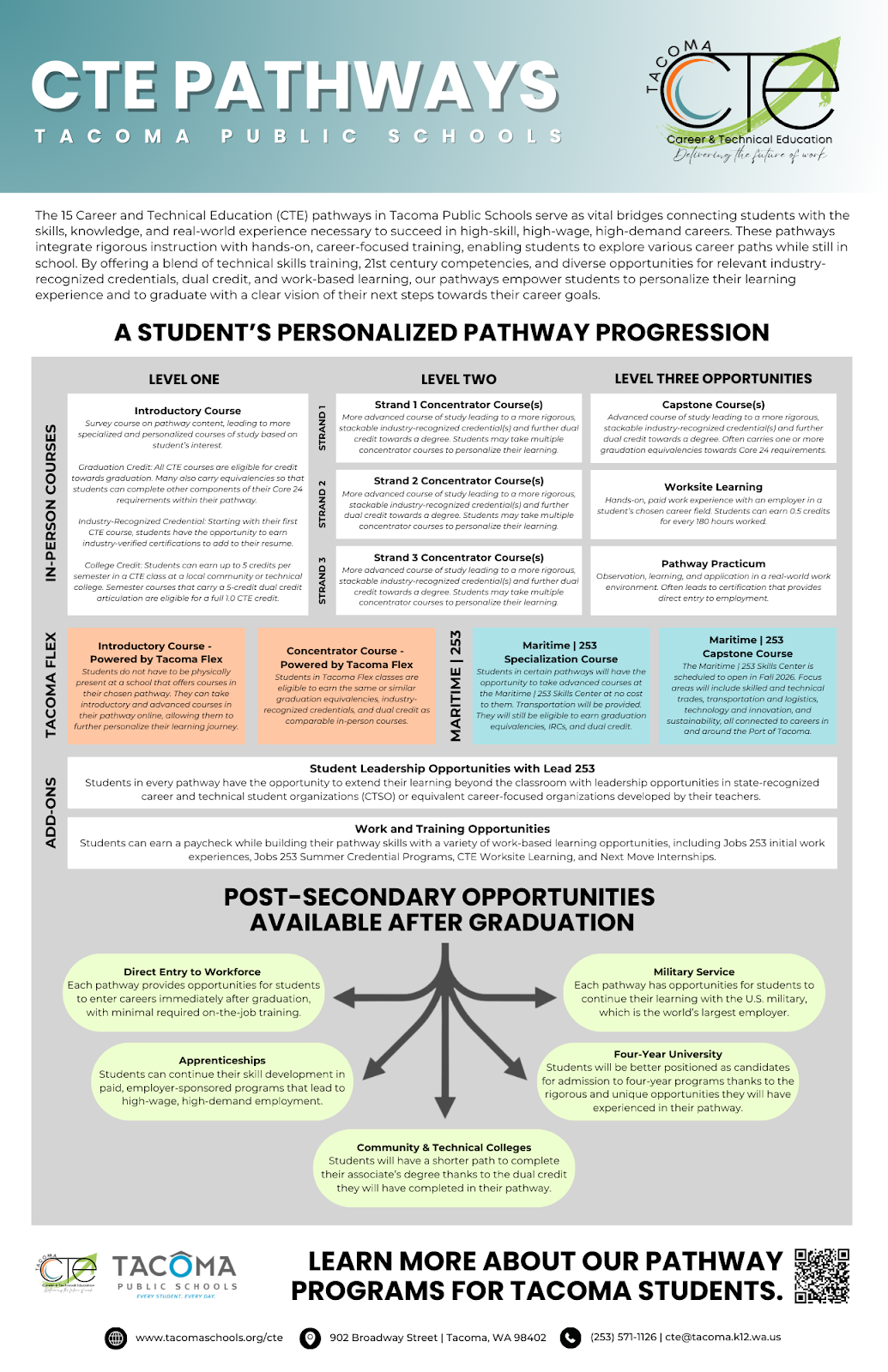
In Tacoma Public Schools, CTE has undergone a significant re-engineering, focusing on pathways that are relevant, measurable, and deeply human-centered. The emphasis has been on fostering coherence across schools, departments, and community partnerships, while continuously refining pathways in high-skill, high-demand industries. Students have access to leadership development through student organizations (CTSOs) and paid training opportunities via internships and worksite learning. They can navigate a structured three-level sequence, available through in-person, online, or specialized building formats.
Level One: Foundational Exploration and Certification
This introductory level includes survey courses, goal-setting exercises, and the accrual of industry-recognized certifications and college credits. It provides students with a broad overview and initial credentials.
Level Two: Deepening Expertise and Specialization
The concentrator level involves more advanced study, leading to specialized and rigorous credentials, often including dual credit opportunities. Within the in-person model, this level further branches into distinct "Strands," allowing students to pursue multiple concentrator courses within a chosen field, thereby personalizing their learning experience.
Level Three: Real-World Application and Capstone Projects
The capstone and application level focuses on practical, real-world application through capstone projects, worksite learning experiences, or pathway practicums. This stage allows students to synthesize their learning and demonstrate mastery in authentic contexts.
A Specialized Ecosystem: The School for Environmental Leadership
The School for Environmental Leadership (SEL) operates as a distinctive "school-within-a-school" program integrated within Terra Linda High School in the San Rafael City Schools district, California. This model allows students to attend a comprehensive public high school while participating in a structured, four-year cohort experience centered on environmental sustainability, leadership, and entrepreneurship.
Students apply in 8th grade and, if accepted, join the program as a cohort in 9th grade. They engage in a curated set of core classes together, including English, Social Studies, and Science, all taught through an environmental lens. The curriculum frequently incorporates partnerships with local community colleges, such as the College of Marin, enabling students to earn college credit for their specialized coursework.
Ninth Grade: Cultivating Leadership and Design Skills
As ninth graders, students embark on semester-long community projects in small teams, addressing local environmental issues like waste diversion, water conservation, or wildfire safety. They also participate in a design challenge, creating model houses that generate as much electricity as they consume, fostering an understanding of renewable energy and efficiency. Throughout this year, they focus on developing critical skills in public speaking, research, professional communication, and meeting facilitation.
Tenth Grade: Driving Systemic Change Through Policy
In their tenth-grade year, students shift from semester-long projects to a single, in-depth project spanning the entire academic year. Their focus moves from immediate action to fostering systemic change. Students actively work to write, advocate for, and implement environmental policies within their school or local city government. This year emphasizes persuasion, understanding governmental structures, and long-term project management.
Eleventh Grade: Mastering Sustainable Enterprise and Engineering
Eleventh graders develop comprehensive business plans for sustainable products or services, pitching their innovative ideas to panels of investors and experts. Concurrently, they engage in hands-on classes that equip them with the skills to use power tools and construct physical solutions and products. This year cultivates financial literacy, entrepreneurship, design thinking, and product development expertise.
Twelfth Grade: Professional Application and Reflective Growth
In their final year, twelfth graders transition from the classroom to complete year-long internships with local businesses, non-profits, or government agencies in the sustainability sector. They also compile a comprehensive portfolio that reflects on their growth over the four years, focusing on professionalism, networking, career readiness, and self-assessment.
Making Transferable Skills Visible: The Cross-Disciplinary Advantage
One of the most impactful ways to amplify the benefits of CTE is by helping students recognize the transferability of the skills they are acquiring. This involves demonstrating how these competencies extend beyond a single course or career field. This can be achieved through interdisciplinary curriculum design, transparently connecting CTE course outcomes to a "Portrait of a Graduate," or through intentional reflective practices.
When CTE instructors and their content-area colleagues collaborate, the transfer of skills becomes an intentional process rather than a matter of chance. Students are not left to make these connections independently; the educational system actively makes them visible. For instance, in a CTE construction course, students learn to interpret technical documents, collaborate on complex projects, and troubleshoot unforeseen issues.
Educators can help students identify these same skills in their history class when analyzing primary sources, working on group presentations, or refining arguments. When students recognize this transferability, their self-perception of capability across diverse contexts is significantly enhanced. The ability to see CTE skills as transferable fundamentally alters their learning experience. They are not merely learning to weld, code, or design; they are developing systematic thinking, clear communication, effective collaboration, and complex problem-solving abilities—skills that hold immense value in every aspect of life.
Actionable Steps for Immediate Impact This Semester
Transforming CTE into durable, personalized pathways doesn't necessitate a complete overhaul of existing programs. Meaningful progress can be achieved by focusing on a single cohort of students and implementing one intentional connection.
Start Small, Build Momentum
Begin by examining your CTE courses and identifying discrete opportunities to connect them with other assets within the district. This could involve linking them to core academic classes, a defined "Portrait of a Graduate" framework, or other graduation requirements such as service learning. Consider how to sustain this momentum, even through minor shifts in direction.
Forge One Meaningful Connection
Reach out to a local business, nonprofit organization, or community group. Clearly articulate the skills your students are developing and inquire about potential opportunities for them to apply these skills in a real-world setting. Start with a small pilot program—perhaps involving three students for one afternoon a week over a semester. Learn from the experience, make adjustments, and then consider expansion.
Alternatively, look within your own school building. Could content area teachers help students recognize the transferability of their CTE skills? Could automotive students bring their diagnostic thinking to a physics unit? Could culinary students apply their project management skills in an English capstone project? Initiate a single conversation. Design one integrated unit. Observe what students discover about themselves through these connections.
Cultivate Entrepreneurial Thinking
While not every student will launch their own business, all students benefit from developing an entrepreneurial mindset. This involves identifying problems within their community that are worth solving, appropriately scoping challenges, designing innovative solutions, and embracing a cycle of testing, learning, and iteration. It also means recognizing opportunities and taking initiative.
This semester, seek opportunities for students to apply their CTE learning to address real-world challenges. Could construction students design and build something that the community needs? Could technology students develop an app to solve a problem at school? Could agriculture students establish a garden to supply the school cafeteria?
When students transition from simply learning skills to actively using those skills to create something of value, a profound shift in ownership occurs. They are no longer merely completing assignments; they are building something tangible and meaningful.
The impressive foundation of CTE programs across the nation has provided countless students with exposure, skill development, and the discovery of previously unimagined possibilities. This is not about increasing workload for its own sake, but rather about strategically connecting existing efforts to create a seamless flow from one experience to the next. Momentum is not built on perfection, but on one intentional connection, followed by another, and then another. Over time, these connections evolve into robust pathways, transforming learning from a series of disconnected courses into a dynamic journey that continuously builds, opens doors, and propels students toward their future aspirations. The key is to focus on the immediate steps, and from there, the path forward will become increasingly clear.




 Explore AI Teaching Tools
Comments (0)
Please login to comment
No comments yet
Be the first to comment on this article