
AI's Blind Spots: Unlocking Your Educational Philosophy for Smarter Teaching Tools
Imagine your most trusted work colleague. Now, imagine that colleague is an artificial intelligence, privy to your every query, your every draft, your every educational aspiration. What assumptions does this AI hold about your teaching? This isn't a hypothetical; it's the emerging reality for educators, and understanding the AI's internal "beliefs" about your work is becoming paramount.
The Unseen Partner: Your AI's Hidden Assumptions
For years, educators have grappled with defining their personal philosophy of education – the core beliefs that shape their approach to teaching and learning. This introspection guides everything from classroom management to assessment strategies. Yet, as AI tools become indispensable assistants, a new question arises: does our AI understand our philosophy?
The truth is, without explicit guidance, AI systems can operate on a foundation of potentially flawed assumptions. These assumptions, built from the vast data they process, might not align with your unique pedagogical vision. This disconnect can lead to AI-generated content that feels generic, misaligned, or even counterproductive to your teaching goals.
A "Context Audit": Peering Inside the AI's Mind
Recently, a groundbreaking capability emerged: AI models can now access and learn from your past interactions and documents, creating a more personalized experience. This enhanced memory, however, amplifies the importance of ensuring the AI's understanding is accurate. A new process, which can be aptly termed a "context audit," offers a powerful way to uncover and refine these AI assumptions.
This audit isn't about friendship or emotional connection with your AI. Instead, it's a rigorous examination of the AI's internal model of your educational philosophy, teaching style, and pedagogical priorities. It’s about ensuring your digital assistant truly comprehends the nuances of your work.
The Audit's Genesis: A Question from the Past
Fifteen years ago, during a presentation in Costa Rica, a teacher leader posed a simple yet profound question: "What is your educational philosophy?" This moment highlighted a fundamental truth: understanding one's own beliefs is crucial for effective teaching. The same principle now applies to the AI tools we employ.
If an AI is tasked with generating lesson plans, crafting assessments, or even drafting communications, it needs to grasp the underlying philosophy driving those tasks. Without this clarity, the output risks being a superficial imitation rather than a genuine reflection of your pedagogical intent.
Why Your Philosophy Matters to ChatGPT (and its ilk)
The more we delegate tasks to AI, the more critical it becomes to intentionally shape the assumptions these systems make about teaching and learning. Consider two educators approaching a lesson on climate change. One might favor direct instruction and repetitive practice, while the other champions inquiry-based learning and collaborative projects. The AI's output for each should be drastically different, but this only occurs if the AI understands their respective philosophies.
This is where the context audit becomes invaluable. It’s a structured dialogue designed to bring the AI's assumptions about your educational philosophy into sharp focus. For professional educators, this process can be transformative, ensuring the AI serves as a truly supportive and aligned partner in your work.
Crafting Your Context Audit: A Step-by-Step Guide
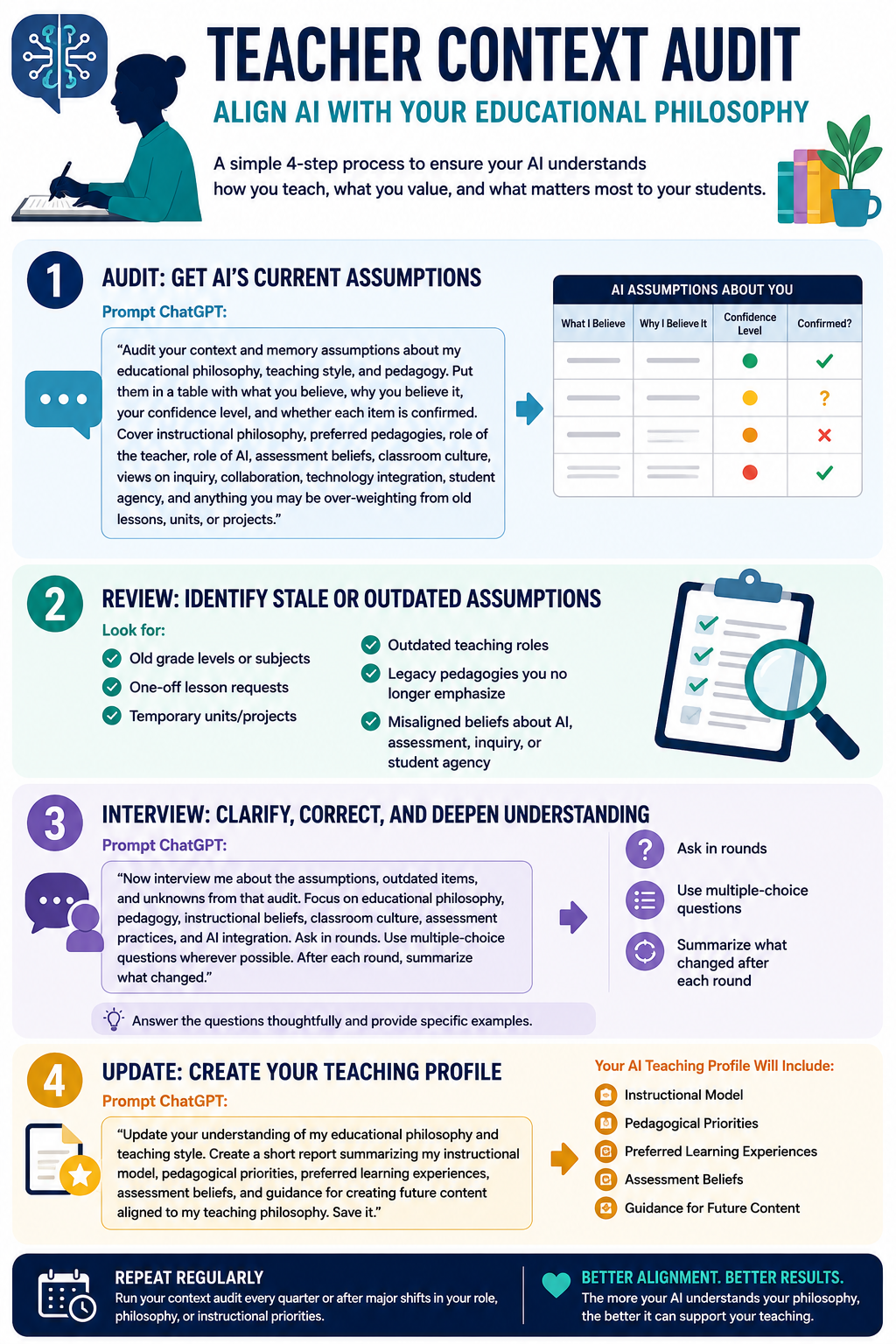
The process of conducting a context audit is designed to be thorough, requiring approximately 45 minutes for maximum benefit. It involves a series of carefully crafted prompts and interactive questioning to reveal and refine the AI's understanding.
Round One: The Initial Assessment
The first step is to prompt the AI to analyze its own understanding of your educational framework. This involves a detailed request to articulate its assumptions:
- Prompt the AI with: "Audit your context and memory assumptions about my educational philosophy, teaching style, and pedagogy. Put them in a table with what you believe, why you believe it, your confidence level, and whether each item is confirmed. Cover instructional philosophy, preferred pedagogies, role of the teacher, role of AI, assessment beliefs, classroom culture, views on inquiry, collaboration, technology integration, student agency, and anything you may be over-weighting from old lessons, units, or projects."
This initial prompt aims to elicit a comprehensive overview of the AI's current perception of your teaching. It forces the AI to articulate its beliefs, providing a baseline for further refinement.
Analyzing the AI's Perspective
Once the AI presents its audit, the crucial step is to review it critically. Look for any outdated assumptions, such as references to previous grade levels or subjects, one-off lesson requests that are no longer relevant, or legacy pedagogies that you no longer emphasize. Pay close attention to any misalignments in beliefs about AI integration, assessment methods, the role of inquiry, or student agency.
Round Two: The Interactive Interview
Following the initial audit, the AI needs to engage in a more dynamic interview to clarify any ambiguities and update its understanding. This round focuses on direct questioning and clarification:
- Prompt the AI with: "Now interview me about the assumptions, outdated items, and unknowns from that audit. Focus on educational philosophy, pedagogy, instructional beliefs, classroom culture, assessment practices, and AI integration. Ask in rounds. Use multiple-choice questions wherever possible. After each round, summarize what changed."
This interactive phase allows you to directly address any discrepancies and guide the AI toward a more accurate representation of your teaching philosophy. The AI's ability to summarize changes after each round ensures a dynamic and responsive learning process.
Round Three: Updating and Consolidating Understanding
After the interactive interview, the AI needs to consolidate the new information and update its internal model. This involves a clear directive to synthesize the learnings:
- Prompt the AI with: "Update your understanding of my educational philosophy and teaching style. Create a short report summarizing my instructional model, pedagogical priorities, preferred learning experiences, assessment beliefs, and guidance for creating future content aligned to my teaching philosophy. Save it."
This final reporting phase ensures that the AI has a coherent and actionable understanding of your educational philosophy, which can then be applied to future content generation and task execution.
Making it Reusable: The Skill Creation
To ensure the benefits of the context audit are long-lasting, the final step is to transform the AI's updated understanding into a reusable skill or profile. This allows the AI to consistently draw upon your refined philosophy without needing to repeat the entire audit process.
Preparing for the Future: Your AI Work Companion
As the school year draws to a close and planning for the next begins, consider dedicating time to this AI preparation. Just as you wouldn't start a new school year with an unorganized classroom, you shouldn't begin with an AI that operates under misguided assumptions about your work.
This context audit is not merely a technical exercise; it's an opportunity for profound self-reflection. It forces you to articulate and solidify your own educational philosophy, ensuring that your AI partner is not just a tool, but a truly informed collaborator.
The Profound Impact of a Refined Partnership
The experience of conducting a context audit can be surprisingly insightful. It can feel akin to a sophisticated simulation of theory-of-mind, where the AI attempts to understand your perspective. The AI might even pose challenging questions, prompting you to consider your own blind spots or areas where your stated philosophy might diverge from your actual practice.
For instance, the AI might ask, "What topic do I think is central to your future that you think is actually a distraction?" This type of question pushes you to identify the AI's potential misconceptions about your professional priorities and the underlying narrative of your work. It can reveal how your past experiences, while valuable, are intended as tools for translation rather than mere historical remnants.
Ultimately, a well-executed context audit transforms your AI from a passive assistant into an active, informed partner. This refined relationship ensures that the content generated, the tasks performed, and the insights offered are deeply aligned with your authentic educational philosophy, making your AI a more effective and indispensable ally in your teaching journey.






 Explore AI Teaching Tools
Comments (0)
Please login to comment
No comments yet
Be the first to comment on this article