
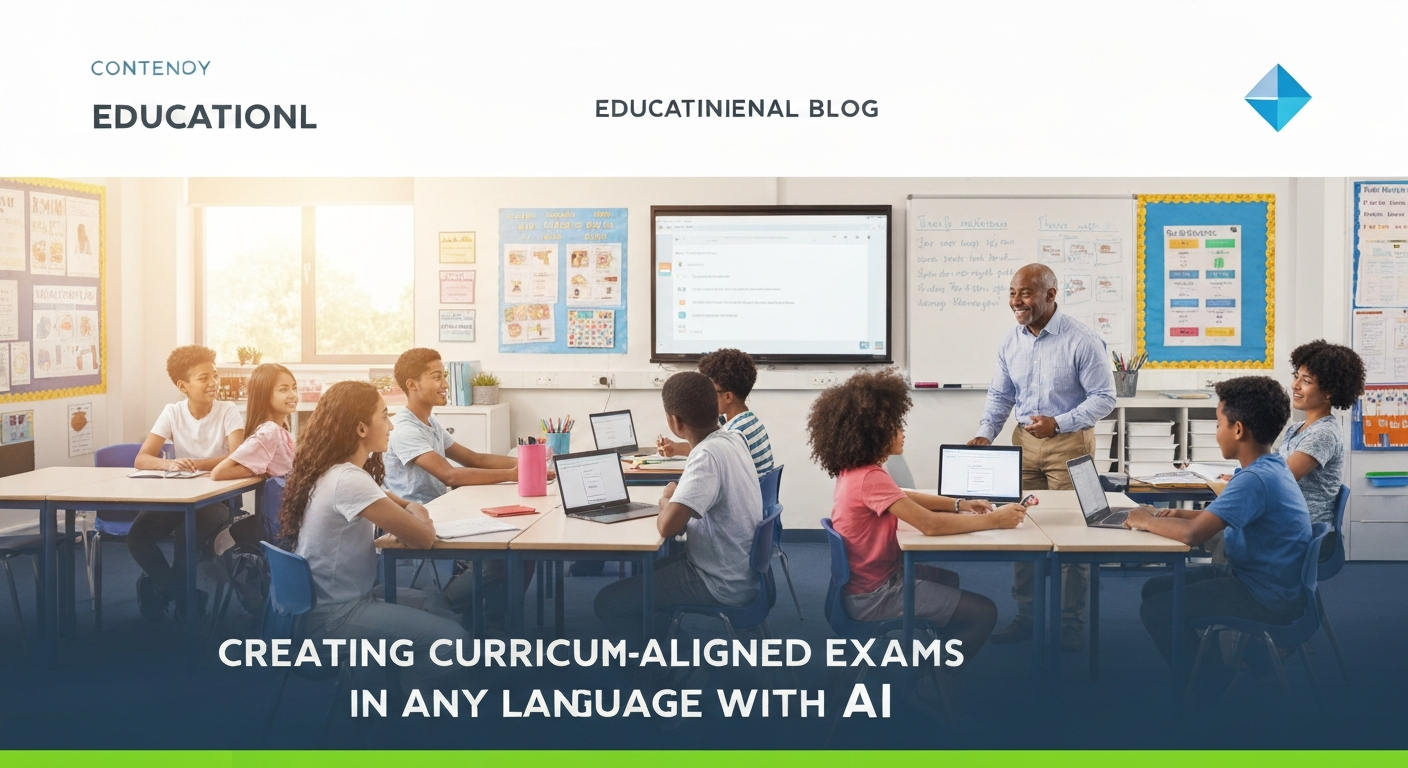
In the dynamic world of education, teachers wear many hats. Among the most crucial, and often time-consuming, is the creation of assessments that accurately measure student understanding, align perfectly with curriculum goals, and are accessible to a diverse range of learners, including those in multilingual classrooms. The traditional approach, while invaluable, can be a marathon of drafting, revising, and translating, leaving educators with less time for direct student engagement. But what if there was a powerful co-pilot, an intelligent assistant that could streamline this entire process, ensuring rigor, relevance, and linguistic precision? Enter Artificial Intelligence. This article will provide a detailed, practical guide on how to leverage AI to craft curriculum-aligned exams in any language, transforming your assessment workflow and empowering you to focus on what truly matters: teaching and learning.
1. Solidify Your Learning Objectives: The Blueprint for AI
Before any assessment can be truly effective, its foundation—the learning objectives—must be crystal clear. These objectives are the compass that guides both your teaching and your evaluation. When working with AI, clarity here is paramount, as the AI's output will directly reflect the specificity of your input. Think of it as providing the AI with a precise blueprint rather than a vague sketch.
From Curriculum Standards to Actionable Objectives
Begin by meticulously reviewing your curriculum standards, whether they are national benchmarks, state frameworks, IB criteria, or institutional guidelines. Break down broad learning goals into specific, measurable, achievable, relevant, and time-bound (SMART) objectives. For instance, instead of "Students will understand photosynthesis," aim for "Students will be able to describe the reactants and products of photosynthesis, explain the role of chlorophyll, and identify the primary sites of the process within a plant cell."
AI tools can assist in this initial phase by helping you extract keywords and concepts from lengthy curriculum documents, or even by suggesting ways to rephrase objectives to be more measurable. When you input your curriculum document or even a detailed AI lesson plan, the AI can analyze it to identify core concepts and potential assessment targets. This preliminary analysis can serve as a valuable starting point, ensuring no critical learning outcome is overlooked.
The Power of Granular Prompts
Once your objectives are refined, translate them into granular prompts for your AI exam creator. The more detail you provide, the better the AI can align questions with your specific teaching goals. Consider including:
- Cognitive Level: Specify the desired Bloom's Taxonomy level (e.g., "create a question that requires students to analyze the causes of World War I," or "design a question that assesses students' ability to evaluate the effectiveness of different economic policies").
- Key Concepts and Vocabulary: List the essential terms and concepts that must be covered.
- Context and Scenarios: Provide specific scenarios or real-world contexts you want the questions to address.
- Expected Output Format: Indicate if you need multiple-choice, short answer, essay, true/false, fill-in-the-blank, or other specific question types. Mentofy Academia, for example, offers over 25 question types, allowing for incredible versatility.
By investing time in this foundational step, you empower the AI to generate highly relevant and accurate questions, significantly reducing the amount of post-generation editing required. This precision in your objectives is the secret ingredient to unlocking AI's full potential in assessment design.
2. Leverage AI for Initial Question Generation and Diversification
With your objectives firmly established, the next step is to harness AI's incredible capacity for generating a high volume of diverse questions. This isn't about letting AI take over entirely, but rather using it as a powerful brainstorming partner and content generator, freeing you from the initial blank page paralysis.
Mass Generation and Variety
Imagine needing to create 50 questions across various difficulty levels and types for a unit exam. Traditionally, this could take hours, if not days. With AI, you can generate this volume in minutes. Input your refined learning objectives and curriculum standards into an exam creator like Mentofy Academia. Specify the number of questions you need, the cognitive levels, and the desired question types. The AI can quickly produce a comprehensive bank of questions.
The true power here lies in diversification. Instead of manually trying to craft multiple-choice, true/false, short answer, and essay questions that all target the same objective, the AI can do this simultaneously. For example, if your objective is "Students will be able to differentiate between renewable and non-renewable energy sources," the AI can generate:
- A multiple-choice question asking to identify a renewable source from a list.
- A true/false statement about the sustainability of coal.
- A short answer question requiring a comparison of solar and fossil fuels.
- An essay prompt asking students to propose a plan for transitioning to renewable energy in their community.
This immediate variety ensures a more holistic assessment that probes different facets of understanding, moving beyond simple recall to higher-order thinking skills.
Multilingual Question Generation
For international classrooms or contexts with diverse language learners, one of AI's most revolutionary features is its ability to generate questions in multiple languages simultaneously. Instead of laboriously translating each question, you can simply instruct the AI to produce the exam in English, Spanish, French, Mandarin, Arabic, or any other language relevant to your students.
This capability dramatically reduces the burden on teachers in bilingual or multilingual settings, ensuring that assessments are equitable and accessible to all students, regardless of their primary language. It's crucial, however, to always review the AI-generated translations for nuance and cultural appropriateness, a point we'll delve into further.
By using AI for this initial, high-volume, and diverse question generation, you're not just saving time; you're enriching your assessment pool with a breadth and depth that would be incredibly challenging to achieve manually. This allows you to move quickly to the critical phase of refinement and alignment.
3. Refine and Align with Curriculum Standards: The Teacher's Touch
While AI is an incredibly powerful generator, it is a tool, not a replacement for human pedagogical expertise. The generated questions are a starting point, a robust draft that requires your discerning eye to ensure perfect alignment with your curriculum, instructional nuances, and the specific needs of your students. This is where the "teacher's touch" becomes indispensable.
Curriculum Cross-Referencing and Gap Analysis
Take the AI-generated questions and systematically compare them against your learning objectives and curriculum standards. Ask yourself:
- Does each question genuinely assess a specified learning objective?
- Does the question's difficulty level match the expected proficiency level for that standard?
- Are there any objectives that haven't been adequately covered by the generated questions?
- Are there any questions that assess content not explicitly taught or not relevant to the curriculum?
AI can help identify potential gaps or over-representation. For instance, if your curriculum emphasizes critical thinking about historical events, but the AI primarily generated recall-based questions, you would then prompt the AI to revise or generate new questions at a higher cognitive level. This iterative process of generation and refinement ensures comprehensive coverage.
Editing for Clarity, Bias, and Relevance
No matter how sophisticated the AI, human oversight is essential for quality control. Review each question for:
- Clarity and Ambiguity: Are the questions phrased clearly? Is there any ambiguity that could confuse students or lead to multiple correct interpretations?
- Bias: Check for any unintentional cultural, gender, or socio-economic bias in the language or scenarios presented. AI models learn from vast datasets, which can sometimes reflect societal biases.
- Relevance: Ensure all examples, scenarios, and contexts are relevant to your students' experiences and the specific scope of your course.
- Distractors (for Multiple Choice): For multiple-choice questions, evaluate the distractors. Are they plausible but incorrect? Are they truly distracting without being misleading or tricky? Good distractors are crucial for accurately assessing understanding.
This refinement stage is an active collaboration. You provide the pedagogical insight, and the AI provides the initial content and the flexibility to revise it quickly. Think of AI as an incredibly efficient assistant who drafts documents, but you, the expert, are the editor-in-chief, ensuring every word serves its purpose perfectly.
Furthermore, this meticulous review is especially important when using AI for exam creation. While tools like Mentofy Academia offer robust question generation, your expertise ensures that the assessments are not just aligned, but also fair, clear, and effective for your unique classroom context. This human-AI partnership elevates the quality of your assessments significantly.
4. Incorporate Differentiated Assessment Strategies
Every classroom is a tapestry of diverse learners, each with unique strengths, challenges, and learning styles. Effective assessment recognizes this diversity and provides multiple pathways for students to demonstrate their knowledge. AI can be an invaluable ally in creating differentiated exams, moving beyond a one-size-fits-all approach.
Varying Difficulty Levels
Not all students are at the same point in their learning journey, and a truly aligned curriculum often includes objectives at different cognitive levels. AI can help you create multiple versions of an exam, or even embed differentiated questions within a single exam, to cater to varying readiness levels. For example, you can prompt the AI to:
- Generate a set of foundational questions for students needing more support (e.g., recall, define, identify).
- Create a set of application-level questions for the majority of students (e.g., explain, compare, solve).
- Develop challenging, higher-order thinking questions for advanced learners (e.g., analyze, evaluate, create).
This allows you to assess all students fairly, giving them an opportunity to succeed at their appropriate level while still providing rigorous challenges for those who are ready. You might even use AI to create modified versions for students with IEPs or 504 plans, adjusting complexity or providing additional scaffolding within the questions themselves.
Diverse Question Types for Different Learners
Some students excel at multiple-choice, others at written responses, and some benefit from visual or kinesthetic tasks. Relying solely on one question type can inadvertently disadvantage certain learners. As mentioned, Mentofy Academia offers over 25 question types, enabling you to build truly diverse assessments.
Leverage AI to generate a mix of question formats:
- Multiple-choice and True/False: Good for quick recall and basic comprehension.
- Short Answer and Fill-in-the-Blank: Require more active recall and precise vocabulary.
- Essay and Open-Ended Questions: Assess deeper understanding, critical thinking, and communication skills.
- Matching and Ordering: Useful for demonstrating relationships and sequences.
- Scenario-Based Questions: Apply knowledge to real-world situations, engaging practical thinkers.
By varying the assessment format, you increase the likelihood that every student finds a way to showcase what they know, rather than being hindered by the format of the assessment itself. This approach not only makes assessments more equitable but also provides you with richer data on student understanding.
5. Ensure Linguistic Accuracy and Cultural Relevance
In our increasingly interconnected world, classrooms are often vibrant hubs of linguistic and cultural diversity. Creating assessments that are not only accurate in content but also linguistically precise and culturally sensitive is paramount for equity and validity. AI offers powerful capabilities here, but human oversight remains critical.
AI for Multilingual Assessment Generation
As touched upon earlier, one of AI's most transformative features for diverse classrooms is its ability to generate questions in multiple languages. If you teach in a school with students whose first language is not the language of instruction, or if you teach language courses, this capability is a game-changer. Instead of relying on manual translation, which can be time-consuming and prone to human error, you can prompt the AI to generate the entire exam, or specific sections, in the target language(s).
This ensures that students are assessed on their understanding of the subject matter, not solely on their proficiency in the instructional language. It levels the playing field, allowing all students to demonstrate their knowledge effectively. For example, a science teacher in a school with a large Spanish-speaking population could generate the same biology exam in both English and Spanish, ensuring that language barriers do not impede assessment of scientific concepts.
The Critical Role of Human Review for Nuance and Culture
While AI translation is incredibly advanced, it's not infallible, especially when it comes to nuance, idiomatic expressions, and cultural context. Therefore, a human review is absolutely essential, particularly from a native speaker or someone deeply familiar with the target culture and language.
When reviewing AI-generated multilingual exams, consider:
- Idiomatic Expressions: Does the AI's translation accurately convey the meaning of idioms or colloquialisms, or does it produce a literal translation that loses meaning?
- Cultural Context: Are any examples or scenarios culturally insensitive or irrelevant to the target audience? For instance, a question about a specific holiday tradition might need to be adapted for a different cultural context.
- Register and Tone: Is the language appropriate for an academic assessment? Does it maintain a consistent and professional tone?
- Subject-Specific Terminology: Has the AI used the correct and most commonly accepted technical or academic terms in the target language?
Collaborating with language specialists or even fluent community members can provide invaluable feedback. This collaborative approach—AI for initial generation, human for critical refinement—ensures that your exams are not only linguistically accurate but also culturally fair and relevant, promoting equitable assessment for all students.
6. Streamline Grading and Feedback with AI
Once exams are administered, the next monumental task is grading and providing feedback. This is another area where AI offers significant time-saving potential, allowing teachers to reclaim hours previously spent on manual correction and dedicate them to more meaningful interactions with students.
Automated Grading for Objective Questions
For objective question types like multiple-choice, true/false, matching, and fill-in-the-blank, AI-powered platforms can grade instantly and with perfect accuracy. When you create an exam using an AI lesson plan tool or Mentofy Academia's exam generator, you can often set the correct answers beforehand. Once students submit their digital exams, the system can provide immediate scores.
This immediate feedback is not just beneficial for teachers; it's incredibly valuable for students. They can see their results right away, identify areas where they struggled, and even receive explanations for incorrect answers, transforming the assessment into a powerful learning opportunity. This instant gratification and diagnostic feedback can significantly enhance the learning cycle.
AI-Assisted Grading for Subjective Questions
The real game-changer comes with AI's ability to assist with subjective questions like short answers and essays. While AI cannot fully replicate the nuanced human judgment required for complex essays, it can significantly streamline the process. Mentofy Academia's Vision AI auto-grading feature is a prime example. This technology can even auto-grade handwritten papers, saving countless hours for teachers who still rely on paper-based assessments.
For digital submissions, AI can:
- Identify Keywords and Concepts: Quickly scan responses for the presence or absence of key terms and ideas you've specified.
- Assess Completeness: Determine if a response addresses all parts of a multi-faceted question.
- Provide Initial Scoring: Offer a preliminary score based on predefined rubrics and criteria, which you can then review and adjust.
- Highlight Areas for Feedback: Point out specific sentences or paragraphs that are unclear, off-topic, or particularly strong, guiding your feedback process.
This doesn't eliminate the teacher's role in grading, but it makes it exponentially more efficient. Instead of reading every word of every paper from scratch, you can focus your attention on the areas highlighted by the AI, providing more targeted and constructive feedback in less time. This allows you to return graded assignments much faster, ensuring feedback is timely and impactful when students still remember the content.
7. Integrate Formative Assessment and Gamification with AI
Exams are often seen as summative, occurring at the end of a unit. However, effective assessment is an ongoing process, with formative checks continually guiding instruction. AI not only excels at creating summative exams but also empowers teachers to integrate dynamic formative assessment and engaging practice, often through gamification.
AI-Powered Formative Quizzes and Practice
Before students take a high-stakes exam, they need opportunities to practice, identify their weaknesses, and reinforce their understanding. AI can rapidly generate short quizzes, practice problems, and review sheets aligned with specific learning objectives. These can be used as:
- Bell-ringers or Exit Tickets: Quick checks at the start or end of a lesson.
- Homework Assignments: Targeted practice for specific skills.
- Self-Study Tools: Students can generate their own practice questions based on their individual learning gaps.
This continuous feedback loop, enabled by AI, helps students master content incrementally and allows teachers to adjust their AI lesson plan and instruction based on real-time data, ensuring all students are adequately prepared for the summative assessment.
Engaging Practice with Classroom Games
Beyond traditional quizzes, AI platforms can inject an element of fun and competition into formative assessment through MentofyCove classroom games. Instead of just drilling facts, students can engage with content in an interactive, multiplayer environment. Imagine using AI to quickly generate questions for a trivia game based on your lesson content, or vocabulary for a word search game.
MentofyCove offers a suite of live classroom games like Word Search, Trivia, Hangman, Crossword, Anagram, and Group Words. These games, fueled by content you or AI can quickly generate from your curriculum, provide a low-stakes, high-engagement way for students to review and apply their knowledge. For instance:
- A trivia game could reinforce key historical dates or scientific facts.
- A word search game or crossword could solidify vocabulary terms from a language arts unit.
- A Group Words activity could help students categorize concepts in science or social studies.
These gamified approaches not only make learning more enjoyable but also reduce test anxiety, helping students build confidence and deeper understanding through active recall and collaborative problem-solving. By integrating AI into both formal and informal assessment, you create a comprehensive and dynamic learning environment that supports student success at every stage.
The landscape of education is constantly evolving, and AI is not just a passing trend but a transformative force. By embracing AI as an intelligent co-pilot, teachers can revolutionize their approach to assessment, moving away from time-consuming manual tasks to focus on pedagogical innovation and personalized student support. From defining precise objectives to generating diverse, multilingual questions, refining for cultural relevance, and even streamlining grading, AI empowers educators to create curriculum-aligned exams that are fair, effective, and efficient. This integration of technology doesn't diminish the teacher's role; it amplifies it, allowing for deeper engagement, more targeted instruction, and ultimately, better learning outcomes for all students.
Ready to save hours every week? Mentofy is free for teachers — start in under 2 minutes.




 Explore AI Teaching Tools
Comments (0)
Please login to comment
No comments yet
Be the first to comment on this article