
California Schools Sound the Alarm: Cellphone Restrictions Surge Amidst Distraction and Well-being Concerns
A seismic shift is underway in California's educational landscape, with school districts across the state enacting increasingly stringent policies to curb student cellphone use. This year, the familiar glow of screens is being dimmed in classrooms and hallways as educators and administrators grapple with the pervasive influence of smartphones on student focus, mental health, and overall school climate.
The Growing Tide of Phone-Free Campuses
The movement to restrict cellphones in schools is no longer a fringe idea; it's rapidly becoming a mainstream educational strategy. From the bustling streets of San Francisco to the sun-drenched coast of Santa Barbara, districts are implementing a variety of approaches, signaling a unified push to reclaim the learning environment from digital distractions.
This trend is not confined to California. Across the nation, a growing number of school districts are recognizing the detrimental impact of constant cellphone connectivity on their students. The issue has gained significant traction, prompting discussions at the highest levels of government and within educational leadership circles.
Troy Flint, a spokesperson for the California School Boards Association, notes the palpable shift in sentiment. "It’s part of the zeitgeist right now, and there is a trend toward cellphone restriction," Flint stated. "There’s more scrutiny of the issue now than there was previously."
Several prominent California districts are leading the charge this academic year. Lincoln Unified School District in Stockton, Santa Barbara Unified, San Francisco Unified, Roseville City School District, and Folsom Cordova Unified near Sacramento are among those that have introduced new or reinforced existing cellphone restrictions.
Varied Approaches to a Common Goal
The implementation of these policies varies significantly, reflecting the diverse needs and philosophies of different school communities. What works in one district might be adapted or entirely reimagined in another, creating a patchwork of strategies aimed at achieving a shared objective: a more focused and engaged student body.
Some schools are opting for a more technologically driven solution, requiring students to place their phones in specialized electronic pouches upon arrival. These pouches, often referred to as "Yondr pouches," can only be unlocked by school staff with a unique magnet, ensuring phones remain inaccessible throughout the school day.
Other districts are taking a simpler, yet equally effective, approach. In these schools, cellphones are to be turned off and stored securely in lockers or backpacks. The most common directive, however, involves students powering down their devices and keeping them out of sight and out of mind during instructional time.
A Gubernatorial Push for Action
California's Governor, Gavin Newsom, has actively encouraged school leaders to address the issue of student cellphone use. In a letter sent to school officials, Newsom reminded them of the existing legislative authority to regulate smartphone usage during school hours, underscoring the growing concern over excessive screen time.
"Excessive smartphone use among young people is linked to increased anxiety, depression, and other mental health issues," Newsom stated in his August 14th correspondence. This direct appeal from the state's highest office has undoubtedly amplified the urgency for districts to take decisive action.
The governor's message highlighted a critical point: schools have the power to shape the digital environment their students inhabit. This empowerment has spurred many districts to move beyond informal guidelines and implement formal, district-wide policies.
Legislative Momentum Builds
Beyond executive encouragement, California lawmakers are also considering measures that could lead to a statewide mandate on student cellphone restrictions. This potential legislation mirrors actions already taken in at least five other states, indicating a national conversation about the role of phones in schools.
The absence of a statewide mandate thus far has placed the onus on individual districts, schools, and even teachers to establish their own rules. This decentralized approach has led to a spectrum of policies, from comprehensive bans to more nuanced regulations.
Los Angeles Unified, the state's largest school district, is in the final stages of developing a policy that will prohibit student cellphone and social media use, slated to take effect in January. This significant move by LAUSD is expected to influence other large urban districts.
Nick Melvoin, an LAUSD school board member who championed the resolution, expressed his hope that the policy will foster greater student engagement. "Kids no longer have the opportunity to just be kids," Melvoin remarked. "I’m hoping this resolution will help students not only focus in class, but also give them a chance to interact and engage more with each other — and just be kids."
Addressing Parental Concerns and the Addiction Factor
While the educational benefits of reduced cellphone use are increasingly recognized, the transition has not been without its challenges. Some parents have voiced concerns about maintaining contact with their children, particularly during emergencies.
"Some parents, some families feel that the cellphone is essential for notification in the case of a natural disaster, a school emergency, or a school shooting," Flint of the CSBA explained. He also noted that phones are sometimes used for less extreme but still important reasons, such as monitoring medication or maintaining contact with students with disabilities.
These concerns highlight the delicate balance schools must strike between implementing effective policies and ensuring the safety and communication needs of families are met. Districts are exploring communication protocols and alternative methods for emergency contact to address these valid parental worries.
The Shadow of Cellphone Addiction
The national conversation around student cellphone use has been significantly shaped by Surgeon General Vivek Murthy's advisory, which called for minimizing the harms associated with social media and protecting children's online environments. Murthy pointed to growing evidence linking social media use to adverse mental health outcomes in young people.
This advisory has resonated deeply within school districts, prompting many to view cellphone usage not just as a distraction, but as a potential indicator of addiction. Santa Barbara Unified, for instance, has made mental health a central focus of its "Off and Away" policy.
Assistant Superintendent ShaKenya Edison of Santa Barbara Unified elaborated on their approach. "One of the things that the (planning) committee was very clear about — we had doctors also on our committee, and psychologists — is that we need to treat cellphone usage as an addiction, not as defiance," Edison stated. "So it really is trying to get at the root of the dependency of the phone."
The COVID-19 pandemic exacerbated students' reliance on digital devices for social connection. As campuses closed, cellphones and smartwatches became the primary conduits for maintaining peer relationships. This increased dependency, experts suggest, can manifest as anxiety or a coping mechanism for academic stress.
Research from the University of San Francisco indicated a doubling of non-school-related screen time among 12- to 13-year-olds during pandemic-induced campus closures. Warning signs of smartphone addiction, as identified by Jason Nagata, associate professor of pediatrics at UCSF, include distress at the thought of being without a phone, constant preoccupation with the device, and arguments stemming from its use.
Santa Barbara Unified is actively working to address this issue both within and beyond the classroom. The district provides parents with resources on monitoring social media and age-appropriate apps, fostering a collaborative approach to tackling digital dependency.
The Undeniable Impact on Student Focus
For many parents, the benefits of cellphone restrictions are becoming increasingly apparent in their children's daily lives. Andrea Blair-Simon, whose eighth-grade daughter Laila attends a school in the Folsom Cordova Unified School District, has witnessed a positive transformation.
"I love the cellphone policy," Blair-Simon shared. "I think it benefits the kids. I think it benefits the teachers. I’m not saying don’t have it (a cellphone), I’m just saying it’s not necessary during school hours."
She observed that before the policy, her daughter and her friends would often text each other during breaks instead of engaging in face-to-face conversations. Now, she sees more genuine interaction and a greater ability for students to concentrate on their studies.
The no-phone policies also play a crucial role in mitigating online bullying. Blair-Simon pointed out how the ability to quickly post unflattering images with malicious comments can have a devastating impact on a child's self-esteem. By reducing cellphone access during school hours, schools aim to create a safer and more respectful environment.
From Pouches to Pockets: Evolving Policies
Folsom Cordova Unified's policy has evolved over time. Last year, students in transitional kindergarten through eighth grade were required to use lockable Yondr pouches. High school students were prohibited from using phones in classrooms.
This year, the approach has shifted. Students are now asked to turn off their phones and store them away. Laila described the new system: "This year, there are no warnings, and you are to be sent straight to the office." Phones are confiscated and stored in a locker until the end of the day if a student is caught with one.
Despite her initial desire to have her phone during lunch or passing periods, Laila acknowledges the tangible improvements. "I acknowledge that students are more focused and spend more time talking to one another during breaks than before the ban," she admitted.
Transforming School Climate Through Policy
The impact of cellphone restrictions extends beyond individual student focus to influence the broader school climate. At James Lick Middle School in San Francisco, a part of the San Francisco Unified district, the implementation of a Yondr Pouch policy has led to a noticeable positive shift.
Drama teacher Keith Carames described the change: "There’s been a significant shift away from the buzzing and the distractions. There’s been a significant decrease in digital bullying." The school's policy requires students to present a lockable pouch upon arrival, with phones to remain secured throughout the school day.
While San Francisco Unified mandates that phones be turned off and put away during classes and passing periods, James Lick Middle School's stricter pouch requirement aims to create a completely phone-free campus environment. This approach underscores the varied levels of restriction being implemented across different schools within the same district.
District-Level Discretion and School Autonomy
Some districts allow individual schools significant autonomy in establishing their own cellphone policies. Fresno Unified, for example, operates under a 20-year-old policy that prohibits the disruptive or inappropriate use of phones. However, the implementation and enforcement of this policy are left to each school's discretion.
This decentralized model allows schools to tailor their approach to their specific student population and campus culture. Bullard High, within Fresno Unified, introduced Yondr pouches in 2022, reporting a notable 17% improvement in English proficiency in the subsequent academic year, a statistic that has been attributed, in part, to the phone-free campus initiative.
Teachers Championing the Change
The sentiment among educators nationwide is overwhelmingly in favor of addressing cellphone distractions. A 2023 report indicated that a significant portion of public K-12 teachers view cellphones as a major problem in the classroom, with nearly three-quarters of high school teachers identifying them as a primary distraction.
In the Roseville City School District, cellphone disruptions have been a recurring topic of discussion at staff meetings. School board member Jonathan Zachreson highlighted an informal experiment where teachers asked students to track their phone alerts during class. The findings revealed a correlation between higher alert frequency and lower academic performance.
This observation led the K-8 district to implement a new policy this year, requiring students to turn off and store away all mobile devices during school hours. While elementary schools in the district already had a no-phone policy, its uniform enforcement across all grade levels was a key objective of the new district-wide initiative.
The Teacher's Perspective: Reclaiming Instructional Time
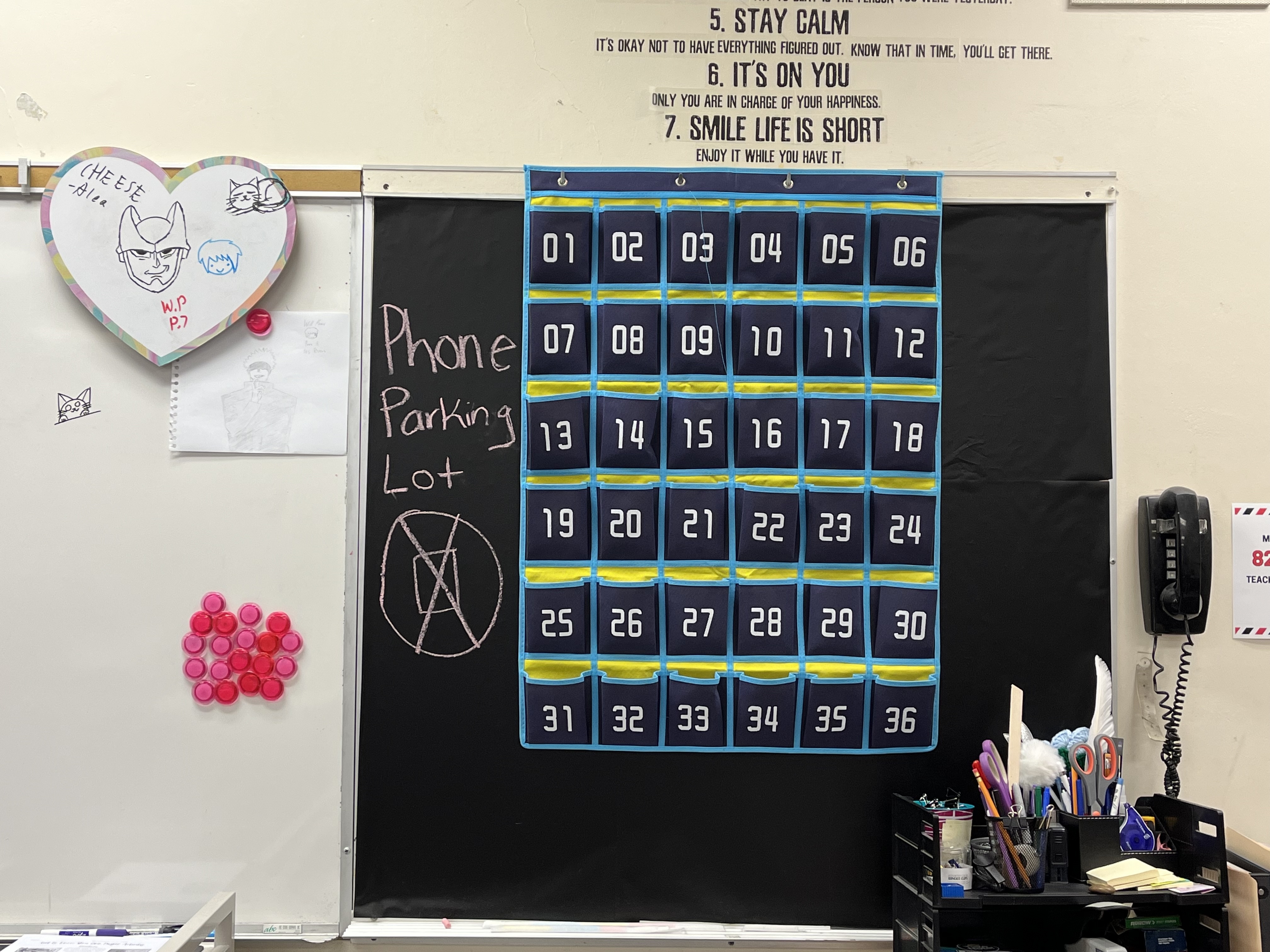
Even in the absence of district-wide mandates, many teachers have taken it upon themselves to ban phones from their classrooms. Nicolle Fefferman, an educator with the Los Angeles Unified School District, is one such teacher who has created a "phone parking lot" in her classroom.
Fefferman emphasizes the importance of maximizing the limited time she has with her students. "I would tell my students: ‘I see you for so little time every day that I’m really selfish. I’m really greedy,’" she explained. “‘I want every minute of your attention for the work that we’re doing together in this class.’”
This sentiment is echoed by teacher unions. United Teachers Los Angeles, representing over 35,000 educators, supports the district's move towards a unified policy. Gina Gray, a middle school English teacher and union representative, stressed the need for collaboration. "School district administrators must work closely with educators and parents to implement these changes," Gray stated. "Educators care deeply about the well-being of our students, and their families should be included in decisions about changes to our school communities."
David Goldberg, President of the California Teachers Association, concurs, stating, "Our union has supported improving school environments and restricting the use of smartphones on campuses." He added, "As educators, we always seek to help our students reach their full potential, and we are moved by the data, listening to our students and their families, and our own experiences showing that smartphones can be a distraction and harmful to the mental health of students."
California Poised for Statewide Action
With a growing number of districts implementing their own restrictions, California is on the cusp of potentially joining a growing list of states with statewide legislation on student cellphone use. While current California law permits districts to regulate phones, it does not mandate such policies.
However, Assembly Bill 3216, currently making its way through the Legislature, aims to change that. This bill would require all school districts to adopt policies limiting or prohibiting student smartphone use. Having passed the Senate Appropriations Committee, it is expected to reach the governor's desk for final approval.
Another piece of legislation, Senate Bill 1283, would provide districts with the option, but not the requirement, to limit student social media use on campus. The bipartisan support for these bills suggests a strong consensus across the political spectrum regarding the need to address the impact of smartphones in schools.
The movement to restrict cellphones in schools is a complex issue with far-reaching implications. As districts continue to navigate these changes, the focus remains on creating optimal learning environments that foster academic success, promote mental well-being, and allow students the space to simply be present and engaged.







 Explore AI Teaching Tools
Comments (0)
Please login to comment
No comments yet
Be the first to comment on this article