
California's Math Challenge: Building Foundational Skills for Student Success
The journey of learning mathematics is akin to constructing a building; each new concept rests upon a solid foundation of prior understanding.
When that foundation is weak, the entire structure becomes unstable.
In California, a concerning trend reveals that many students are struggling to build this essential mathematical scaffolding, leading to a widening achievement gap as they progress through their school years.
This article explores the critical early stages of math education and offers actionable strategies for educators, policymakers, and parents to help California students not just keep pace, but truly excel.
The Escalating Math Proficiency Gap in California Schools
The fundamental principle of mathematics is its cumulative nature.
Skills like multiplication are essentially repeated addition, and a firm grasp of these basic operations unlocks the ability to tackle more complex concepts such as fractions and algebraic equations.
However, research indicates that in California, this sequential mastery is not consistently occurring.
Instead, a significant number of students find themselves falling further behind in math with each passing year they remain in the state's educational system.
Examining recent state assessment results paints a stark picture.
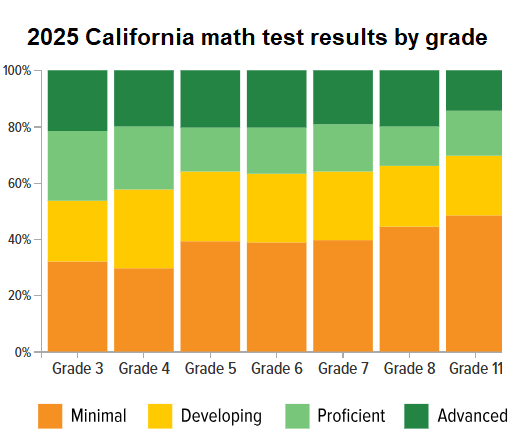
Among third graders, a crucial entry point for formal math instruction, only 46% of California students met the state's proficiency benchmarks.
This figure, while concerning, represents a peak.
As students advance, the percentage of those meeting expectations steadily declines.
By fourth grade, this proficiency rate drops to 42%, and this downward trend continues relentlessly.
By the time students reach 11th grade, a mere 31% demonstrate proficiency in mathematics according to state standards.
It's important to clarify that this doesn't imply students are not progressing or are inherently less capable as they age.
Rather, they are not acquiring the necessary skills at a pace that aligns with the state's definition of proficiency at each grade level.
Consequently, the longer they are in school, the more students drift away from the expected mathematical competencies.
This pattern is particularly striking when contrasted with other academic subjects.
Studies indicate that proficiency rates in English Language Arts, for example, tend to increase across grade levels.
The challenge in mathematics, however, is not unique to California.
Many states across the nation grapple with a similar decline in math proficiency as students move through their K-12 education.
Nevertheless, this widespread issue offers little solace to the students within California who are directly impacted.
The problem is pervasive across the state.
When analyzing districts that reported scores for both third and 11th graders, a significant majority – 328 out of 353 – exhibited lower math proficiency rates in high school compared to their elementary school counterparts.
The disparity is even more pronounced in some of the largest urban districts.
For instance, in Los Angeles Unified School District, proficiency rates plummeted from 48% in third grade to just 26% in 11th grade.
Similarly, Fresno Unified School District saw a decline from 37% to 17%, and San Diego Unified School District experienced a drop from 55% to 36% over the same grade span.
These statistics highlight a systemic challenge that requires urgent attention at multiple levels.
Strategies for Addressing Early Math Gaps
Addressing these early math deficits requires a multi-faceted approach, involving state-level initiatives, district-wide planning, and classroom-level interventions.
The state of California has taken a commendable step by updating its list of approved math curricula.
This provides a foundational framework, empowering districts to make informed choices about instructional materials.
However, the success of these choices hinges on robust, ongoing implementation support for educators on the ground.
Without this vital support, even the best curricula can fall short of their intended impact.
At the local level, school and district leaders must conduct a critical assessment of their resource allocation.
A key area for examination is the comparison of investments in reading versus mathematics.
Research suggests that while schools often have a variety of support systems in place for reading instruction – including early screening tools, professional development, and dedicated teacher coaches – equivalent investments in mathematics are frequently lacking.
This imbalance can inadvertently exacerbate the math proficiency gap.
Optimizing Instructional Time for Math
Time is a critical variable in effective mathematics instruction.
In countries that consistently achieve high math scores, students typically receive an average of 60 minutes of dedicated math instruction per day, translating to approximately 300 minutes per week.
In contrast, large California districts, such as Long Beach, Los Angeles, and San Diego, often leave the allocation of math instructional time to individual teachers, without establishing clear district-wide requirements.
This variability can lead to insufficient time being devoted to essential math concepts, hindering student progress.
Empowering Teachers with Effective Tools
At the classroom level, educators play a pivotal role in ensuring genuine skill mastery.
Teachers should prioritize strategies that allow them to identify and address learning gaps before they widen.
For example, studies indicate that low-stakes homework assignments can be invaluable tools for this purpose.
By regularly assessing student understanding through these assignments, teachers can pinpoint areas of difficulty early on, rather than waiting until the end of the academic year when a student might fail a high-stakes state test.
This proactive approach allows for timely intervention and remediation, preventing students from falling irrevocably behind.
The Crucial Role of Parents and Guardians
The support system for a student's mathematical development extends beyond the school walls.
Parents and guardians are essential partners in this endeavor.
Ensuring that a child arrives at school on time and with their homework completed lays a crucial groundwork for daily learning.
Beyond these fundamental expectations, parents can actively engage in their child's mathematical education through at-home "math checkups." These informal assessments can help determine if a child can effectively apply the concepts they are learning in school to real-world scenarios, reinforcing their understanding and building confidence.
Rethinking Algebra Placement for Equitable Access
Beyond foundational skills, California needs a more coherent and data-driven approach to algebra placement decisions.
Historically, the state has oscillated between extremes – from an "algebra for all" mandate in the late 1990s to some districts adopting an "algebra for none" policy in recent years.
Neither of these approaches has proven to be the optimal solution.
Students who demonstrate readiness for algebra, as evidenced by their seventh-grade test scores, often thrive when given the opportunity to advance.
Conversely, pushing students into algebra before they have mastered the prerequisite skills can be detrimental to their learning and confidence.
A more effective model, observed in states such as North Carolina, Texas, and Virginia, involves letting data guide these high-stakes placement decisions.
Implementing an automatic enrollment policy based on demonstrated readiness can ensure that students are placed in the most appropriate mathematical pathway, maximizing their chances of success.
This data-driven approach promotes equity by ensuring that opportunities are provided based on academic preparedness rather than arbitrary policies.
The Widening Achievement Gap: A Call for Urgency
Ultimately, state and local policymakers must recognize that California's math proficiency gap is intrinsically linked to the foundational skills of its lowest-performing students.
Over the past decade, while the state's highest-achieving students have made academic gains, those at the lower end of the performance spectrum have fallen further behind.
In fact, the mathematics achievement gap in California has widened at a rate exceeding that of all but seven other states.
This trend demands immediate and decisive action.
The solutions to these complex challenges are within reach.
However, they require a concerted effort and a profound sense of urgency from California's policymakers.
By prioritizing foundational math skills, investing in robust teacher support, empowering parents, and adopting data-driven placement strategies, the state can begin to close the proficiency gap and ensure that all California students have the opportunity to build a strong and successful future in mathematics.
Conclusion
The data clearly indicates that a significant challenge exists in California's math education landscape, characterized by a declining proficiency rate as students progress through the grades.
This trend, while not unique to the state, demands targeted interventions.
By focusing on strengthening foundational math skills from the earliest grades, providing comprehensive support for educators, actively involving parents, and implementing data-informed placement policies, California can begin to reverse this trend.
Mentofy is committed to supporting this mission by providing accessible, high-quality learning resources that empower students, teachers, and parents to build the mathematical understanding necessary for lifelong success.






 Explore AI Teaching Tools
Comments (0)
Please login to comment
No comments yet
Be the first to comment on this article